Autism, ADHD, Giftedness
Autism, ADHD, Giftedness: Characteristics, Differences & Overlaps
Autism, ADHD, Giftedness: Characteristics, Differences & Overlaps

DESCRIPTION:
Autism, ADHD & Giftedness: How do they differ? Insights into behaviour, social isolation and neurodivergence.
Autism, ADHD and Giftedness: Overlaps, Differences and the Risk of Misdiagnosis
TL;DR: Autism, ADHD and giftedness share many traits — and are frequently confused as a result. This article explains the commonalities, the diagnostically critical differences and why nuanced assessment is indispensable.
Anyone who wants to understand neurodivergent profiles cannot avoid a central question: why are these three categories so often confused with one another — and what actually distinguishes them?
The overlap is substantial, but not unlimited. A closer look is worthwhile.
What Autism, ADHD and Giftedness Have in Common
At first glance, these three profiles appear to be clearly distinct categories. In practice, however, their patterns of thinking and behaviour overlap considerably.
People who fit one or more of these profiles experience the world in a particular way — they perceive patterns and social nuances differently from neurotypical individuals.
All three profiles share:
A tendency toward hyperfocus on special interests
Frequently divergent and creative thinking
Asynchronous development — certain abilities far above average, while others lag behind
Pronounced emotional sensitivity
They also share common social experiences: all three groups frequently describe feeling perceived as outsiders or misunderstood by peers.
This experience, however, arises from different underlying causes — a distinction that is critical for accurate assessment.
Autism: Characteristics and Particularities
Autism spectrum conditions are neurological developmental variants that affect communication, social interaction and sensory processing.
Central autistic traits include:
Social communication: Many autistic people process social information differently — this concerns non-verbal communication, eye contact and the implicit subtext of conversation. This is not indifference, but a difference rooted more deeply in social intuition.
Sensory particularities: Hyper- and hypo-perception of sensory stimuli is a central characteristic. Noise, sounds, light or touch may be perceived more intensely. Sensory overload is a frequent consequence.
Routine and flexibility: Many of these individuals typically prefer predictability and clear structures. Changes to daily routines can be challenging.
Special interests: Intensive engagement with specific topics is a characteristic autistic trait — it structures thinking, identity and social connection.
Alexithymia: A frequently overlooked phenomenon — difficulty identifying and naming one's own feelings — affects many autistic people and complicates diagnosis.
ADHD: Neurobiological Foundations and Everyday Impact
Attention regulation, impulse control and executive functions are neurobiologically organised differently in people with ADHD. This leads to characteristic symptoms:
Attention regulation: The term "attention deficit" is misleading. People with ADHD can concentrate — but not on demand and not independently of their level of interest. Cognitive tasks that are neither stimulating nor intrinsically motivating become difficult to access.
Impulse control: Impulsive behaviour, difficulty regulating responses, and an altered perception of time are typical symptoms. The need for immediate feedback and stimulation shapes many areas of life.
Hyperactivity: Can manifest physically — or be experienced as inner mental hyperactivity: a chronically active stream of thought that is difficult to quiet.
Working memory: Frequently impaired, affecting planning and organisation. Emotional dysregulation is also part of the clinical picture.
Giftedness: What It Means and Why It Requires Adaptation
Giftedness is conventionally defined by an IQ above 130, but encompasses far more than academic performance.
Gifted individuals process information faster, recognise patterns quickly and think in systems. This can appear unusual from the outside — they often jump several steps ahead mentally. Social adaptation comes at a cost.
Characteristic features include:
Intensity and depth: Gifted people experience emotions, ideas and impressions with exceptional intensity. This intensity concerns intellectual curiosity as much as moral sensitivity and empathy.
Social isolation: The discrepancy between one's own interests and those of peers frequently leads to isolation. Young, gifted individuals often become bored in conventional school settings when their cognitive capacities are not challenged, which can lead to behavioural difficulties and misdiagnosis.
Asynchronous development: Above-average cognitive abilities combined with age-appropriate emotional development create tensions that can appear from the outside as a conspicuous problem.
Existential depth: An early preoccupation with existential questions is typical. The need for intellectual depth often goes unmet in neurotypical environments and can lead to depression or withdrawal.
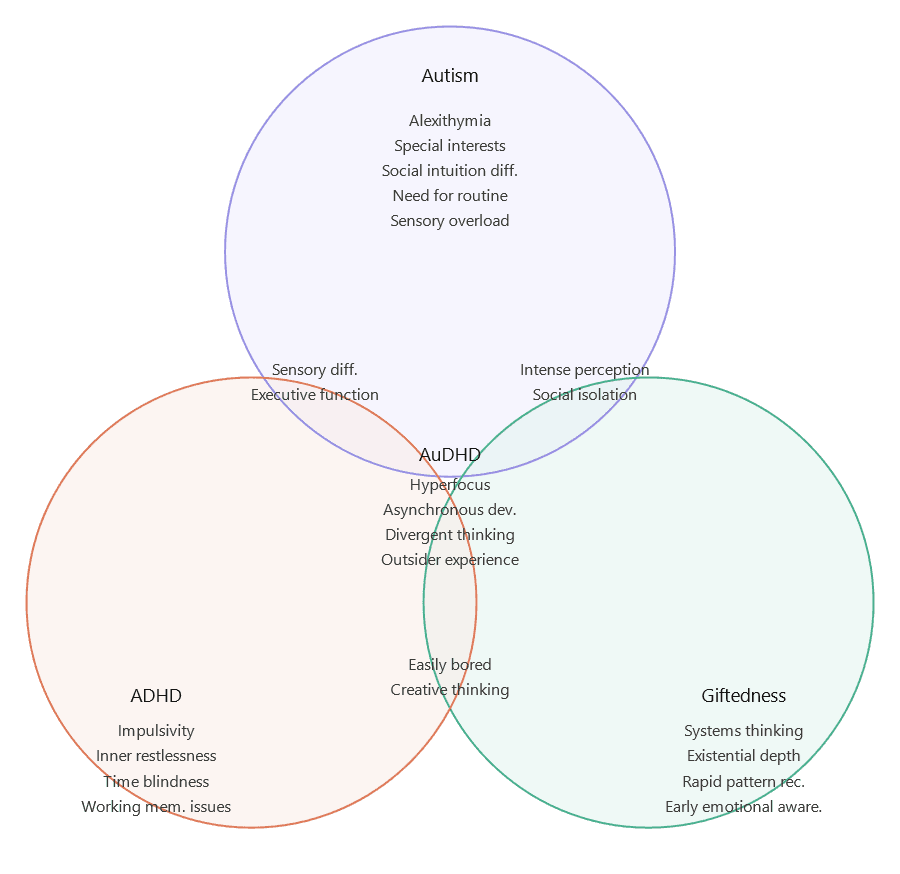
The Overlap: Where All Three Profiles Converge
The commonalities are substantial. All three profiles tend toward:
Hyperfocus on intrinsically motivating subjects
Asynchronous development
Heightened, intense perception
Divergent thinking
Unique learning pathways that the linear school system frequently fails to accommodate
The combined profile AuDHD — the co-occurrence of autism and ADHD — is particularly common among gifted individuals and is often overlooked.
Neurodivergence and high cognitive ability are not mutually exclusive — they frequently co-occur.
Differences That Matter Diagnostically
Despite all commonalities, significant differences exist:
Social difficulties — different origins:
Profile | Origin of social difficulties |
Autism | Social intuition and communication |
ADHD | Impulsivity, inattention, emotional dysregulation |
Giftedness | Differences in interest and intensity |
Emotional processing:
Autistic individuals frequently experience alexithymia — difficulty identifying their own feelings.
Gifted individuals often develop a deep emotional awareness very early.
Emotional dysregulation in the third group can overlay both.
The role of trauma:
Chronic misunderstandings and social rejection leave their mark across all three groups. Trauma is not a primary feature of these profiles, but it can produce similar patterns and considerably complicate the diagnostic process.
Why Differentiated Assessment Is Essential
Neurodivergence as a concept has significantly expanded awareness of neurological variation. At the same time, it carries the risk of oversimplification:
Not every social difficulty is autistic in origin
Not every intensity signals giftedness
Not every distractibility is pathological
People with these profiles do not need a unifying category, but a differentiated assessment that carefully identifies individual strengths and challenges.
Only then can targeted support be developed:
For the autistic child who needs clear structures
For the adult who requires executive strategies
For gifted children and adults whose potential remains chronically unchallenged
The simultaneous presence of multiple neurodivergent profiles is not the exception. Both profiles can mask each other; the third overlaps with both. One finding does not replace another — the profiles complement and explain one another.
Conclusion: Understanding Commonalities, Respecting Differences
The commonalities across these three profiles are real — in phenomenology, in lived experience and in the challenges that those affected face.
At the same time, they have different causes, different neurobiological foundations and require different forms of support.
Neurodivergence is not a single unified concept. Autism is not giftedness, and yet all three share a fundamental experience: perceiving the world in a particular way.
Related:
DESCRIPTION:
Autism, ADHD & Giftedness: How do they differ? Insights into behaviour, social isolation and neurodivergence.
Autism, ADHD and Giftedness: Overlaps, Differences and the Risk of Misdiagnosis
TL;DR: Autism, ADHD and giftedness share many traits — and are frequently confused as a result. This article explains the commonalities, the diagnostically critical differences and why nuanced assessment is indispensable.
Anyone who wants to understand neurodivergent profiles cannot avoid a central question: why are these three categories so often confused with one another — and what actually distinguishes them?
The overlap is substantial, but not unlimited. A closer look is worthwhile.
What Autism, ADHD and Giftedness Have in Common
At first glance, these three profiles appear to be clearly distinct categories. In practice, however, their patterns of thinking and behaviour overlap considerably.
People who fit one or more of these profiles experience the world in a particular way — they perceive patterns and social nuances differently from neurotypical individuals.
All three profiles share:
A tendency toward hyperfocus on special interests
Frequently divergent and creative thinking
Asynchronous development — certain abilities far above average, while others lag behind
Pronounced emotional sensitivity
They also share common social experiences: all three groups frequently describe feeling perceived as outsiders or misunderstood by peers.
This experience, however, arises from different underlying causes — a distinction that is critical for accurate assessment.
Autism: Characteristics and Particularities
Autism spectrum conditions are neurological developmental variants that affect communication, social interaction and sensory processing.
Central autistic traits include:
Social communication: Many autistic people process social information differently — this concerns non-verbal communication, eye contact and the implicit subtext of conversation. This is not indifference, but a difference rooted more deeply in social intuition.
Sensory particularities: Hyper- and hypo-perception of sensory stimuli is a central characteristic. Noise, sounds, light or touch may be perceived more intensely. Sensory overload is a frequent consequence.
Routine and flexibility: Many of these individuals typically prefer predictability and clear structures. Changes to daily routines can be challenging.
Special interests: Intensive engagement with specific topics is a characteristic autistic trait — it structures thinking, identity and social connection.
Alexithymia: A frequently overlooked phenomenon — difficulty identifying and naming one's own feelings — affects many autistic people and complicates diagnosis.
ADHD: Neurobiological Foundations and Everyday Impact
Attention regulation, impulse control and executive functions are neurobiologically organised differently in people with ADHD. This leads to characteristic symptoms:
Attention regulation: The term "attention deficit" is misleading. People with ADHD can concentrate — but not on demand and not independently of their level of interest. Cognitive tasks that are neither stimulating nor intrinsically motivating become difficult to access.
Impulse control: Impulsive behaviour, difficulty regulating responses, and an altered perception of time are typical symptoms. The need for immediate feedback and stimulation shapes many areas of life.
Hyperactivity: Can manifest physically — or be experienced as inner mental hyperactivity: a chronically active stream of thought that is difficult to quiet.
Working memory: Frequently impaired, affecting planning and organisation. Emotional dysregulation is also part of the clinical picture.
Giftedness: What It Means and Why It Requires Adaptation
Giftedness is conventionally defined by an IQ above 130, but encompasses far more than academic performance.
Gifted individuals process information faster, recognise patterns quickly and think in systems. This can appear unusual from the outside — they often jump several steps ahead mentally. Social adaptation comes at a cost.
Characteristic features include:
Intensity and depth: Gifted people experience emotions, ideas and impressions with exceptional intensity. This intensity concerns intellectual curiosity as much as moral sensitivity and empathy.
Social isolation: The discrepancy between one's own interests and those of peers frequently leads to isolation. Young, gifted individuals often become bored in conventional school settings when their cognitive capacities are not challenged, which can lead to behavioural difficulties and misdiagnosis.
Asynchronous development: Above-average cognitive abilities combined with age-appropriate emotional development create tensions that can appear from the outside as a conspicuous problem.
Existential depth: An early preoccupation with existential questions is typical. The need for intellectual depth often goes unmet in neurotypical environments and can lead to depression or withdrawal.
The Overlap: Where All Three Profiles Converge
The commonalities are substantial. All three profiles tend toward:
Hyperfocus on intrinsically motivating subjects
Asynchronous development
Heightened, intense perception
Divergent thinking
Unique learning pathways that the linear school system frequently fails to accommodate
The combined profile AuDHD — the co-occurrence of autism and ADHD — is particularly common among gifted individuals and is often overlooked.
Neurodivergence and high cognitive ability are not mutually exclusive — they frequently co-occur.
Differences That Matter Diagnostically
Despite all commonalities, significant differences exist:
Social difficulties — different origins:
Profile | Origin of social difficulties |
Autism | Social intuition and communication |
ADHD | Impulsivity, inattention, emotional dysregulation |
Giftedness | Differences in interest and intensity |
Emotional processing:
Autistic individuals frequently experience alexithymia — difficulty identifying their own feelings.
Gifted individuals often develop a deep emotional awareness very early.
Emotional dysregulation in the third group can overlay both.
The role of trauma:
Chronic misunderstandings and social rejection leave their mark across all three groups. Trauma is not a primary feature of these profiles, but it can produce similar patterns and considerably complicate the diagnostic process.
Why Differentiated Assessment Is Essential
Neurodivergence as a concept has significantly expanded awareness of neurological variation. At the same time, it carries the risk of oversimplification:
Not every social difficulty is autistic in origin
Not every intensity signals giftedness
Not every distractibility is pathological
People with these profiles do not need a unifying category, but a differentiated assessment that carefully identifies individual strengths and challenges.
Only then can targeted support be developed:
For the autistic child who needs clear structures
For the adult who requires executive strategies
For gifted children and adults whose potential remains chronically unchallenged
The simultaneous presence of multiple neurodivergent profiles is not the exception. Both profiles can mask each other; the third overlaps with both. One finding does not replace another — the profiles complement and explain one another.
Conclusion: Understanding Commonalities, Respecting Differences
The commonalities across these three profiles are real — in phenomenology, in lived experience and in the challenges that those affected face.
At the same time, they have different causes, different neurobiological foundations and require different forms of support.
Neurodivergence is not a single unified concept. Autism is not giftedness, and yet all three share a fundamental experience: perceiving the world in a particular way.
Related:
Newsletter
Would you like to be notified when I publish a new blog post? Sign up here.
Click "Subscribe for free" if you have read and accepted my privacy policy. You can revoke your consent at any time.
Newsletter
Would you like to be notified when I publish a new blog post? Sign up here.
Click "Subscribe for free" if you have read and accepted my privacy policy. You can revoke your consent at any time.