Collien Fernandes
Collien Fernandes speaks: The outrage surrounding allegations against her ex-husband through the lens of psychoanalysis
Collien Fernandes speaks: The outrage surrounding allegations against her ex-husband through the lens of psychoanalysis
DESCRIPTION:
Collien Fernandes speaks: Focus on psychoanalysis. Outrage as a commodity, in this case due to the allegations against her ex-husband. What lies behind the conflict?
Because all men are pigs: A psychoanalysis of the outrage machine surrounding actress Collien Fernandes and her allegations against her ex-husband
Collien Fernandes speaks out about allegations against her ex-husband, Christian Ulmen, and Germany goes into a frenzy. What happens when flawed reporting unleashes collective projection dynamics?
One case, one wave, one machine
When Der Spiegel reported in March 2026 on actress Collien Fernandes’ allegations against her ex-husband Christian Ulmen, it took less than 48 hours for a relationship conflict to become a national event. Thousands of people gathered in front of the Brandenburg Gate. Politicians such as Saskia Esken (SPD) and Ricarda Lang (Bündnis 90/Die Grünen) made statements. Climate activist Luisa Neubauer (Bündnis 90/Die Grünen) called out from the podium: “Men can be glad that we simply want equality. And not retribution.” Loud applause.
Collien Fernandes spoke about what she described as years of digital abuse at the hands of her ex-husband. She is fully within her rights to do so, and the allegations against her ex-husband, Christian Ulmen, must be taken seriously. But what followed had little to do with the case itself.
Tagesschau, Zeit, Süddeutsche Zeitung and several Funke Media publications had to correct their reporting retrospectively: earlier versions had given the impression that Ulmen had created and distributed deepfake pornography featuring his ex-wife, which was not the case. Christian Ulmen stated through his lawyers that these were “untrue facts based on a one-sided account”. It is worth noting that Ulmen is not taking legal action against the main allegation: the creation of fake accounts in his ex-wife’s name.
The facts are therefore complex, unclear and legally undecided. The presumption of innocence applies.
Nevertheless, the outrage machine was running at full throttle. And that is highly interesting from a psychoanalytical perspective, not because of the case, but because of us.
The scene: what we really see when we look
Alfred Lorenzer, psychoanalyst and social theorist, developed the concept of the ‘scene’ as an analytical unit: a condensed pattern of interaction that carries unconscious meanings and reactivates early relational experiences. A scene is never merely what it shows. It is always also what is experienced through it: affectively, preconsciously, collectively.
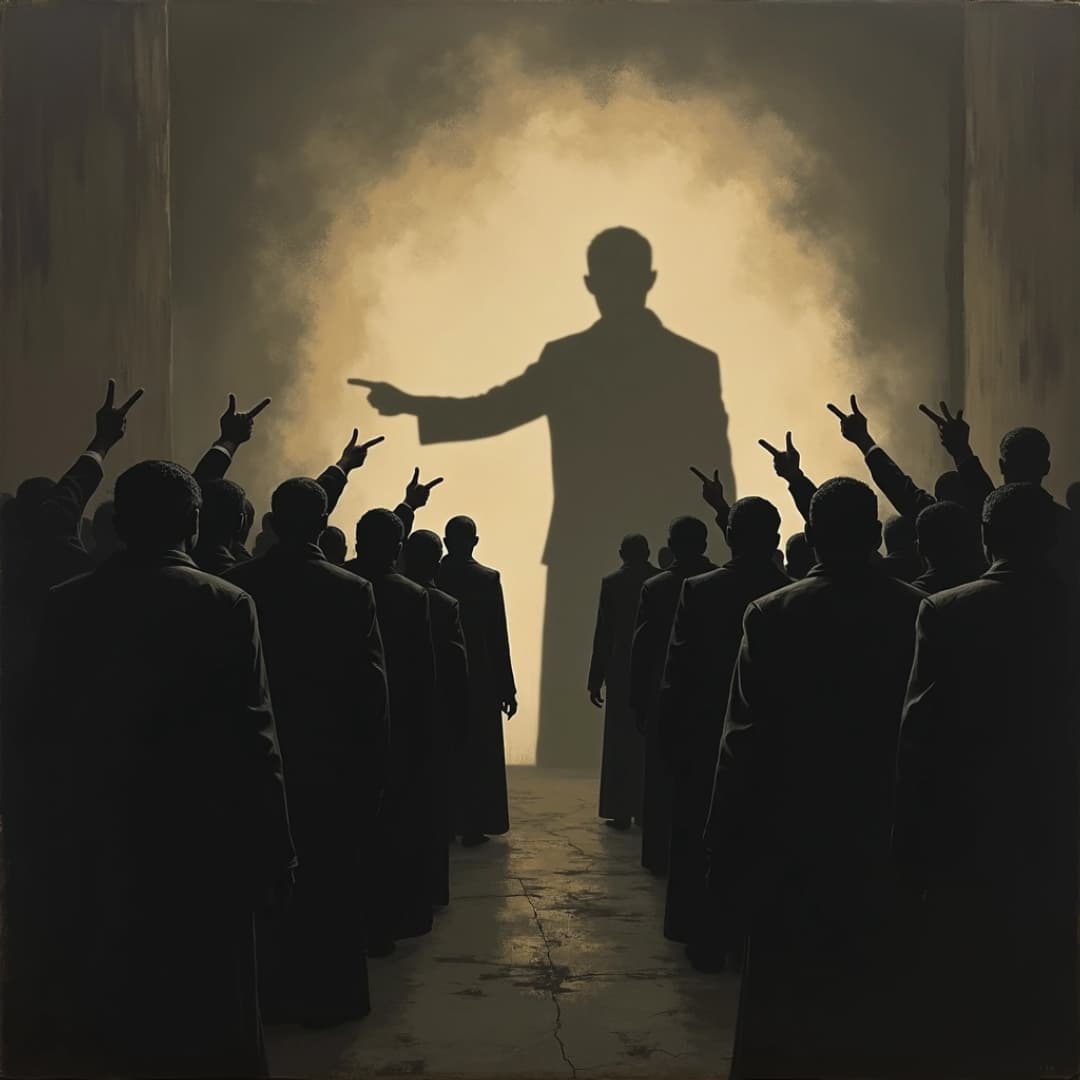
What took place at the Brandenburg Gate was such a scene. Not primarily a political rally, but a collective ritual with fixed roles: perpetrators, victims, the community of the righteous. The substance of the accusations, their validity, their legal classification, and the difference between deepfakes and fake profiles no longer mattered. The scene had its own script.
Susanne Langner called this spectacle a representational symbol: not conceptual thinking, but a scenic experience that eludes rational reflection, much like a religious ritual or a myth. One feels the truth of the scene without thinking it through. This explains why corrections to the reporting could not stem the tide of outrage: the corrections were discursive, the scene is affective—two different registers.
The community of outrage and the problem of ambivalence
Theodor W. Adorno described the authoritarian character, a psychological structure that cannot tolerate ambivalence and relieves itself through a rigid good-evil dichotomy. Important: this is not a theory about extremists. It is a theory about a widespread psychological mode of functioning that is activated under emotional pressure.
The community of outrage surrounding the Collien Fernandes case exemplifies this structure. The man – not Christian Ulmen alone, but ‘the man’ as a category – becomes the embodiment of evil. Anyone who asks whether allegations against the ex-husband must be proven makes themselves a suspect. Anyone who qualifies their stance is an accomplice.
Articles appeared in feminist media in which women reported that, following this case, they no longer wished to live with men, were cutting off contact, and intended to remain celibate. This is not a political analysis. It is group regression: the emotional bonding of a community that maintains its cohesion through collective exclusion.
Adorno would ask: What does this division achieve psychologically? The answer: it provides relief. As long as the perpetrator is clearly on the outside, and with him all men as potential perpetrators, one need not face the complexity of one’s own self. No contradiction, no grey area, no uncertainty. Only absolute certainty.
The desire of outrage and the pleasure of being in the right
Jacques Lacan taught us that desire is never what it purports to be. What the wave of outrage officially desired was justice. What it actually produced was something else: jouissance, a pleasure beyond the pleasure principle, disguised as moral zeal.
The statement from the stage at the Brandenburg Gate: ‘Men can be glad that we simply want equality. And not retribution is revealing in this regard. Semantically, it is a reassurance. Affectively, it is a threat. And it takes pleasure in itself: the speaker relishes the power to exact retribution, were she so inclined. This is not a criticism of her as a person; it is a description of what happens to language in moments of collective outrage.
Lacan calls this the structure of desire: it is directed not at the real object, the specific case, the specific allegations, but at what the object promises: complete moral clarity, complete identity as the righteous. This promise can never be fulfilled. So, the next case is needed. And the one after that. The outrage machine is a perpetual-motion machine of unfulfilled desire.
The commodity of outrage and the Spiegel front-page story
In his critique of commodity aesthetics, Wolfgang Fritz Haug described how commodities exert their effect through their sensory-aesthetic promise rather than their actual utility value. The promise always exceeds what is delivered. That is precisely why we continue to consume.
The Spiegel headline “You virtually raped me” is a commodity in this sense. Its aesthetic promise: complete moral clarity, an identified perpetrator, an unambiguous victim. Der Spiegel regularly publishes favourable articles about the NGO HateAid. In the context of the Fernandes case, HateAid explicitly thanked the Der Spiegel team on Instagram. This is no scandal, but it shows that a network of media outlets, NGOs and activist alliances is operating here, one that shares common interests: attention, political influence, and legislation.
Federal Minister of Justice Stefanie Hubig immediately announced stricter laws to protect against deepfakes, even though deepfakes were not the core allegation. The use value – that is, actual protection for those genuinely affected – took a back seat to the exchange value: political visibility, legislative momentum, the success of the demonstration.
43,000 nameless women in Berlin with comparable experiences of violence did not become ‘content’ in the process. They lack the prominence that could be exploited as an aesthetic added value. Not every pain has market value.
Mass psychology of self-exoneration and the denial of grief
Alexander Mitscherlich described how collective defence against guilt works: not through denial, but through displacement. People take offence at the other to avoid confronting their own. The emotion is genuine, but it is misdirected.
What is the community of outrage avoiding in this case? The structural reality: that digital violence against women is widespread and the legal framework is indeed inadequate, regardless of what Christian Ulmen did or did not do. This structural confrontation would be arduous, protracted, and devoid of emotional climax. Instead, the high-profile case involving an identified perpetrator and a well-known actress delivers: a scene, a catharsis, the feeling of having taken action, and the feeling of having been on the side of good.
Mitscherlich would say: genuine mourning, both psychological and political, is slow and without applause. The scene of outrage is fast, loud and community-building. It gives the feeling of having done something. It is, in the psychoanalytical sense, a defence against the consternation it purports to generate.
What needs to be worked through therapeutically, and what does not
The phrase ‘working through it therapeutically’ often crops up in debates like this, usually as an imposition on those affected. But perhaps the question should be framed differently: What needs to be worked through collectively?
Collien Fernandes speaks publicly about her experiences. That deserves respect, regardless of the legal outcome of the allegations against her ex-husband, Christian Ulmen. The question of legal loopholes in the context of digital violence is also legitimate and urgent. No one disputes that.
What psychoanalytic social psychology disputes is the logic that distils a judgment on an entire gender from an unresolved individual case within 48 hours. This logic does not protect women. It creates community through othering and exclusion, a form of cohesion that is psychologically understandable, yet politically dangerous.
For it immunises itself against correction. When major media outlets retracted and corrected their flawed reports, it did nothing to stem the tide of outrage. The scene had already been played out. The verdict had been passed.
That is not feminism. It is a collective projection with a feminist label. The difference is psychologically relevant and politically decisive.
RELATED ARTICLES:
Prince Andrew in the Epstein Scandal: The Psychology of Details in the Epstein Files
The Trend on TikTok: Adults Sucking on Dummies to Cope with Stress
Corporate Bullshit and the Meritocracy: When Companies Put on a Show Rather Than Communicate
Social Media Filters, Comparisons, Beauty Ideals and How They Affect Us
The Psychology of Power and Abuse of Power: Does Power Change Character and Behaviour?
DESCRIPTION:
Collien Fernandes speaks: Focus on psychoanalysis. Outrage as a commodity, in this case due to the allegations against her ex-husband. What lies behind the conflict?
Because all men are pigs: A psychoanalysis of the outrage machine surrounding actress Collien Fernandes and her allegations against her ex-husband
Collien Fernandes speaks out about allegations against her ex-husband, Christian Ulmen, and Germany goes into a frenzy. What happens when flawed reporting unleashes collective projection dynamics?
One case, one wave, one machine
When Der Spiegel reported in March 2026 on actress Collien Fernandes’ allegations against her ex-husband Christian Ulmen, it took less than 48 hours for a relationship conflict to become a national event. Thousands of people gathered in front of the Brandenburg Gate. Politicians such as Saskia Esken (SPD) and Ricarda Lang (Bündnis 90/Die Grünen) made statements. Climate activist Luisa Neubauer (Bündnis 90/Die Grünen) called out from the podium: “Men can be glad that we simply want equality. And not retribution.” Loud applause.
Collien Fernandes spoke about what she described as years of digital abuse at the hands of her ex-husband. She is fully within her rights to do so, and the allegations against her ex-husband, Christian Ulmen, must be taken seriously. But what followed had little to do with the case itself.
Tagesschau, Zeit, Süddeutsche Zeitung and several Funke Media publications had to correct their reporting retrospectively: earlier versions had given the impression that Ulmen had created and distributed deepfake pornography featuring his ex-wife, which was not the case. Christian Ulmen stated through his lawyers that these were “untrue facts based on a one-sided account”. It is worth noting that Ulmen is not taking legal action against the main allegation: the creation of fake accounts in his ex-wife’s name.
The facts are therefore complex, unclear and legally undecided. The presumption of innocence applies.
Nevertheless, the outrage machine was running at full throttle. And that is highly interesting from a psychoanalytical perspective, not because of the case, but because of us.
The scene: what we really see when we look
Alfred Lorenzer, psychoanalyst and social theorist, developed the concept of the ‘scene’ as an analytical unit: a condensed pattern of interaction that carries unconscious meanings and reactivates early relational experiences. A scene is never merely what it shows. It is always also what is experienced through it: affectively, preconsciously, collectively.
What took place at the Brandenburg Gate was such a scene. Not primarily a political rally, but a collective ritual with fixed roles: perpetrators, victims, the community of the righteous. The substance of the accusations, their validity, their legal classification, and the difference between deepfakes and fake profiles no longer mattered. The scene had its own script.
Susanne Langner called this spectacle a representational symbol: not conceptual thinking, but a scenic experience that eludes rational reflection, much like a religious ritual or a myth. One feels the truth of the scene without thinking it through. This explains why corrections to the reporting could not stem the tide of outrage: the corrections were discursive, the scene is affective—two different registers.
The community of outrage and the problem of ambivalence
Theodor W. Adorno described the authoritarian character, a psychological structure that cannot tolerate ambivalence and relieves itself through a rigid good-evil dichotomy. Important: this is not a theory about extremists. It is a theory about a widespread psychological mode of functioning that is activated under emotional pressure.
The community of outrage surrounding the Collien Fernandes case exemplifies this structure. The man – not Christian Ulmen alone, but ‘the man’ as a category – becomes the embodiment of evil. Anyone who asks whether allegations against the ex-husband must be proven makes themselves a suspect. Anyone who qualifies their stance is an accomplice.
Articles appeared in feminist media in which women reported that, following this case, they no longer wished to live with men, were cutting off contact, and intended to remain celibate. This is not a political analysis. It is group regression: the emotional bonding of a community that maintains its cohesion through collective exclusion.
Adorno would ask: What does this division achieve psychologically? The answer: it provides relief. As long as the perpetrator is clearly on the outside, and with him all men as potential perpetrators, one need not face the complexity of one’s own self. No contradiction, no grey area, no uncertainty. Only absolute certainty.
The desire of outrage and the pleasure of being in the right
Jacques Lacan taught us that desire is never what it purports to be. What the wave of outrage officially desired was justice. What it actually produced was something else: jouissance, a pleasure beyond the pleasure principle, disguised as moral zeal.
The statement from the stage at the Brandenburg Gate: ‘Men can be glad that we simply want equality. And not retribution is revealing in this regard. Semantically, it is a reassurance. Affectively, it is a threat. And it takes pleasure in itself: the speaker relishes the power to exact retribution, were she so inclined. This is not a criticism of her as a person; it is a description of what happens to language in moments of collective outrage.
Lacan calls this the structure of desire: it is directed not at the real object, the specific case, the specific allegations, but at what the object promises: complete moral clarity, complete identity as the righteous. This promise can never be fulfilled. So, the next case is needed. And the one after that. The outrage machine is a perpetual-motion machine of unfulfilled desire.
The commodity of outrage and the Spiegel front-page story
In his critique of commodity aesthetics, Wolfgang Fritz Haug described how commodities exert their effect through their sensory-aesthetic promise rather than their actual utility value. The promise always exceeds what is delivered. That is precisely why we continue to consume.
The Spiegel headline “You virtually raped me” is a commodity in this sense. Its aesthetic promise: complete moral clarity, an identified perpetrator, an unambiguous victim. Der Spiegel regularly publishes favourable articles about the NGO HateAid. In the context of the Fernandes case, HateAid explicitly thanked the Der Spiegel team on Instagram. This is no scandal, but it shows that a network of media outlets, NGOs and activist alliances is operating here, one that shares common interests: attention, political influence, and legislation.
Federal Minister of Justice Stefanie Hubig immediately announced stricter laws to protect against deepfakes, even though deepfakes were not the core allegation. The use value – that is, actual protection for those genuinely affected – took a back seat to the exchange value: political visibility, legislative momentum, the success of the demonstration.
43,000 nameless women in Berlin with comparable experiences of violence did not become ‘content’ in the process. They lack the prominence that could be exploited as an aesthetic added value. Not every pain has market value.
Mass psychology of self-exoneration and the denial of grief
Alexander Mitscherlich described how collective defence against guilt works: not through denial, but through displacement. People take offence at the other to avoid confronting their own. The emotion is genuine, but it is misdirected.
What is the community of outrage avoiding in this case? The structural reality: that digital violence against women is widespread and the legal framework is indeed inadequate, regardless of what Christian Ulmen did or did not do. This structural confrontation would be arduous, protracted, and devoid of emotional climax. Instead, the high-profile case involving an identified perpetrator and a well-known actress delivers: a scene, a catharsis, the feeling of having taken action, and the feeling of having been on the side of good.
Mitscherlich would say: genuine mourning, both psychological and political, is slow and without applause. The scene of outrage is fast, loud and community-building. It gives the feeling of having done something. It is, in the psychoanalytical sense, a defence against the consternation it purports to generate.
What needs to be worked through therapeutically, and what does not
The phrase ‘working through it therapeutically’ often crops up in debates like this, usually as an imposition on those affected. But perhaps the question should be framed differently: What needs to be worked through collectively?
Collien Fernandes speaks publicly about her experiences. That deserves respect, regardless of the legal outcome of the allegations against her ex-husband, Christian Ulmen. The question of legal loopholes in the context of digital violence is also legitimate and urgent. No one disputes that.
What psychoanalytic social psychology disputes is the logic that distils a judgment on an entire gender from an unresolved individual case within 48 hours. This logic does not protect women. It creates community through othering and exclusion, a form of cohesion that is psychologically understandable, yet politically dangerous.
For it immunises itself against correction. When major media outlets retracted and corrected their flawed reports, it did nothing to stem the tide of outrage. The scene had already been played out. The verdict had been passed.
That is not feminism. It is a collective projection with a feminist label. The difference is psychologically relevant and politically decisive.
RELATED ARTICLES:
Prince Andrew in the Epstein Scandal: The Psychology of Details in the Epstein Files
The Trend on TikTok: Adults Sucking on Dummies to Cope with Stress
Corporate Bullshit and the Meritocracy: When Companies Put on a Show Rather Than Communicate
Social Media Filters, Comparisons, Beauty Ideals and How They Affect Us
The Psychology of Power and Abuse of Power: Does Power Change Character and Behaviour?
Newsletter
Would you like to be notified when I publish a new blog post? Sign up here.
Click "Subscribe for free" if you have read and accepted my privacy policy. You can revoke your consent at any time.
Newsletter
Would you like to be notified when I publish a new blog post? Sign up here.
Click "Subscribe for free" if you have read and accepted my privacy policy. You can revoke your consent at any time.