Minimalism, Cluttercore or New Maximalism
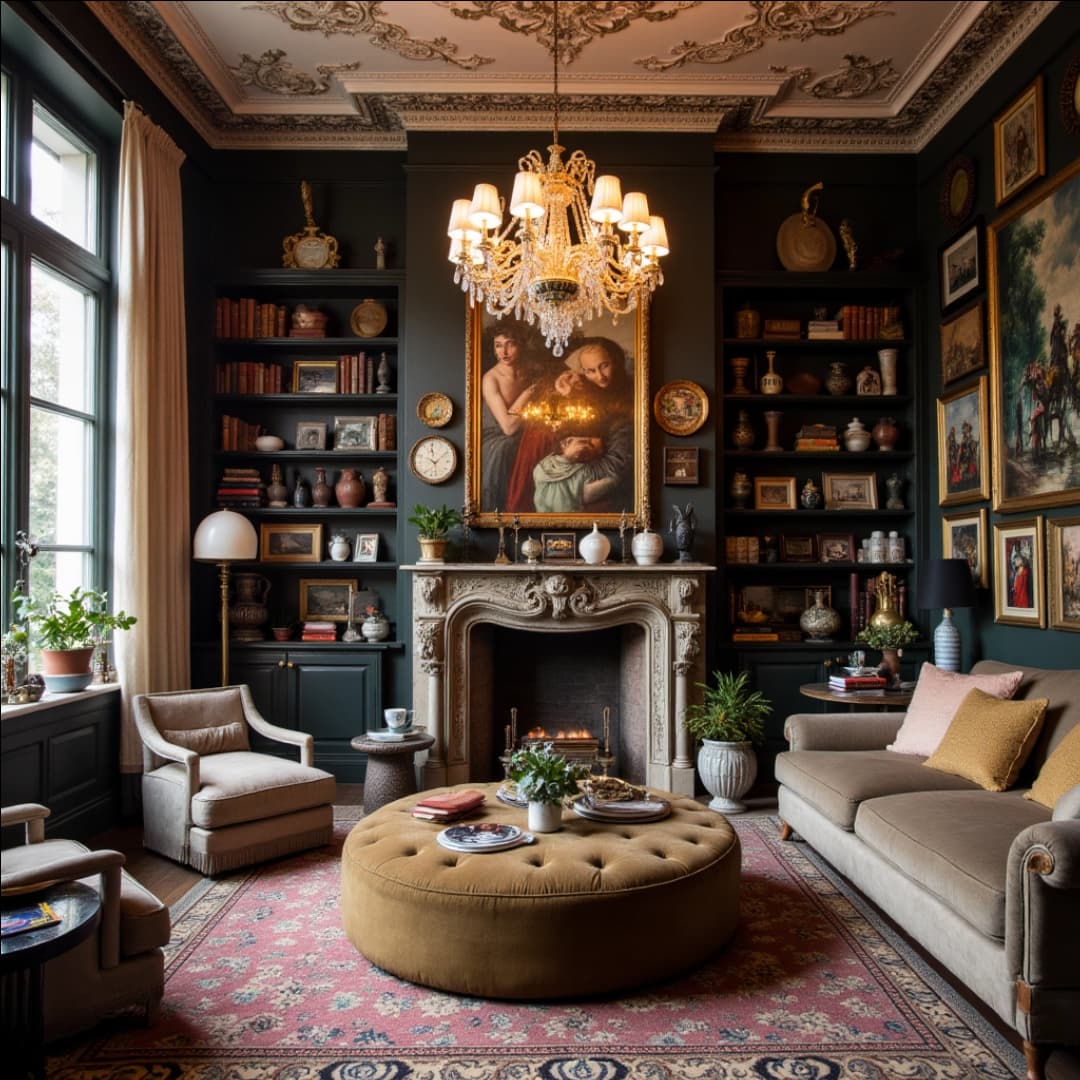
DESCRIPTION:
Minimalism or New Maximalism? Intentional Clutter as a counterpoint to the Minimalist Home? Regardless of the interior design style—minimalism, maximalism—it’s always about lifestyle for TikTok and Instagram.
New Maximalism instead of Minimalism for the Privileged: Ostentatiously Lavish Clutter-Core Trinkets with Intentional Clutter instead of Simple Minimalist Homes
Visual media, just as minimalism and decluttering established themselves as trends, have generated an apparently opposing trend: New Maximalism with Intentional Clutter.
What it’s about:
How this trend is staged on Instagram and other platforms,
The psychological and societal aspects associated with it, and
The connection between this opulent style of living and the concept of privilege.
What is Intentional Clutter?
Definitions and ConceptsCluttercore
“Cluttercore” was the first to challenge minimalism, celebrating an exuberant, individual style—“chaotically good aesthetics”, where rooms are crammed with knick-knacks. The key is to “own and proudly display A LOT of things. No more empty walls and plain surfaces; instead, the movement aimed to be ‘eclectic and meaningful’. ” The barely perceptible difference from hoarding was defined by Cluttercore as the deliberate arrangement of objects to create a cosy atmosphere: “It’s a lifestyle vibe… you curate and display a variety of personal items,” and rooms are built in layers—with books, artworks, mementoes—“to tell a story. ” Another feature is the focus on personalisation and emotional value, rather than pure aesthetics: Cluttercore differs from Maximalism by emphasising personal collections and sentimental items. Typical features include layers of objects, eclectic collections, cosy lighting, and a warm, inviting atmosphere.
New Maximalism
The “new maximalism” is an evolution of classic maximalism. While the traditional approach was simply overloaded, the 2025 version aims to be a “curated form of: more is more. ” Its designers use bold colours, patterns, and dramatic details, but claim to pay attention to elegance and spatial effect. An article on interior design trends for 2025 emphasises that maximalism is making a comeback: dramatic interiors with bold colours and sweeping colour fields as the focal point. The philosophy is intended as a reaction to minimalism: “Maximalism is an aesthetic counter-design…” So, more of everything: colour, decoration, and a celebration of complexity.
Intentional Clutter
The trend of “intentional clutter” was described by ELLE Decor as the “new maximalism. ” It arose from a return to a lived-in, personal home and is considered particularly trendy in 2025. The principle: one says goodbye to the sterile, tidy rooms of minimalism and presents beloved objects in lavish arrangements. According to the article, it’s not about mess, but about “curating favourite pieces to create a lived-in aesthetic that shows who you are”: with books, memories, art, and found objects, often inspired by TikTok trends. The personal touch is important: souvenirs and flea market finds, with empty spaces left as points of calm. These three terms show different facets of the return to abundance: The “new maximalism” brings elegance and structure to “more is more”, “intentional clutter” curates personal pieces for a lived-in look, and “cluttercore” loudly celebrates the colourful jumble as an expression of one’s own personality.
Basic Idea: The Fight Against Traditional Minimalism
Abundance is valued. Where minimalism prescribes decluttering and sorting out for the elite, Intentional Clutter celebrates accumulation and collecting. A minimalist home is characterised by virtuous restraint, empty surfaces, and few decorations, while a home in the style of Intentional Clutter boasts colours, patterns, and a multitude of objects. While minimalism celebrates detachment as a simple lifestyle, Intentional Clutter openly celebrates consumerism, in the acquisition and display of objects. The minimalist aesthetic aims to suggest restraint and mental clarity, whereas Intentional Clutter revels in visual stimuli. But whatever the style: knick-knacks become a religion—through abundance in maximalism, through abstinence in minimalism. At the heart of New Maximalism are the “living space”, “its stories”, traces and memories. Things are not meant to be functional, but primarily to tell stories: about travels, encounters, values, or one’s own development, and, inevitably, also about one’s own wealth. This creates a collection that claims not to be random, but carefully selected and arranged.
Characteristic Elements
Collecting Mania: Books, artworks, ceramics, plants, mementoes or flea market finds are supposedly combined deliberately.
Curated Chaos: Different styles, colours, and materials side by side are meant to create tension.
Individual Signature: The space becomes an expression of personality—still a living catalogue, but disguised as a biographical collage.
Sensual Abundance: Textures, patterns, and objects are intended to create warmth, intimacy, and a cultivated, imperfect character.
It is important that this is not simply unplanned mess or carelessness, as with “low earners”. Intentional Clutter maintains social distinction as “conscious design”, arranging abundance for a high price, with colours coordinated and contrasts deliberately set. It is a designed chaos that feigns closeness and authenticity, but just at the edge of overwhelm or sensory overload.
Living Room: Shelves full of books, combined with artworks, plants, personal photos, and trinkets.
Kitchen: Spices, crockery, old and new utensils openly on display, “telling stories”.
Workspaces: Collections of odds and ends that “inspire”—from sketches to found objects.
Intentional Clutter aims not just to decorate, but to create an atmosphere in which people can feel at home—surrounded by things that carry meaning, generate warmth, and underline the uniqueness of the individual. Of course, one does not do the cleaning oneself.
Intentional Clutter: Baroque Abundance as Privilege Trend or Status Symbol?
Even during the pandemic lockdown, “Cluttercore” became the secret counterpoint to minimalism: “Chuck out your decluttering manuals,” wrote The Guardian at the time—in times of enforced retreat, clutter returned dusty and triumphant. At the same time, the same newspaper crowned so-called Bookshelf Wealth as the first major design trend of 2024: a home full of carefully curated books, not for reading, but as an interior variant of the fashion trend “quiet luxury”. Here, books serve only to “communicate a certain kind of educated class”. This trend is not new. The artificial book spines, set up for decoration and as a status symbol, were formerly called dummy books or faux book spines in English. The trend of feigning education and wealth in this way became fashionable from the 18th to the early 20th century, especially in Biedermeier and Historicism— in libraries, salons, and representative living rooms of wealthy citizens and the nobility. Their use served, as today, the desire for social representation. The bookshelf was meant to suggest education and wealth, even if there were actually few or no books present. Sometimes, however, these dummies also served as disguises for doors or secret compartments, camouflaged as a book wall. Nothing has changed to this day: it’s about the educated middle class and self-presentation of social relevance—abundance as staging. Those who display their bookshelves, art collections, and flea market finds signal not only taste, but also the time and capital to accumulate such abundance. As The Guardian noted during the pandemic, well-stocked shelves indicate a lifestyle “in which you are not thrown out because of a rent increase”—they embody permanence and prosperity.
Collecting Elites and the Irony of Cluttercore
“Cluttercore” thus celebrates chaos with intent, while the self-presentation of collectors follows an elitist logic. One does not simply keep what is “still good” and might be useful later. Old globes, ceramic vases, and colour-coordinated books are meant to demonstrate personality, and at the same time serve as markers of distinction. The irony: just like minimalism, an attitude to life is marketed as a lifestyle. In the case of Cluttercore, the market sells matching furniture programmes, influencers compile “curation lists”, and even professional tidying coaches give tips for stylish chaos. What started as liberation from the compulsion to order becomes the next aesthetic norm.
Psychological Mechanisms and Social Media
Abundance and restraint are only possible where sufficient means are available. Both extremes exploit psychological needs. Minimalism addresses the longing for control in an overloaded world, thus masking the social reality of the majority. Cluttercore appeals to nostalgia and individuality and plays with the status signal of old books and rare objects. On social media, both styles become a stage: minimalist feeds with three designer vases are just as pressurising as photos of “organised chaos” that propagate the right amount of abundance. On the one hand, a consciously designed, lively environment can strengthen the feeling of security and individuality. The presence of personal items and mementoes can evoke positive emotions and a sense of connection to one’s own history. On the other hand, an excess of objects can also lead to sensory overload and stress. The art is to find a balance and design the clutter so that it is perceived as pleasant and inspiring, not chaotic and overwhelming. On Instagram and TikTok, accordingly, idealised versions of Intentional Clutter are presented, which rarely reflect reality. The photographed homes are carefully staged and perfectly arranged, as a lifestyle accessible to a privileged group of people.
Emotional Attachment to Objects
One of the most important emotional roots of Intentional Clutter lies in the attachment people develop to the symbolism of objects. In contrast to the minimalist lifestyle, which focuses on reduction and functionality, Intentional Clutter allows the collecting and displaying of items that tell personal stories and evoke memories—or at least pretend to, if acquired by the interior designer—photos, souvenirs, artworks, or simply things that claim to have special meaning.
Spatial Design and Personal Forms of Expression
Intentional Clutter creates living spaces that pretend to be lively, dynamic, and full of character. Furniture, artworks, and decorative items are consciously selected and arranged to create a certain atmosphere and reflect the personal preferences of the inhabitants. Intentional Clutter uses one’s own four walls as a kind of shop window for real or merely supposed creativity.
The Role of Instagram in the New Maximalism Movement
On Instagram and TikTok, people present their collections and share the—more or less true—stories behind them. Social media celebrates consumerism in successful interior design concepts.
Visual Representation of Intentional Clutter
Instagram in particular plays a central role in popularising Intentional Clutter. The platform provides a stage for the visual representation of lavish, colourful, and detailed interiors. Through high-resolution photos and videos, these living spaces are idealised and presented as desirable. The focus is on aesthetics and the staging of objects, often giving the impression that Intentional Clutter is a perfect and harmonious chaos. These representations can inspire viewers, but also create unrealistic expectations. Many of the photographed homes are carefully arranged and do not show the everyday challenges that can come with such a lifestyle. The boundaries between authentic representation and staged perfection often blur, creating the impression that Intentional Clutter can only be achieved through consumerism and the acquisition of ever more objects, contrary to the minimalist lifestyle that many perceive as healthier.
Influencers’ Impact on Interior Trends#
Influencers thus gain significant influence on interior trends, especially on Instagram and TikTok. They present Intentional Clutter as an expression of personality and individuality, achieved through the accumulation of objects and the mixing of styles. Through their reach and credibility, they set trends and encourage consumption. Many followers emulate the interiors presented by influencers and try to replicate them in their own homes. It is often forgotten that behind the perfect pictures and videos lies a great deal of effort and careful planning. Moreover, the focus on outward appearance and the accumulation of possessions can have negative effects on mental health. The emphasis on aesthetics can mean that the actual purpose of the living space—to be a place of relaxation and well-being—takes a back seat, making supposedly clutter-free minimalism more attractive.
Hashtags and the Community Around Maximalist Aesthetics
Hashtags play a crucial role in connecting people interested in maximalist aesthetics. Hashtags such as intentionalclutter, maximalism, moreismore, and eclectichome serve as search terms and enable users to discover inspiring content and connect with like-minded people. Through these hashtags, a community emerges in which people present their own interpretations of Intentional Clutter, inspire each other, and give feedback. The community provides a platform for exchanging ideas, tips, and tricks for designing living spaces in the maximalist style. However, the focus on visual representation and the perfection of one’s own interior can also lead to a competition for the most likes and followers, increasing the pressure to produce ever new and more spectacular content that includes more ‘clutter’.
Neoliberal Trap: Critique of Consumerism as a Profit Model
Both Minimalism and Intentional Clutter are commodities. The supposed critique of consumerism in minimalism is monetised through online courses, apps, and perfectly staged “declutter challenges”. Conversely, Cluttercore caters to the need for abundance with curated decorative items, piles of books, and “bibliophile” furniture. The “Bookshelf Wealth” aesthetic shows how even books degenerate into branded goods of arrivisme—a counterpart to “quiet luxury”, where the right selection of objects is meant to suggest social advancement. The rise of Intentional Clutter and Maximalism also has social dimensions. Only in a world often shaped by consumerism and the pursuit of more can Intentional Clutter be seen as an expression of individuality and self-actualisation. At the same time, the trend raises questions about sustainability and the use of resources.
Conclusion: Beyond the Extremes
Intentional Clutter can make spaces lively, Minimalism can create liberation—yet both approaches reveal their elitist-comic face when viewed from a distance. The baroque abundance of collecting elites is just as much a phenomenon of affluence as the ascetic restraint of the self-optimisers. More sensible than the next trend movement would be an individual middle ground: Which things truly enrich my life? Which collections give me meaning, and where does abundance become a status show? Where does restraint become liberation, and where a pose? Only reflection on these questions enables spaces that are authentic and not just zeitgeisty.
The Path to a More Conscious Lifestyle
Regardless of whether one chooses minimalism or intentional clutter, it is important to live consciously. This means thinking about which values and priorities one has in life and how to reflect these in one’s living space and consumption habits. A conscious lifestyle also involves distancing oneself from the idealised representations on Instagram and TikTok and finding one’s own path. A homely home is authentic and enhances one’s own well-being, not social standing.
RELATED ARTICLES:
Minimalism is just a form of privilege. How to recognise real and live a tidy life
Self-deception, its consequences and how to recognise self-deception