Name your Brain – Naming feelings
Name your Brain – Naming feelings: Understanding, regulating and expressing emotions
Name your Brain – Naming feelings: Understanding, regulating and expressing emotions
DESCRIPTION:
Understanding and naming emotions: Learn to recognise, express and better regulate your feelings consciously. Expand your emotional vocabulary!
Identifying feelings: those who learn to recognise and express their emotions properly gain emotional clarity
Many people experience a queasy feeling in their stomach or a lump in their throat, yet still cannot describe exactly what they are really feeling. This difficulty in recognising one’s own feelings and consciously perceiving emotions is widespread and not a sign of weakness. On the contrary, research into emotions shows that a nuanced emotional vocabulary is the key to greater self-regulation. Those who can name their emotions gain control over their own emotional world. In this article, you’ll learn why naming feelings is so effective, what neuroscience has discovered about naming emotions, and how the viral ‘Name Your Brain’ method brings this principle into everyday life in a surprisingly simple way.
Why naming feelings is so important for our emotional development
The ability to name a feeling is not something that comes naturally. It begins in childhood, when caregivers mirror the child’s emotions and name them. When a parent says, “You’re feeling sad right now because your tower has fallen over,” the child learns to identify their own feelings correctly. This process lays the foundation for emotional development and how we deal with feelings later in adulthood.
Those who have not learnt to describe their emotions precisely often experience them as vague physical reactions: a flutter in the stomach, tightness in the chest or restlessness for no clear reason. Without the right vocabulary, these sensations remain threatening because we cannot interpret them correctly. Positive psychology and clinical emotion research both confirm that actively expanding one’s emotional vocabulary enables people to regulate their feelings more effectively, reduce misunderstandings in relationships, and foster genuine closeness. A rich emotional vocabulary not only makes us more resilient but also allows us to perceive our emotions and act accordingly consciously.
What does neuroscience say about naming emotions?
The scientific basis is provided by a groundbreaking 2007 study by Matthew Lieberman and his team at UCLA. Using functional magnetic resonance imaging, the researchers investigated what happens in the brain when people put their feelings into words. Researchers refer to this process as ‘affect labelling’, i.e. the naming of affects and emotions.
The results were remarkable: simply naming an emotion led to a measurable reduction in amygdala activity. At the same time, activity increased in the right ventrolateral prefrontal cortex, a brain region associated with self-regulation and impulse control. This link was mediated by the medial prefrontal cortex, suggesting a distinct neural regulatory pathway. Crucially, only the naming of the emotion produced this effect. When the participants gave the people in the images a name without naming the emotion, amygdala activity remained unchanged. The study thus provides neurobiological evidence for what many therapists have long known intuitively: talking about feelings helps to regulate them.
The ‘Name Your Brain’ method: How a viral trend popularised naming emotions
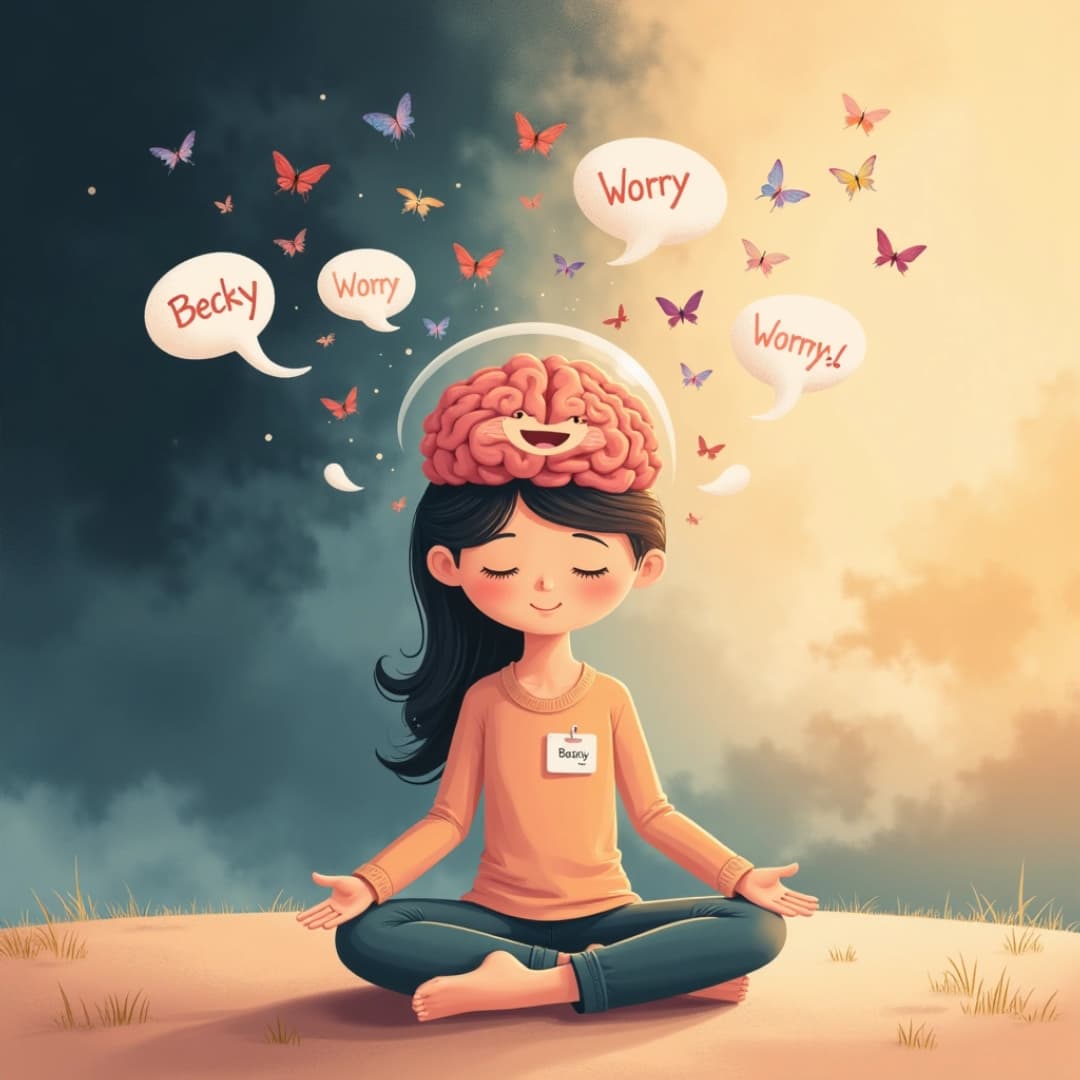
Former Google engineer and bestselling author Mo Gawdat popularised the “Name Your Brain” method. In his book “That Little Voice In Your Head”, he describes how he gave his inner voice the name “Becky”. The idea behind it is simple: when negative self-talk begins, you address your brain by this name, as if it were another person. Instead of identifying with the feeling, you say, for example: “It’s just Becky having another panic attack.”
By giving it a name, the automatic merging of self and thought is interrupted. You observe your inner voice from the outside, rather than letting it control you. This shift in perspective creates psychological distance and reduces the emotional impact of negative feelings. The method spread rapidly after Faye Plunkett shared the concept in a viral Instagram video and celebrities such as Reese Witherspoon publicly endorsed it. At its core, the method is a practical, everyday way of naming feelings, based on the principles of externalisation and cognitive defusion.
Why naming feelings changes the way negative emotions arise
Behind the method lies a mechanism that therapists refer to as externalisation. When we experience negative emotions as part of our identity, they feel threatening and overwhelming. However, as soon as we assign them a separate identity, they become something we can observe, rather than something we are. This shift in perspective is not merely a trick but a fundamental change in how the brain processes emotions.
Psychologist Dr LaKeita Carter explains: It is about separating negative feelings from ourselves. It is not you who has the thought, but ‘Negative Nia’ who has it. This separation activates the prefrontal cortex whilst simultaneously reducing amygdala activity. The result is a state of greater emotional clarity and capacity for action. The evolutionary background makes the mechanism easier to understand: our brain was optimised for survival in a dangerous environment and therefore generates a negativity bias that leads us to construct major catastrophes out of minor uncertainties. Those who can name their emotions and thus perceive them consciously break through this automatic process, making room for rational assessment once again.
How is naming feelings related to Acceptance and Commitment Therapy?
The ‘Name Your Brain’ technique is, at its core, an exercise in cognitive defusion, a central concept of Acceptance and Commitment Therapy. ACT is not about fighting or suppressing negative emotions. Instead, clients learn to build a new relationship with their feelings. Cognitive defusion means recognising thoughts and feelings for what they actually are: mental events, not facts. The ability to name a feeling precisely is the first step in this process.
When you give your thoughts a name, you are applying a form of defusion. You no longer say ‘I am a failure’, but ‘Becky is saying right now that I am a failure’. This linguistic difference may seem small, but it changes the entire psychological dynamic. You are no longer the victim of your emotions, but their observer. Research findings show that regular practice of cognitive defusion reduces the credibility of negative thoughts, increases the willingness to allow unpleasant feelings, and improves overall mood. In Non-Violent Communication, too, accurately naming one’s own feelings plays a central role, for example, when formulating ‘I’ messages that create genuine closeness rather than misunderstanding.
How to better name your feelings, techniques for dealing with feelings
In addition to the ‘Name Your Brain’ method, there are other effective ways to recognise and express your emotions consciously. One tried-and-tested technique is to preface every emotional reaction with the phrase ‘I notice that I’m currently feeling that…’. This shifts your focus from the content of the experience to the process of experiencing it, and activates the observing part of the mind. An emotion wheel or an emotion list can also help, as we often struggle to name our feelings simply because we lack the words.
Another technique involves repeating the negative thought in a silly voice, such as a cartoon character’s. Humour immediately reduces the emotional intensity of a feeling. Categorising emotions as ‘descriptive’ or ‘judgemental’ also helps to create some distance. Furthermore, it can be helpful to write down the feelings and look at them on a sheet of paper as if they were the words of a stranger. This externalisation through writing combines naming the feeling with the tried-and-tested method of expressive writing, which has been proven to reduce stress and promote emotional processing. All these techniques interrupt the automatic way in which we normally identify with our feelings and expand our emotional vocabulary.
How do negative emotions affect the body and mind if we do not express them?
Recurring negative emotions and ruminative loops are more than just unpleasant feelings. They trigger a stress response in the body, leading to increased release of cortisol and adrenaline. Chronic rumination can lead to sleep disturbances, high blood pressure, digestive problems and a weakened immune system. The constant activation of the sympathetic nervous system keeps the body in a state of alert, which is exhausting in the long run. Those who constantly suppress their feelings rather than express them intensify this physical reaction.
On a psychological level, the inability to consciously perceive and name emotions leads to an intensification of depressive symptoms and anxiety disorders. Those who are unaware of their own feelings cannot communicate them to others, leading to misunderstandings in relationships and isolation. Neurobiology shows that during chronic stress, the amygdala becomes hyperactive, whilst activity in the prefrontal cortex decreases. The less we regulate our emotions, the harder it is to think rationally. Depression or anxiety disorders can result. This is precisely where consciously naming feelings comes in: it activates the prefrontal cortex and dampens the amygdala’s response.
How to apply the ‘Name Your Brain’ method step by step
The first step is to choose a name for your brain. Therapist Stephanie Boucher recommends a name that sounds light-hearted and humorous. Humour counteracts the heaviness of negative feelings and makes it easier to maintain some distance. The name should have nothing to do with yourself or people close to you, so that the separation between self and emotion is successful. Many people deliberately choose a name that makes them smile, as this enhances the defusion effect whilst also making it easier to name the feeling.
In the second step, you practise catching your brain in the act. Whenever a negative feeling arises, address it using the chosen name: “Oh, it’s just Herbert worrying.” It may feel strange at first, but with regular practice, the distancing becomes increasingly natural. Try to describe the feeling as precisely as possible: is it fear, shame, anger or sadness? The more precisely you can name your emotions, the more effective the method is.
In the third step, you’ll learn to recognise the triggers for your “Herbert”. What makes him sound the alarm? Which situations calm him down? Boucher recommends getting to know your own brain as if it were a conversation partner. A diary can help with this: note when “Herbert” becomes particularly active and the feelings he evokes. This will help you recognise patterns in your emotional world and act accordingly. Important: always speak to your brain with compassion and empathy, because showing your feelings is not a sign of weakness, but of strength.
What role do mindfulness and self-compassion play in dealing with our emotions?
The ‘Name Your Brain’ method is closely linked to the principles of mindfulness. Mindfulness means perceiving the present moment consciously and without judgment. When you give your brain a name and observe its feelings, you are practising a form of mindful self-observation. You perceive what you are really feeling without reacting to it immediately. This process of tuning in is the first step towards consciously perceiving your own emotions.
Equally central is the attitude of self-compassion. Mo Gawdat describes the brain as an employee who needs proper care: exercise, nutrition, sleep and mental stimulation. Instead of condemning the brain for its negative feelings, you treat it like an overworked organ that needs support. Cognitive behavioural therapy confirms this approach: those who accept their feelings rather than fighting them reduce psychological stress and become more resilient in the long term. Positive emotions, too, can be strengthened by consciously naming them. Those who regularly name positive emotions such as gratitude, joy or connection train their brain to perceive these feelings more frequently. Acceptance and the conscious expression of our emotions together form the basis for a healthy approach to our entire emotional world.
Are there limits, and when do you need professional help in dealing with emotions?
The ‘Name Your Brain’ method and the conscious naming of feelings are effective self-help techniques, but they have their limits. In cases of severe mental illness such as clinical depression, generalised anxiety disorder or post-traumatic stress disorder, self-help alone is not sufficient. In such cases, professional psychotherapeutic support is necessary, for example, through cognitive behavioural therapy, schema therapy or dialectical behaviour therapy. A qualified therapist can help you name your own emotions, resolve conflicts and promote emotional expression in a way that suits you.
For some people, the technique may initially have the opposite effect: rather than creating distance, the attempt at externalisation actually heightens awareness of negative feelings. People with a tendency towards dissociation should be particularly cautious. In such cases, it is advisable first to learn the exercise under therapeutic guidance. The method works best as a complement to a comprehensive therapeutic approach that also includes emotion regulation, mindfulness training and work on the underlying beliefs. Ultimately, the aim is to create a safe space in which we can express and understand our feelings appropriately, so that we can work with our emotions rather than fight against them.
How does naming emotions change the brain in the long term?
Research into neuroplasticity shows that repeated mental exercises can permanently alter the structure and function of the brain. Studies on mindfulness meditation demonstrate that regular practice increases the density of grey matter in the prefrontal cortex and reduces the volume of the amygdala. Similar effects can be expected from regularly naming emotions: every time you name a feeling and consciously step back from it, you strengthen the neural connections between the prefrontal cortex and the amygdala.
Over time, this regulation becomes more automatic and requires less conscious effort. The brain literally learns to regulate its own stress response more efficiently. The combination of regular practice, self-compassion and an understanding of how emotions arise makes the conscious naming of feelings a valuable tool for long-term emotional health and self-esteem. Those who understand how to name their emotions and no longer view them as the enemy but rather as signposts reflecting our needs gain not only emotional clarity but also the ability to let feelings help us rather than fear them.
Key points at a glance
· Naming feelings is the key to greater emotional clarity and self-regulation. Those who can describe their emotions accurately regulate them better.
· The UCLA study by Matthew Lieberman (2007) shows that naming emotions reduces amygdala activity and activates the prefrontal cortex.
· Mo Gawdat’s ‘Name Your Brain’ method utilises this principle by giving the inner critic a name, thereby creating psychological distance from negative feelings.
· Cognitive defusion from Acceptance and Commitment Therapy involves recognising feelings as mental events rather than as facts.
· A nuanced emotional vocabulary, supported by an emotion wheel or emotion list, improves one’s ability to manage feelings.
· Chronic rumination and suppressed emotions raise cortisol levels and can lead to depression or anxiety disorders.
· The technique works best in combination with mindfulness, self-compassion and non-violent communication using ‘I’ messages.
· In cases of severe mental illness, the method does not replace professional psychotherapy, but complements it.
· Regular practice permanently alters brain structure through neuroplasticity and strengthens emotional self-regulation.
· Three steps to implementation: choose a humorous name, describe the emotion precisely, and get to know the triggers of your own emotional world.
RELATED ARTICLES:
DESCRIPTION:
Understanding and naming emotions: Learn to recognise, express and better regulate your feelings consciously. Expand your emotional vocabulary!
Identifying feelings: those who learn to recognise and express their emotions properly gain emotional clarity
Many people experience a queasy feeling in their stomach or a lump in their throat, yet still cannot describe exactly what they are really feeling. This difficulty in recognising one’s own feelings and consciously perceiving emotions is widespread and not a sign of weakness. On the contrary, research into emotions shows that a nuanced emotional vocabulary is the key to greater self-regulation. Those who can name their emotions gain control over their own emotional world. In this article, you’ll learn why naming feelings is so effective, what neuroscience has discovered about naming emotions, and how the viral ‘Name Your Brain’ method brings this principle into everyday life in a surprisingly simple way.
Why naming feelings is so important for our emotional development
The ability to name a feeling is not something that comes naturally. It begins in childhood, when caregivers mirror the child’s emotions and name them. When a parent says, “You’re feeling sad right now because your tower has fallen over,” the child learns to identify their own feelings correctly. This process lays the foundation for emotional development and how we deal with feelings later in adulthood.
Those who have not learnt to describe their emotions precisely often experience them as vague physical reactions: a flutter in the stomach, tightness in the chest or restlessness for no clear reason. Without the right vocabulary, these sensations remain threatening because we cannot interpret them correctly. Positive psychology and clinical emotion research both confirm that actively expanding one’s emotional vocabulary enables people to regulate their feelings more effectively, reduce misunderstandings in relationships, and foster genuine closeness. A rich emotional vocabulary not only makes us more resilient but also allows us to perceive our emotions and act accordingly consciously.
What does neuroscience say about naming emotions?
The scientific basis is provided by a groundbreaking 2007 study by Matthew Lieberman and his team at UCLA. Using functional magnetic resonance imaging, the researchers investigated what happens in the brain when people put their feelings into words. Researchers refer to this process as ‘affect labelling’, i.e. the naming of affects and emotions.
The results were remarkable: simply naming an emotion led to a measurable reduction in amygdala activity. At the same time, activity increased in the right ventrolateral prefrontal cortex, a brain region associated with self-regulation and impulse control. This link was mediated by the medial prefrontal cortex, suggesting a distinct neural regulatory pathway. Crucially, only the naming of the emotion produced this effect. When the participants gave the people in the images a name without naming the emotion, amygdala activity remained unchanged. The study thus provides neurobiological evidence for what many therapists have long known intuitively: talking about feelings helps to regulate them.
The ‘Name Your Brain’ method: How a viral trend popularised naming emotions
Former Google engineer and bestselling author Mo Gawdat popularised the “Name Your Brain” method. In his book “That Little Voice In Your Head”, he describes how he gave his inner voice the name “Becky”. The idea behind it is simple: when negative self-talk begins, you address your brain by this name, as if it were another person. Instead of identifying with the feeling, you say, for example: “It’s just Becky having another panic attack.”
By giving it a name, the automatic merging of self and thought is interrupted. You observe your inner voice from the outside, rather than letting it control you. This shift in perspective creates psychological distance and reduces the emotional impact of negative feelings. The method spread rapidly after Faye Plunkett shared the concept in a viral Instagram video and celebrities such as Reese Witherspoon publicly endorsed it. At its core, the method is a practical, everyday way of naming feelings, based on the principles of externalisation and cognitive defusion.
Why naming feelings changes the way negative emotions arise
Behind the method lies a mechanism that therapists refer to as externalisation. When we experience negative emotions as part of our identity, they feel threatening and overwhelming. However, as soon as we assign them a separate identity, they become something we can observe, rather than something we are. This shift in perspective is not merely a trick but a fundamental change in how the brain processes emotions.
Psychologist Dr LaKeita Carter explains: It is about separating negative feelings from ourselves. It is not you who has the thought, but ‘Negative Nia’ who has it. This separation activates the prefrontal cortex whilst simultaneously reducing amygdala activity. The result is a state of greater emotional clarity and capacity for action. The evolutionary background makes the mechanism easier to understand: our brain was optimised for survival in a dangerous environment and therefore generates a negativity bias that leads us to construct major catastrophes out of minor uncertainties. Those who can name their emotions and thus perceive them consciously break through this automatic process, making room for rational assessment once again.
How is naming feelings related to Acceptance and Commitment Therapy?
The ‘Name Your Brain’ technique is, at its core, an exercise in cognitive defusion, a central concept of Acceptance and Commitment Therapy. ACT is not about fighting or suppressing negative emotions. Instead, clients learn to build a new relationship with their feelings. Cognitive defusion means recognising thoughts and feelings for what they actually are: mental events, not facts. The ability to name a feeling precisely is the first step in this process.
When you give your thoughts a name, you are applying a form of defusion. You no longer say ‘I am a failure’, but ‘Becky is saying right now that I am a failure’. This linguistic difference may seem small, but it changes the entire psychological dynamic. You are no longer the victim of your emotions, but their observer. Research findings show that regular practice of cognitive defusion reduces the credibility of negative thoughts, increases the willingness to allow unpleasant feelings, and improves overall mood. In Non-Violent Communication, too, accurately naming one’s own feelings plays a central role, for example, when formulating ‘I’ messages that create genuine closeness rather than misunderstanding.
How to better name your feelings, techniques for dealing with feelings
In addition to the ‘Name Your Brain’ method, there are other effective ways to recognise and express your emotions consciously. One tried-and-tested technique is to preface every emotional reaction with the phrase ‘I notice that I’m currently feeling that…’. This shifts your focus from the content of the experience to the process of experiencing it, and activates the observing part of the mind. An emotion wheel or an emotion list can also help, as we often struggle to name our feelings simply because we lack the words.
Another technique involves repeating the negative thought in a silly voice, such as a cartoon character’s. Humour immediately reduces the emotional intensity of a feeling. Categorising emotions as ‘descriptive’ or ‘judgemental’ also helps to create some distance. Furthermore, it can be helpful to write down the feelings and look at them on a sheet of paper as if they were the words of a stranger. This externalisation through writing combines naming the feeling with the tried-and-tested method of expressive writing, which has been proven to reduce stress and promote emotional processing. All these techniques interrupt the automatic way in which we normally identify with our feelings and expand our emotional vocabulary.
How do negative emotions affect the body and mind if we do not express them?
Recurring negative emotions and ruminative loops are more than just unpleasant feelings. They trigger a stress response in the body, leading to increased release of cortisol and adrenaline. Chronic rumination can lead to sleep disturbances, high blood pressure, digestive problems and a weakened immune system. The constant activation of the sympathetic nervous system keeps the body in a state of alert, which is exhausting in the long run. Those who constantly suppress their feelings rather than express them intensify this physical reaction.
On a psychological level, the inability to consciously perceive and name emotions leads to an intensification of depressive symptoms and anxiety disorders. Those who are unaware of their own feelings cannot communicate them to others, leading to misunderstandings in relationships and isolation. Neurobiology shows that during chronic stress, the amygdala becomes hyperactive, whilst activity in the prefrontal cortex decreases. The less we regulate our emotions, the harder it is to think rationally. Depression or anxiety disorders can result. This is precisely where consciously naming feelings comes in: it activates the prefrontal cortex and dampens the amygdala’s response.
How to apply the ‘Name Your Brain’ method step by step
The first step is to choose a name for your brain. Therapist Stephanie Boucher recommends a name that sounds light-hearted and humorous. Humour counteracts the heaviness of negative feelings and makes it easier to maintain some distance. The name should have nothing to do with yourself or people close to you, so that the separation between self and emotion is successful. Many people deliberately choose a name that makes them smile, as this enhances the defusion effect whilst also making it easier to name the feeling.
In the second step, you practise catching your brain in the act. Whenever a negative feeling arises, address it using the chosen name: “Oh, it’s just Herbert worrying.” It may feel strange at first, but with regular practice, the distancing becomes increasingly natural. Try to describe the feeling as precisely as possible: is it fear, shame, anger or sadness? The more precisely you can name your emotions, the more effective the method is.
In the third step, you’ll learn to recognise the triggers for your “Herbert”. What makes him sound the alarm? Which situations calm him down? Boucher recommends getting to know your own brain as if it were a conversation partner. A diary can help with this: note when “Herbert” becomes particularly active and the feelings he evokes. This will help you recognise patterns in your emotional world and act accordingly. Important: always speak to your brain with compassion and empathy, because showing your feelings is not a sign of weakness, but of strength.
What role do mindfulness and self-compassion play in dealing with our emotions?
The ‘Name Your Brain’ method is closely linked to the principles of mindfulness. Mindfulness means perceiving the present moment consciously and without judgment. When you give your brain a name and observe its feelings, you are practising a form of mindful self-observation. You perceive what you are really feeling without reacting to it immediately. This process of tuning in is the first step towards consciously perceiving your own emotions.
Equally central is the attitude of self-compassion. Mo Gawdat describes the brain as an employee who needs proper care: exercise, nutrition, sleep and mental stimulation. Instead of condemning the brain for its negative feelings, you treat it like an overworked organ that needs support. Cognitive behavioural therapy confirms this approach: those who accept their feelings rather than fighting them reduce psychological stress and become more resilient in the long term. Positive emotions, too, can be strengthened by consciously naming them. Those who regularly name positive emotions such as gratitude, joy or connection train their brain to perceive these feelings more frequently. Acceptance and the conscious expression of our emotions together form the basis for a healthy approach to our entire emotional world.
Are there limits, and when do you need professional help in dealing with emotions?
The ‘Name Your Brain’ method and the conscious naming of feelings are effective self-help techniques, but they have their limits. In cases of severe mental illness such as clinical depression, generalised anxiety disorder or post-traumatic stress disorder, self-help alone is not sufficient. In such cases, professional psychotherapeutic support is necessary, for example, through cognitive behavioural therapy, schema therapy or dialectical behaviour therapy. A qualified therapist can help you name your own emotions, resolve conflicts and promote emotional expression in a way that suits you.
For some people, the technique may initially have the opposite effect: rather than creating distance, the attempt at externalisation actually heightens awareness of negative feelings. People with a tendency towards dissociation should be particularly cautious. In such cases, it is advisable first to learn the exercise under therapeutic guidance. The method works best as a complement to a comprehensive therapeutic approach that also includes emotion regulation, mindfulness training and work on the underlying beliefs. Ultimately, the aim is to create a safe space in which we can express and understand our feelings appropriately, so that we can work with our emotions rather than fight against them.
How does naming emotions change the brain in the long term?
Research into neuroplasticity shows that repeated mental exercises can permanently alter the structure and function of the brain. Studies on mindfulness meditation demonstrate that regular practice increases the density of grey matter in the prefrontal cortex and reduces the volume of the amygdala. Similar effects can be expected from regularly naming emotions: every time you name a feeling and consciously step back from it, you strengthen the neural connections between the prefrontal cortex and the amygdala.
Over time, this regulation becomes more automatic and requires less conscious effort. The brain literally learns to regulate its own stress response more efficiently. The combination of regular practice, self-compassion and an understanding of how emotions arise makes the conscious naming of feelings a valuable tool for long-term emotional health and self-esteem. Those who understand how to name their emotions and no longer view them as the enemy but rather as signposts reflecting our needs gain not only emotional clarity but also the ability to let feelings help us rather than fear them.
Key points at a glance
· Naming feelings is the key to greater emotional clarity and self-regulation. Those who can describe their emotions accurately regulate them better.
· The UCLA study by Matthew Lieberman (2007) shows that naming emotions reduces amygdala activity and activates the prefrontal cortex.
· Mo Gawdat’s ‘Name Your Brain’ method utilises this principle by giving the inner critic a name, thereby creating psychological distance from negative feelings.
· Cognitive defusion from Acceptance and Commitment Therapy involves recognising feelings as mental events rather than as facts.
· A nuanced emotional vocabulary, supported by an emotion wheel or emotion list, improves one’s ability to manage feelings.
· Chronic rumination and suppressed emotions raise cortisol levels and can lead to depression or anxiety disorders.
· The technique works best in combination with mindfulness, self-compassion and non-violent communication using ‘I’ messages.
· In cases of severe mental illness, the method does not replace professional psychotherapy, but complements it.
· Regular practice permanently alters brain structure through neuroplasticity and strengthens emotional self-regulation.
· Three steps to implementation: choose a humorous name, describe the emotion precisely, and get to know the triggers of your own emotional world.
RELATED ARTICLES:
Newsletter
Would you like to be notified when I publish a new blog post? Sign up here.
Click "Subscribe for free" if you have read and accepted my privacy policy. You can revoke your consent at any time.
Newsletter
Would you like to be notified when I publish a new blog post? Sign up here.
Click "Subscribe for free" if you have read and accepted my privacy policy. You can revoke your consent at any time.