Christmas
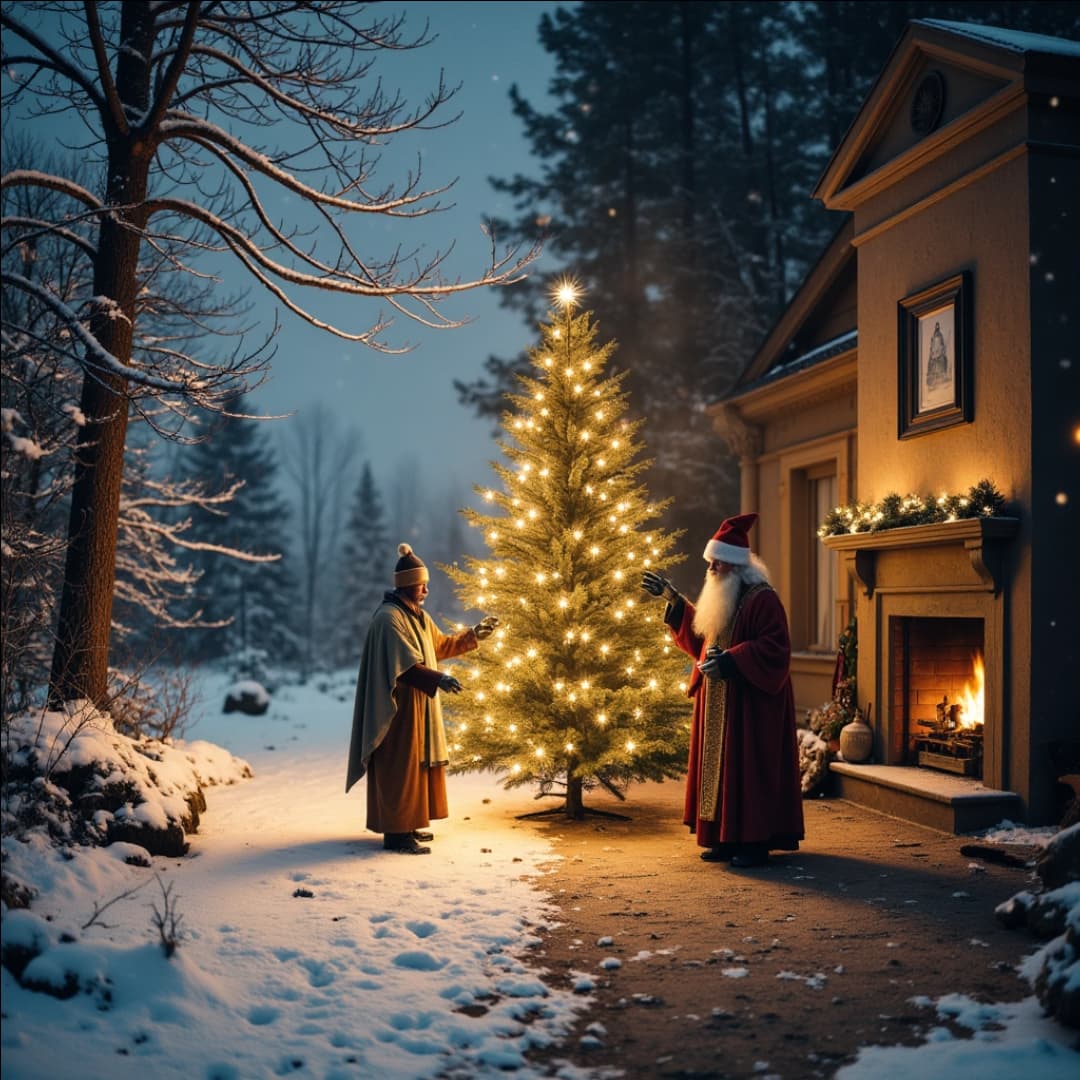
DESCRIPTION:
Christmas: Origin, development, traditions and customs.
Christmas and its pagan origins
For many, Christmas is the most important holiday of the year. But anyone who believes that 25 December is exclusively a Christian celebration is greatly mistaken. The roots of this holiday go back deep into history, long before the Christmas story found its way into the Bible. Much of what we now consider integral to the festive season – from the Christmas tree to Father Christmas – has surprisingly pagan origins.
What it's all about:
· The Roman Saturnalia,
· The Germanic Yule celebrations,
· Why the Church chose the date,
· The role Martin Luther played, and
· How historical figures and authors shaped the image of Santa Claus and the Christ Child.
An ancient sun cult eventually became the modern Christmas celebration.
When was Christmas actually "invented" and first mentioned?
The question of its exact origins is not so easy to answer, as Christmas as we know it today has developed over centuries. It is historically certain that the celebration of Jesus' birth played no role at all in the first centuries of Christianity. Easter, the celebration of the resurrection, was the central event. It was not until 336 that a note appeared in a Roman chronicle stating that Christ was born in Bethlehem on 25 December. This is the first time that the date 336 is documented in Rome.
The linguistic development is also interesting. The word Christmas itself did not appear in the German-speaking world until much later. It is believed to have been first used around 1170 in a poem by the Bavarian singer Spervogel as "ze wihen nahten" (in the holy nights). This suggests that the days and nights around the winter solstice had always been perceived as a special, magical time, long before they were transformed entirely theologically by the Christian Christmas festival.
The emergence of Christmas was therefore not a single event, but a slow process of cultural adaptation. The Church recognised that people loved their old customs. Instead of banning them, they were reinterpreted. Thus, the celebration of the cycles of nature became the celebration of the arrival of the Saviour.
Why is Christmas celebrated on 25 December and not on another day?
There is no historical evidence that Jesus was actually born in winter. The Bible does not mention a date. An essential indication against winter is the mention of shepherds in the fields with their flocks, which is unlikely in the cold December weather in Judea. So why is Christmas celebrated on 25 December? The answer lies in Roman religious policy.
In the Roman Empire, this date marked the winter solstice (according to the Julian calendar), and the festival of "Sol Invictus, the invincible sun god. Emperor Aurelian had strengthened this cult. For Christians, it was natural to interpret Christ as the "true sun" that illuminates the darkness of the world. In 354, the feast of Jesus' birth was officially included in the Roman calendar of festivals, as a counterpoint to the pagan sun cult, so to speak.
The symbolism was also a perfect fit: from the winter solstice onwards, the days grow longer again, light triumphs over darkness. This metaphor could be applied perfectly to Jesus Christ and his birth. One could say that Christianity strategically chose this date to counter the popular pagan celebrations with what we now know as the feast of the Nativity.
What does the winter solstice have to do with the birth of Christ?
The winter solstice was of existential importance to people in ancient times and the early Middle Ages. It was the longest night of the year, often called Mother Night. The fear that the light might not return was real. When we celebrate Christmas today, we unconsciously draw on these ancient fears and hopes. In Nordic traditions, the Yule festival was celebrated, with Odin (or Jólnir) playing a central role.
The Germanic Yule festival was a celebration of the rebirth of light and fertility. Oaths were sworn on the boar (a custom that may be the precursor to our New Year's resolutions), and large fires were lit to drive away the darkness. The Church deliberately placed the celebration of Jesus' birth at this time to transform the pagan symbolism of the "return of the sun" (Sol) into the "arrival of the Son" (Son of God).
This superimposition was so successful that many elements merged seamlessly. The "light of the world" (Jesus Christ) replaced the physical sun, but the rituals – candles, fires, huddling together in the cold – remained. Thus, the reference to Christmas is always also a reference to the astronomical turning point of the year.
What pagan origins do our favourite customs have?
Many traditions that we consider to be early Christian today have a pagan background. Take mistletoe, for example: it was sacred to the Druids and was considered a symbol of peace and reconciliation. Or decorating with evergreen branches: this was supposed to save the life force through " (the spirit of the dead) during the dead of winter and ward off evil spirits. So when we decorate our homes for the festive season, we are performing rituals that are thousands of years old.
The idea of gift-giving is not purely Christian either. Even during the Roman Saturnalia, people gave each other gifts, and masters served their slaves. In the Nordic countries, the Yule goat brought gifts or demanded them. These pagan customs were Christianised over the centuries, but their essence remained. Christmas is thus a cultural melting pot.
Another aspect is the festive meal. The Germanic tribes celebrated Yule with lavish feasts to fortify themselves for the rest of the winter. Today's roast goose or pork dinner can undoubtedly be traced back to this. It was about celebrating survival and strengthening the community – an aspect that still characterises Christmas today.
How did Saint Nicholas become the modern Santa Claus?
The Nicholas we celebrate on 6 December goes back to Bishop Nicholas of Myra, who lived in what is now Turkey in the 4th century. He was known for his charity and his gifts to the poor. But how did the bishop with his mitre and staff become the fat man in the red coat we know as Santa Claus? This is where Dutch immigrants to America came into play, bringing their "Sinterklaas" with them.
Another decisive transformation took place in 19th-century New York. Writers such as Washington Irving and Clement Clarke Moore (the latter with his poem "A Visit from St. Nicholas") began to change the image of Nicholas. He lost his episcopal insignia, got a sleigh and reindeer, and became rounder and more jolly. The cartoonist Thomas Nast later drew him as we almost all picture him today.
The modern Father Christmas is therefore a fictional character who combines European legends of saints with Nordic folklore (such as elves and gnomes) and American storytelling. It is fascinating to see how Washington Irving and other writers reinvented a character who is now recognised by people all over the world as a symbol of Christmas.
Christ Child or Father Christmas: who actually brings the presents?
In Germany, there is a clear distinction – or rivalry – between the Christ Child and Father Christmas. Interestingly, it was the reformer Martin Luther who popularised the Christ Child. Since Protestants did not venerate saints (and therefore St. Nicholas), Luther needed a new gift-giver. He promoted the "Holy Christ" as the one who brings gifts to refocus attention on Jesus' birth.
Originally, St. Nicholas brought gifts on 6 December. Luther shifted the gift-giving to 24 December, Christmas Eve, and made it the responsibility of the Christ Child. Ironically, the Christ Child is now more revered in Catholic areas (southern Germany, Austria), while the Protestant north often tends towards the (secularised) Father Christmas.
Santa Claus, on the other hand, is, as described above, a mixture of St. Nicholas and Father Frost. The fact that both figures coexist underscores the festival's complexity. Whether it is the angelic being or the jolly old man with the bushy beard, the custom of giving gifts at the celebration of Christ's birth remains central.
Since when has the Christmas tree been a permanent fixture?
The Christmas tree, now the symbol par excellence of Christmas, has had a comparatively short career as a common folk tradition, even though its roots are ancient. Evergreen plants have always symbolised vitality. However, the decorated tree in the living room probably dates to the Middle Ages, with origins of the Paradise plays. On 24 December, the anniversary of Adam and Eve, "paradise trees" (often fir trees hung with apples) were set up in churches.
The first written mention of a Christmas tree as we know it dates back to 1605 in Alsace. Initially, this was a privilege of the wealthy citizens and the nobility. The Church was sceptical about the tree for a long time, as it had no direct biblical reference and was considered "forest stuff". It was not until the 19th century that the tree began its triumphant advance into every living room, not least thanks to the nobility, who popularised this custom.
Today, it is hard to imagine Christmas without a tree. It combines the pagan symbolism of eternal life (greenery in winter) with the Christian symbolism of light (candles) and the fruits of paradise (baubles, stylised as apples).
What do the nativity scene and the depiction of the birth of Jesus tell us?
The nativity scene is often the emotional centrepiece of church celebrations and many living rooms. The depiction of the birth of Jesus with Mary, Joseph and the child in the stable in Bethlehem makes the theological event tangible. Francis of Assisi is considered the "inventor" of the living nativity scene. In 1223, he re-enacted the Christmas story with live animals and people in Greccio to bring the mystery of the Incarnation of God closer to the simple population, who often could not read.
The figures that stand in the nativity scene today come from different sources. The Christmas story in the Gospel of Luke mentions the shepherds and the manger. The three wise men from the East (or Three Kings), on the other hand, come from the Gospel of Matthew. Oxen and donkeys are not mentioned in the Bible at the time of the birth; they found their way into the stable through Old Testament prophecies and apocryphal writings.
This scenic representation of the nativity plays helps to capture the celebration of the birth of Jesus. It grounds the lofty theological concept of the Incarnation (God becoming man) in a humble, understandable setting: a stable birth.
Silent Night and other songs: What does Christmas sound like?
Music plays a central role in our Christmas celebrations. No other festival has such a rich treasure trove of songs. Probably the most famous Christmas carol in the world is "Silent Night, Holy Night". It was first performed in 1818 in Oberndorf near Salzburg. Joseph Mohr wrote the lyrics; Franz Xaver Gruber composed the melody. It was written in a time of hardship after the Napoleonic Wars and struck a chord with people.
Songs were initially used to spread the theological message. Luther wrote "Vom Himmel hoch, da komm ich her" (From Heaven Above, I Come) to spread his teachings. But in the 19th century, during the Biedermeier and Romantic eras, the character of the songs changed. They became more sentimental, more familiar, and emphasised "Holy Night" as an idyllic family event.
Today, people sing or listen to a mixture of old church hymns and modern pop songs. But whether it's "O du fröhliche" or "Last Christmas," music creates the atmosphere we perceive as festive and connects generations under the Christmas tree.
Is Christmas today just commercialism or still a celebration of love?
Critics often complain about the holiday's commercialisation. In fact, gingerbread sales begin as early as September, and the pressure to find the perfect gift can cause enormous stress. Santa Claus in Coca-Cola's advertising has globalised the image of Santa Claus and turned him into an advertising icon. Has the meaning of the winter solstice, the festival of love and the celebration of the birth of the Saviour been lost?
Not necessarily. Despite consumerism, Christmas remains the most important family celebration of the year. People travel hundreds of kilometres to be with their loved ones. It is a time for pause, generosity and reflection. Even if many no longer focus on the religious background – the birth of Jesus Christ – the values of peace, light and hope remain central.
Christmas today is a hybrid. It combines Advent and anticipation, old pagan customs, Christian liturgy and modern consumerism. But at its core, it is still about what people celebrated thousands of years ago: the hope that after darkness, light will return.
The most essential facts in brief
· The origin of the date lies in the Roman festival of the sun god (Sol Invictus) and the winter solstice, not in the historical date of Jesus' birth.
· Christmas was first documented in Rome on 25 December in 336 and later firmly established in the calendar in 354.
· Many traditions are pagan: the Christmas tree, mistletoe and the lighting of lights date back to pre-Christian rites.
· The modern Santa Claus is a blend of Saint Nicholas, Father Frost, and literary figures from Washington Irving and Clement Clarke Moore.
· Martin Luther established the Christ Child to bring gifts on 24 December and focus attention on the birth of Jesus.
· Francis of Assisi popularised the nativity scene and the depiction of Jesus’ birth to illustrate the Christmas story.
· Despite commercialisation, Christmas remains a central family celebration that unites elements from different cultures and eras around the world, from the Roman Sol Invictus to the modern Santa Claus.
· The Christmas story combines accounts of shepherds, angels and the Magi from the East, even though these come from different gospels.
· Important celebrations in the surrounding period include the Feast of the Epiphany and the Feast of the Baptism of the Lord (Baptism of Christ), which conclude the Christmas cycle.
· The Christian Christmas celebration is a successful example of the integration of old customs into a new faith, which is why it remains relevant today, when we celebrate it in December.
Season's greetings from practice
Regardless of whether you uphold the old traditions, celebrate the festival in a Christian manner or enjoy the tranquillity of the winter days, I wish you a peaceful Christmas from the bottom of my heart.
Especially in a time often characterised by hustle and bustle, I hope you find moments of peace and relaxation. May you end the old year peacefully and look ahead with new strength and confidence.
Have a good start to the new year – I wish you a happy New Year and all the best for the coming year!
Yours sincerely, Dirk Stemper
Related:
DESCRIPTION:
Christmas: Origin, development, traditions and customs.
Christmas and its pagan origins
For many, Christmas is the most important holiday of the year. But anyone who believes that 25 December is exclusively a Christian celebration is greatly mistaken. The roots of this holiday go back deep into history, long before the Christmas story found its way into the Bible. Much of what we now consider integral to the festive season – from the Christmas tree to Father Christmas – has surprisingly pagan origins.
What it's all about:
· The Roman Saturnalia,
· The Germanic Yule celebrations,
· Why the Church chose the date,
· The role Martin Luther played, and
· How historical figures and authors shaped the image of Santa Claus and the Christ Child.
An ancient sun cult eventually became the modern Christmas celebration.
When was Christmas actually "invented" and first mentioned?
The question of its exact origins is not so easy to answer, as Christmas as we know it today has developed over centuries. It is historically certain that the celebration of Jesus' birth played no role at all in the first centuries of Christianity. Easter, the celebration of the resurrection, was the central event. It was not until 336 that a note appeared in a Roman chronicle stating that Christ was born in Bethlehem on 25 December. This is the first time that the date 336 is documented in Rome.
The linguistic development is also interesting. The word Christmas itself did not appear in the German-speaking world until much later. It is believed to have been first used around 1170 in a poem by the Bavarian singer Spervogel as "ze wihen nahten" (in the holy nights). This suggests that the days and nights around the winter solstice had always been perceived as a special, magical time, long before they were transformed entirely theologically by the Christian Christmas festival.
The emergence of Christmas was therefore not a single event, but a slow process of cultural adaptation. The Church recognised that people loved their old customs. Instead of banning them, they were reinterpreted. Thus, the celebration of the cycles of nature became the celebration of the arrival of the Saviour.
Why is Christmas celebrated on 25 December and not on another day?
There is no historical evidence that Jesus was actually born in winter. The Bible does not mention a date. An essential indication against winter is the mention of shepherds in the fields with their flocks, which is unlikely in the cold December weather in Judea. So why is Christmas celebrated on 25 December? The answer lies in Roman religious policy.
In the Roman Empire, this date marked the winter solstice (according to the Julian calendar), and the festival of "Sol Invictus, the invincible sun god. Emperor Aurelian had strengthened this cult. For Christians, it was natural to interpret Christ as the "true sun" that illuminates the darkness of the world. In 354, the feast of Jesus' birth was officially included in the Roman calendar of festivals, as a counterpoint to the pagan sun cult, so to speak.
The symbolism was also a perfect fit: from the winter solstice onwards, the days grow longer again, light triumphs over darkness. This metaphor could be applied perfectly to Jesus Christ and his birth. One could say that Christianity strategically chose this date to counter the popular pagan celebrations with what we now know as the feast of the Nativity.
What does the winter solstice have to do with the birth of Christ?
The winter solstice was of existential importance to people in ancient times and the early Middle Ages. It was the longest night of the year, often called Mother Night. The fear that the light might not return was real. When we celebrate Christmas today, we unconsciously draw on these ancient fears and hopes. In Nordic traditions, the Yule festival was celebrated, with Odin (or Jólnir) playing a central role.
The Germanic Yule festival was a celebration of the rebirth of light and fertility. Oaths were sworn on the boar (a custom that may be the precursor to our New Year's resolutions), and large fires were lit to drive away the darkness. The Church deliberately placed the celebration of Jesus' birth at this time to transform the pagan symbolism of the "return of the sun" (Sol) into the "arrival of the Son" (Son of God).
This superimposition was so successful that many elements merged seamlessly. The "light of the world" (Jesus Christ) replaced the physical sun, but the rituals – candles, fires, huddling together in the cold – remained. Thus, the reference to Christmas is always also a reference to the astronomical turning point of the year.
What pagan origins do our favourite customs have?
Many traditions that we consider to be early Christian today have a pagan background. Take mistletoe, for example: it was sacred to the Druids and was considered a symbol of peace and reconciliation. Or decorating with evergreen branches: this was supposed to save the life force through " (the spirit of the dead) during the dead of winter and ward off evil spirits. So when we decorate our homes for the festive season, we are performing rituals that are thousands of years old.
The idea of gift-giving is not purely Christian either. Even during the Roman Saturnalia, people gave each other gifts, and masters served their slaves. In the Nordic countries, the Yule goat brought gifts or demanded them. These pagan customs were Christianised over the centuries, but their essence remained. Christmas is thus a cultural melting pot.
Another aspect is the festive meal. The Germanic tribes celebrated Yule with lavish feasts to fortify themselves for the rest of the winter. Today's roast goose or pork dinner can undoubtedly be traced back to this. It was about celebrating survival and strengthening the community – an aspect that still characterises Christmas today.
How did Saint Nicholas become the modern Santa Claus?
The Nicholas we celebrate on 6 December goes back to Bishop Nicholas of Myra, who lived in what is now Turkey in the 4th century. He was known for his charity and his gifts to the poor. But how did the bishop with his mitre and staff become the fat man in the red coat we know as Santa Claus? This is where Dutch immigrants to America came into play, bringing their "Sinterklaas" with them.
Another decisive transformation took place in 19th-century New York. Writers such as Washington Irving and Clement Clarke Moore (the latter with his poem "A Visit from St. Nicholas") began to change the image of Nicholas. He lost his episcopal insignia, got a sleigh and reindeer, and became rounder and more jolly. The cartoonist Thomas Nast later drew him as we almost all picture him today.
The modern Father Christmas is therefore a fictional character who combines European legends of saints with Nordic folklore (such as elves and gnomes) and American storytelling. It is fascinating to see how Washington Irving and other writers reinvented a character who is now recognised by people all over the world as a symbol of Christmas.
Christ Child or Father Christmas: who actually brings the presents?
In Germany, there is a clear distinction – or rivalry – between the Christ Child and Father Christmas. Interestingly, it was the reformer Martin Luther who popularised the Christ Child. Since Protestants did not venerate saints (and therefore St. Nicholas), Luther needed a new gift-giver. He promoted the "Holy Christ" as the one who brings gifts to refocus attention on Jesus' birth.
Originally, St. Nicholas brought gifts on 6 December. Luther shifted the gift-giving to 24 December, Christmas Eve, and made it the responsibility of the Christ Child. Ironically, the Christ Child is now more revered in Catholic areas (southern Germany, Austria), while the Protestant north often tends towards the (secularised) Father Christmas.
Santa Claus, on the other hand, is, as described above, a mixture of St. Nicholas and Father Frost. The fact that both figures coexist underscores the festival's complexity. Whether it is the angelic being or the jolly old man with the bushy beard, the custom of giving gifts at the celebration of Christ's birth remains central.
Since when has the Christmas tree been a permanent fixture?
The Christmas tree, now the symbol par excellence of Christmas, has had a comparatively short career as a common folk tradition, even though its roots are ancient. Evergreen plants have always symbolised vitality. However, the decorated tree in the living room probably dates to the Middle Ages, with origins of the Paradise plays. On 24 December, the anniversary of Adam and Eve, "paradise trees" (often fir trees hung with apples) were set up in churches.
The first written mention of a Christmas tree as we know it dates back to 1605 in Alsace. Initially, this was a privilege of the wealthy citizens and the nobility. The Church was sceptical about the tree for a long time, as it had no direct biblical reference and was considered "forest stuff". It was not until the 19th century that the tree began its triumphant advance into every living room, not least thanks to the nobility, who popularised this custom.
Today, it is hard to imagine Christmas without a tree. It combines the pagan symbolism of eternal life (greenery in winter) with the Christian symbolism of light (candles) and the fruits of paradise (baubles, stylised as apples).
What do the nativity scene and the depiction of the birth of Jesus tell us?
The nativity scene is often the emotional centrepiece of church celebrations and many living rooms. The depiction of the birth of Jesus with Mary, Joseph and the child in the stable in Bethlehem makes the theological event tangible. Francis of Assisi is considered the "inventor" of the living nativity scene. In 1223, he re-enacted the Christmas story with live animals and people in Greccio to bring the mystery of the Incarnation of God closer to the simple population, who often could not read.
The figures that stand in the nativity scene today come from different sources. The Christmas story in the Gospel of Luke mentions the shepherds and the manger. The three wise men from the East (or Three Kings), on the other hand, come from the Gospel of Matthew. Oxen and donkeys are not mentioned in the Bible at the time of the birth; they found their way into the stable through Old Testament prophecies and apocryphal writings.
This scenic representation of the nativity plays helps to capture the celebration of the birth of Jesus. It grounds the lofty theological concept of the Incarnation (God becoming man) in a humble, understandable setting: a stable birth.
Silent Night and other songs: What does Christmas sound like?
Music plays a central role in our Christmas celebrations. No other festival has such a rich treasure trove of songs. Probably the most famous Christmas carol in the world is "Silent Night, Holy Night". It was first performed in 1818 in Oberndorf near Salzburg. Joseph Mohr wrote the lyrics; Franz Xaver Gruber composed the melody. It was written in a time of hardship after the Napoleonic Wars and struck a chord with people.
Songs were initially used to spread the theological message. Luther wrote "Vom Himmel hoch, da komm ich her" (From Heaven Above, I Come) to spread his teachings. But in the 19th century, during the Biedermeier and Romantic eras, the character of the songs changed. They became more sentimental, more familiar, and emphasised "Holy Night" as an idyllic family event.
Today, people sing or listen to a mixture of old church hymns and modern pop songs. But whether it's "O du fröhliche" or "Last Christmas," music creates the atmosphere we perceive as festive and connects generations under the Christmas tree.
Is Christmas today just commercialism or still a celebration of love?
Critics often complain about the holiday's commercialisation. In fact, gingerbread sales begin as early as September, and the pressure to find the perfect gift can cause enormous stress. Santa Claus in Coca-Cola's advertising has globalised the image of Santa Claus and turned him into an advertising icon. Has the meaning of the winter solstice, the festival of love and the celebration of the birth of the Saviour been lost?
Not necessarily. Despite consumerism, Christmas remains the most important family celebration of the year. People travel hundreds of kilometres to be with their loved ones. It is a time for pause, generosity and reflection. Even if many no longer focus on the religious background – the birth of Jesus Christ – the values of peace, light and hope remain central.
Christmas today is a hybrid. It combines Advent and anticipation, old pagan customs, Christian liturgy and modern consumerism. But at its core, it is still about what people celebrated thousands of years ago: the hope that after darkness, light will return.
The most essential facts in brief
· The origin of the date lies in the Roman festival of the sun god (Sol Invictus) and the winter solstice, not in the historical date of Jesus' birth.
· Christmas was first documented in Rome on 25 December in 336 and later firmly established in the calendar in 354.
· Many traditions are pagan: the Christmas tree, mistletoe and the lighting of lights date back to pre-Christian rites.
· The modern Santa Claus is a blend of Saint Nicholas, Father Frost, and literary figures from Washington Irving and Clement Clarke Moore.
· Martin Luther established the Christ Child to bring gifts on 24 December and focus attention on the birth of Jesus.
· Francis of Assisi popularised the nativity scene and the depiction of Jesus’ birth to illustrate the Christmas story.
· Despite commercialisation, Christmas remains a central family celebration that unites elements from different cultures and eras around the world, from the Roman Sol Invictus to the modern Santa Claus.
· The Christmas story combines accounts of shepherds, angels and the Magi from the East, even though these come from different gospels.
· Important celebrations in the surrounding period include the Feast of the Epiphany and the Feast of the Baptism of the Lord (Baptism of Christ), which conclude the Christmas cycle.
· The Christian Christmas celebration is a successful example of the integration of old customs into a new faith, which is why it remains relevant today, when we celebrate it in December.
Season's greetings from practice
Regardless of whether you uphold the old traditions, celebrate the festival in a Christian manner or enjoy the tranquillity of the winter days, I wish you a peaceful Christmas from the bottom of my heart.
Especially in a time often characterised by hustle and bustle, I hope you find moments of peace and relaxation. May you end the old year peacefully and look ahead with new strength and confidence.
Have a good start to the new year – I wish you a happy New Year and all the best for the coming year!
Yours sincerely, Dirk Stemper
Related:
Newsletter
Would you like to be notified when I publish a new blog post? Sign up here.
Click "Subscribe for free" if you have read and accepted my privacy policy. You can revoke your consent at any time.
Newsletter
Would you like to be notified when I publish a new blog post? Sign up here.
Click "Subscribe for free" if you have read and accepted my privacy policy. You can revoke your consent at any time.