AI deskilling and cognitive debt
AI deskilling and cognitive debt: AI use undermines thinking ability after 10 minutes
AI deskilling and cognitive debt: AI use undermines thinking ability after 10 minutes
DESCRIPTION:
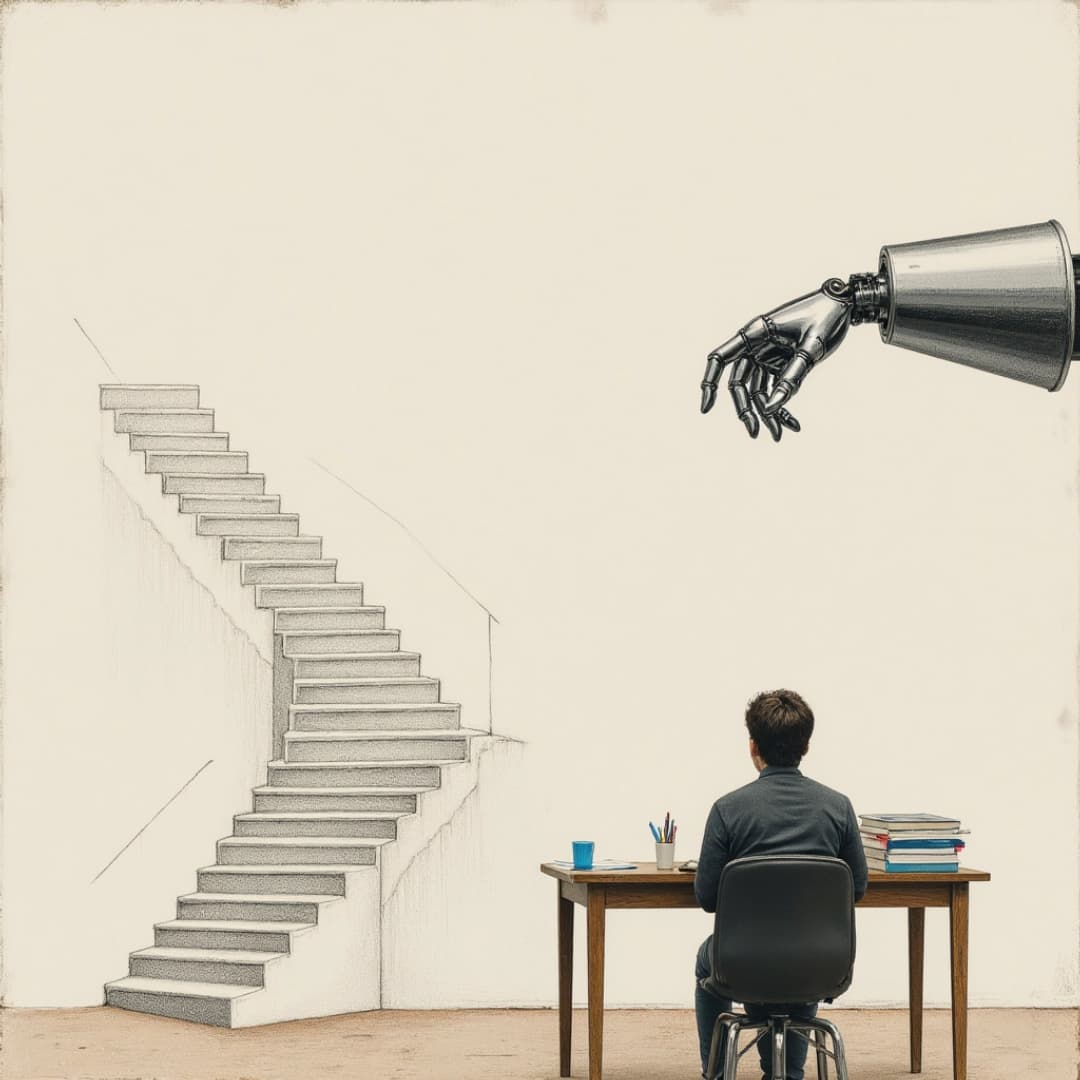
The AI world: cognitive ability and cognitive debt in the deskilling process. The MIT study ‘Your Brain on ChatGPT’ and an RCT show that AI use reduces cognitive ability, stamina and brain activity. Cognitive debt – the ‘loan’ the brain takes out in the AI age with ChatGPT, Gemini and the like.
AI deskilling and cognitive debt: Ten minutes of AI use undermines cognitive ability
The debate on artificial intelligence and thinking has so far suffered from one shortcoming: it has consisted almost entirely of fears. AI makes people stupid, lazy, dependent – a perception that feels true but is scarcely confirmed by empirical evidence. That has changed. A study published in April 2026 (arXiv 2604.04721) provides, for the first time, data from randomised controlled trials involving over 1,200 participants. The result is even more unsettling than the fears, because it is precise: AI assistance does not make you stupid. It makes you impatient. Those who have worked with AI assistance subsequently give up more quickly without it and perform measurably worse, after just about ten minutes of use.
What exactly did the study investigate?
The design is classic and robust. Participants completed tasks involving mathematical reasoning and reading comprehension, with one group receiving AI assistance and the other not, assigned at random. Afterwards, everyone had to tackle the same types of tasks on their own. As expected, performance improved with AI: those with an assistant providing answers performed better. The key finding came next. In the subsequent solo phase, the AI groups performed significantly worse than the control groups and abandoned tasks more frequently and at earlier stages. The authors, led by Liu, identify the mechanism: AI conditions users to expect immediate answers, thereby depriving them of the experience of overcoming a difficulty themselves. Perseverance is, so to speak, ‘trained out’ of them.
What is remarkable is how quickly the effect sets in. It didn’t take months to get used to it. Ten minutes were enough. This suggests that this is not a slow change in character, but a rapid recalibration of expectations. Within minutes, the brain learns that not knowing is a state that can be ended immediately and, from then on, treats it as an imposition.
What is cognitive debt? The credit with the chatbot
The term was coined by a research team led by Nataliya Kosmyna at the MIT Media Lab (Massachusetts Institute of Technology) in the highly acclaimed MIT study *Your Brain on ChatGPT* (2025): cognitive debt. The MIT researchers asked 54 students to write essays: one group used ChatGPT, another used a search engine, and a third used no tools at all (‘brain-only’), whilst measuring brain activity using EEG. The result was clear: the ‘brain-only’ group showed the strongest and most widespread neural activity, the search engine group showed moderate activity, and the ChatGPT group showed the weakest. Those who used generative AI when writing essays thought measurably less for themselves and later remembered their own texts less well. Psychology Today summarised the findings in 2026 under the term “Cognitive Offloading, Debt, and Atrophy” and popularised it.
Those who delegate a task to AI are taking out a loan: the output is immediately available, whilst the costs – unbuilt competence, unpractised frustration tolerance – are deferred. As with any loan, interest accrues: when the next problem arises without AI, it is not only the knowledge that is lacking, but also the willingness to endure that absence. The debt becomes due when the assistance fails – in an exam, in a conversation, in a crisis.
The concept behind this is older than AI itself. Cognitive psychology has long been familiar with cognitive offloading: notes, calculators, sat-navs. Research on the subject has always been double-edged: offloading improves performance in the moment but weakens it as soon as the aid is absent. Anyone who drives with a GPS for years loses measurable spatial memory. What is new about AI is not the principle, but its scope: the calculator took over the arithmetic, the sat-nav the navigation. Generative AI, whether ChatGPT, Gemini or Claude, takes over the thinking itself – precisely the activity in which something like intellectual self-efficacy is formed in the first place.
Why is perseverance more important than knowledge?
Psychology has known since Albert Bandura’s work on self-efficacy that the belief that one can overcome difficult situations through one’s own efforts does not arise from successes at all; it arises from difficulties that have been overcome. The difference is crucial. A success achieved without resistance does not build self-efficacy. Learning research calls this ‘desirable difficulties’: only arduous learning is lasting learning. Effort is not a loss of momentum; effort is learning.
A technology that systematically eliminates effort, therefore eliminates not only detours, but also the very substance from which psychological resilience is made. In everyday life, we see the consequences of such a recalibration of expectations long before AI existed, and exacerbated by it: people who experience inability not as a temporary state but as a judgment on themselves. Frustration intolerance is rarely a character trait. It is the result of a learning history, and the study shows just how brief the latter can be.
Is AI making us stupider? No
The headline “AI makes you stupid” is wrong. The participants’ intelligence remained unchanged after ten minutes of using AI. What had changed was their attitude towards the task’s difficulty. They were still just as capable; they didn’t try for as long. Nor does the reduced neural activity observed in the MIT study indicate a loss of intelligence; rather, it reflects a lack of engagement: the brain works less because the AI is doing the work – a dependency that only becomes apparent as a loss of competence when the tool is absent. This is the more troubling news because skills can be reclaimed, whereas attitudes become ingrained in one’s personality. A generation that comes to know thinking as an on-demand service develops the same attitude towards its own effort as it does towards a hotline’s hold queue: it is an imposition for which there must be a premium tariff.
And it is worth asking the question we regularly pose in this blog: Who benefits from this attitude? The business models of AI providers are based precisely on the fact that not knowing is experienced as unbearable. Every difficulty endured is a missed prompt. The impatience measured by the study is not a side effect of the product. It is the product.
What does this mean for parents, schools and work?
Firstly: no alarmism. The same body of research shows that AI assistance improves performance whilst in use. Those who need AI as a tool for results will get results. The question is not whether, but where. There are tasks whose value lies in the result (the email, the tax return), and tasks whose value lies in the process (the exercise, the first piece of writing, the problem through which a child grows). AI in the first area is a relief. AI in the second area is a deprivation.
In practical terms, this means a simple, hard rule: try first, then ask. Anyone who has devoted twenty minutes of genuine effort to a task can use AI as a corrective without sacrificing their willingness to make an effort; after all, the difficulty has already been experienced. Schools and universities that ban the use of AI across the board are missing the point, just as much as those that integrate it across the board: it all comes down to the order. And when it comes to one’s own work, the most honest of all self-tests applies: am I turning to AI because the task needs support, or because not knowing feels uncomfortable? In the second case, the discomfort is not a problem that AI should solve.
AI as a thinking partner in the AI age
The crucial decision in the AI age lies in whether AI becomes a substitute for one’s own thinking or a sparring partner that challenges one’s own efforts rather than taking them over. A thinking partner asks follow-up questions. Those who use AI in this way are upskilling rather than deskilling: they are not delegating thought, but sharpening it. This is precisely the AI competence that a mature AI world demands of its users and that does not arise on its own. Psychotherapy, when viewed in the light of day, is like a counter-model to the instant answer: a format that prompts people to stay with a difficulty that cannot be away-prompted. Perhaps this explains why the demand for therapy is growing in proportion to the extent to which culture perfects frictionlessness. Somewhere there must be a place where endurance is still practised.
Frustration tolerance can be trained, at any age, using the very same methods by which it was lost: through measured, manageable difficulty. Anyone who notices their own patience with problems dwindling can deliberately create pockets of slowness: one problem a day solved without aids; a text written without assistance; a journey undertaken without satnav.
Summary: AI deskilling, persistence and cognitive debt
· A randomised controlled trial (arXiv, April 2026, with over 1,200 participants) demonstrates, for the first time, a causal link: AI assistance improves performance whilst in use but subsequently reduces stamina and independent effort.
· The effect sets in after just ten minutes of AI use; it is not a slow process of habituation, but a rapid recalibration of expectations: not knowing is learned as a state that can be ended immediately.
· The term ‘cognitive debt’ was coined by the MIT study ‘Your Brain on ChatGPT’ (Kosmyna et al., MIT Media Lab, 2025), which used EEG on 54 students; the ChatGPT group showed the weakest neural connectivity, the ‘brain-only’ group the strongest. Mechanism: Immediate performance on credit, deferred costs, due when the assistance is absent.
· The finding fits into the body of offloading research (GPS and spatial memory), but reaches a new level: AI does not take over a sub-function, but the act of thinking itself.
· Clinically central: according to Bandura, self-efficacy arises from overcoming difficulties, not from successes; desirable difficulties are the stuff of sustainable learning.
· AI does not make us less intelligent; it changes our relationship with difficulty. This is harder to correct than a knowledge deficit.
· Discussion question: Providers’ business models are based on the premise that ignorance becomes unbearable. The impatience we see is not a side effect, but the product itself.
· Practical rule: Struggle first, then ask. Use AI for result-oriented tasks and rely on your own efforts for execution-oriented tasks, where competence and frustration tolerance develop.
· Frustration tolerance can be trained at any age through measured difficulty without aids: pockets of slowness as a way to clear cognitive debt.
Sources, studies and current research
· Your Brain on ChatGPT, arXiv 2506.08872 (full text)
· Your Brain on AI: Cognitive Offloading, Debt, and Atrophy, Psychology Today (2026)
Related
DESCRIPTION:
The AI world: cognitive ability and cognitive debt in the deskilling process. The MIT study ‘Your Brain on ChatGPT’ and an RCT show that AI use reduces cognitive ability, stamina and brain activity. Cognitive debt – the ‘loan’ the brain takes out in the AI age with ChatGPT, Gemini and the like.
AI deskilling and cognitive debt: Ten minutes of AI use undermines cognitive ability
The debate on artificial intelligence and thinking has so far suffered from one shortcoming: it has consisted almost entirely of fears. AI makes people stupid, lazy, dependent – a perception that feels true but is scarcely confirmed by empirical evidence. That has changed. A study published in April 2026 (arXiv 2604.04721) provides, for the first time, data from randomised controlled trials involving over 1,200 participants. The result is even more unsettling than the fears, because it is precise: AI assistance does not make you stupid. It makes you impatient. Those who have worked with AI assistance subsequently give up more quickly without it and perform measurably worse, after just about ten minutes of use.
What exactly did the study investigate?
The design is classic and robust. Participants completed tasks involving mathematical reasoning and reading comprehension, with one group receiving AI assistance and the other not, assigned at random. Afterwards, everyone had to tackle the same types of tasks on their own. As expected, performance improved with AI: those with an assistant providing answers performed better. The key finding came next. In the subsequent solo phase, the AI groups performed significantly worse than the control groups and abandoned tasks more frequently and at earlier stages. The authors, led by Liu, identify the mechanism: AI conditions users to expect immediate answers, thereby depriving them of the experience of overcoming a difficulty themselves. Perseverance is, so to speak, ‘trained out’ of them.
What is remarkable is how quickly the effect sets in. It didn’t take months to get used to it. Ten minutes were enough. This suggests that this is not a slow change in character, but a rapid recalibration of expectations. Within minutes, the brain learns that not knowing is a state that can be ended immediately and, from then on, treats it as an imposition.
What is cognitive debt? The credit with the chatbot
The term was coined by a research team led by Nataliya Kosmyna at the MIT Media Lab (Massachusetts Institute of Technology) in the highly acclaimed MIT study *Your Brain on ChatGPT* (2025): cognitive debt. The MIT researchers asked 54 students to write essays: one group used ChatGPT, another used a search engine, and a third used no tools at all (‘brain-only’), whilst measuring brain activity using EEG. The result was clear: the ‘brain-only’ group showed the strongest and most widespread neural activity, the search engine group showed moderate activity, and the ChatGPT group showed the weakest. Those who used generative AI when writing essays thought measurably less for themselves and later remembered their own texts less well. Psychology Today summarised the findings in 2026 under the term “Cognitive Offloading, Debt, and Atrophy” and popularised it.
Those who delegate a task to AI are taking out a loan: the output is immediately available, whilst the costs – unbuilt competence, unpractised frustration tolerance – are deferred. As with any loan, interest accrues: when the next problem arises without AI, it is not only the knowledge that is lacking, but also the willingness to endure that absence. The debt becomes due when the assistance fails – in an exam, in a conversation, in a crisis.
The concept behind this is older than AI itself. Cognitive psychology has long been familiar with cognitive offloading: notes, calculators, sat-navs. Research on the subject has always been double-edged: offloading improves performance in the moment but weakens it as soon as the aid is absent. Anyone who drives with a GPS for years loses measurable spatial memory. What is new about AI is not the principle, but its scope: the calculator took over the arithmetic, the sat-nav the navigation. Generative AI, whether ChatGPT, Gemini or Claude, takes over the thinking itself – precisely the activity in which something like intellectual self-efficacy is formed in the first place.
Why is perseverance more important than knowledge?
Psychology has known since Albert Bandura’s work on self-efficacy that the belief that one can overcome difficult situations through one’s own efforts does not arise from successes at all; it arises from difficulties that have been overcome. The difference is crucial. A success achieved without resistance does not build self-efficacy. Learning research calls this ‘desirable difficulties’: only arduous learning is lasting learning. Effort is not a loss of momentum; effort is learning.
A technology that systematically eliminates effort, therefore eliminates not only detours, but also the very substance from which psychological resilience is made. In everyday life, we see the consequences of such a recalibration of expectations long before AI existed, and exacerbated by it: people who experience inability not as a temporary state but as a judgment on themselves. Frustration intolerance is rarely a character trait. It is the result of a learning history, and the study shows just how brief the latter can be.
Is AI making us stupider? No
The headline “AI makes you stupid” is wrong. The participants’ intelligence remained unchanged after ten minutes of using AI. What had changed was their attitude towards the task’s difficulty. They were still just as capable; they didn’t try for as long. Nor does the reduced neural activity observed in the MIT study indicate a loss of intelligence; rather, it reflects a lack of engagement: the brain works less because the AI is doing the work – a dependency that only becomes apparent as a loss of competence when the tool is absent. This is the more troubling news because skills can be reclaimed, whereas attitudes become ingrained in one’s personality. A generation that comes to know thinking as an on-demand service develops the same attitude towards its own effort as it does towards a hotline’s hold queue: it is an imposition for which there must be a premium tariff.
And it is worth asking the question we regularly pose in this blog: Who benefits from this attitude? The business models of AI providers are based precisely on the fact that not knowing is experienced as unbearable. Every difficulty endured is a missed prompt. The impatience measured by the study is not a side effect of the product. It is the product.
What does this mean for parents, schools and work?
Firstly: no alarmism. The same body of research shows that AI assistance improves performance whilst in use. Those who need AI as a tool for results will get results. The question is not whether, but where. There are tasks whose value lies in the result (the email, the tax return), and tasks whose value lies in the process (the exercise, the first piece of writing, the problem through which a child grows). AI in the first area is a relief. AI in the second area is a deprivation.
In practical terms, this means a simple, hard rule: try first, then ask. Anyone who has devoted twenty minutes of genuine effort to a task can use AI as a corrective without sacrificing their willingness to make an effort; after all, the difficulty has already been experienced. Schools and universities that ban the use of AI across the board are missing the point, just as much as those that integrate it across the board: it all comes down to the order. And when it comes to one’s own work, the most honest of all self-tests applies: am I turning to AI because the task needs support, or because not knowing feels uncomfortable? In the second case, the discomfort is not a problem that AI should solve.
AI as a thinking partner in the AI age
The crucial decision in the AI age lies in whether AI becomes a substitute for one’s own thinking or a sparring partner that challenges one’s own efforts rather than taking them over. A thinking partner asks follow-up questions. Those who use AI in this way are upskilling rather than deskilling: they are not delegating thought, but sharpening it. This is precisely the AI competence that a mature AI world demands of its users and that does not arise on its own. Psychotherapy, when viewed in the light of day, is like a counter-model to the instant answer: a format that prompts people to stay with a difficulty that cannot be away-prompted. Perhaps this explains why the demand for therapy is growing in proportion to the extent to which culture perfects frictionlessness. Somewhere there must be a place where endurance is still practised.
Frustration tolerance can be trained, at any age, using the very same methods by which it was lost: through measured, manageable difficulty. Anyone who notices their own patience with problems dwindling can deliberately create pockets of slowness: one problem a day solved without aids; a text written without assistance; a journey undertaken without satnav.
Summary: AI deskilling, persistence and cognitive debt
· A randomised controlled trial (arXiv, April 2026, with over 1,200 participants) demonstrates, for the first time, a causal link: AI assistance improves performance whilst in use but subsequently reduces stamina and independent effort.
· The effect sets in after just ten minutes of AI use; it is not a slow process of habituation, but a rapid recalibration of expectations: not knowing is learned as a state that can be ended immediately.
· The term ‘cognitive debt’ was coined by the MIT study ‘Your Brain on ChatGPT’ (Kosmyna et al., MIT Media Lab, 2025), which used EEG on 54 students; the ChatGPT group showed the weakest neural connectivity, the ‘brain-only’ group the strongest. Mechanism: Immediate performance on credit, deferred costs, due when the assistance is absent.
· The finding fits into the body of offloading research (GPS and spatial memory), but reaches a new level: AI does not take over a sub-function, but the act of thinking itself.
· Clinically central: according to Bandura, self-efficacy arises from overcoming difficulties, not from successes; desirable difficulties are the stuff of sustainable learning.
· AI does not make us less intelligent; it changes our relationship with difficulty. This is harder to correct than a knowledge deficit.
· Discussion question: Providers’ business models are based on the premise that ignorance becomes unbearable. The impatience we see is not a side effect, but the product itself.
· Practical rule: Struggle first, then ask. Use AI for result-oriented tasks and rely on your own efforts for execution-oriented tasks, where competence and frustration tolerance develop.
· Frustration tolerance can be trained at any age through measured difficulty without aids: pockets of slowness as a way to clear cognitive debt.
Sources, studies and current research
· Your Brain on ChatGPT, arXiv 2506.08872 (full text)
· Your Brain on AI: Cognitive Offloading, Debt, and Atrophy, Psychology Today (2026)
Related
Newsletter
Would you like to be notified when I publish a new blog post? Sign up here.
Click "Subscribe for free" if you have read and accepted my privacy policy. You can revoke your consent at any time.
Newsletter
Would you like to be notified when I publish a new blog post? Sign up here.
Click "Subscribe for free" if you have read and accepted my privacy policy. You can revoke your consent at any time.