Circular breathing and consciousness expansion
Circular breathing and consciousness expansion: Astonishing research findings on breathing
Circular breathing and consciousness expansion: Astonishing research findings on breathing
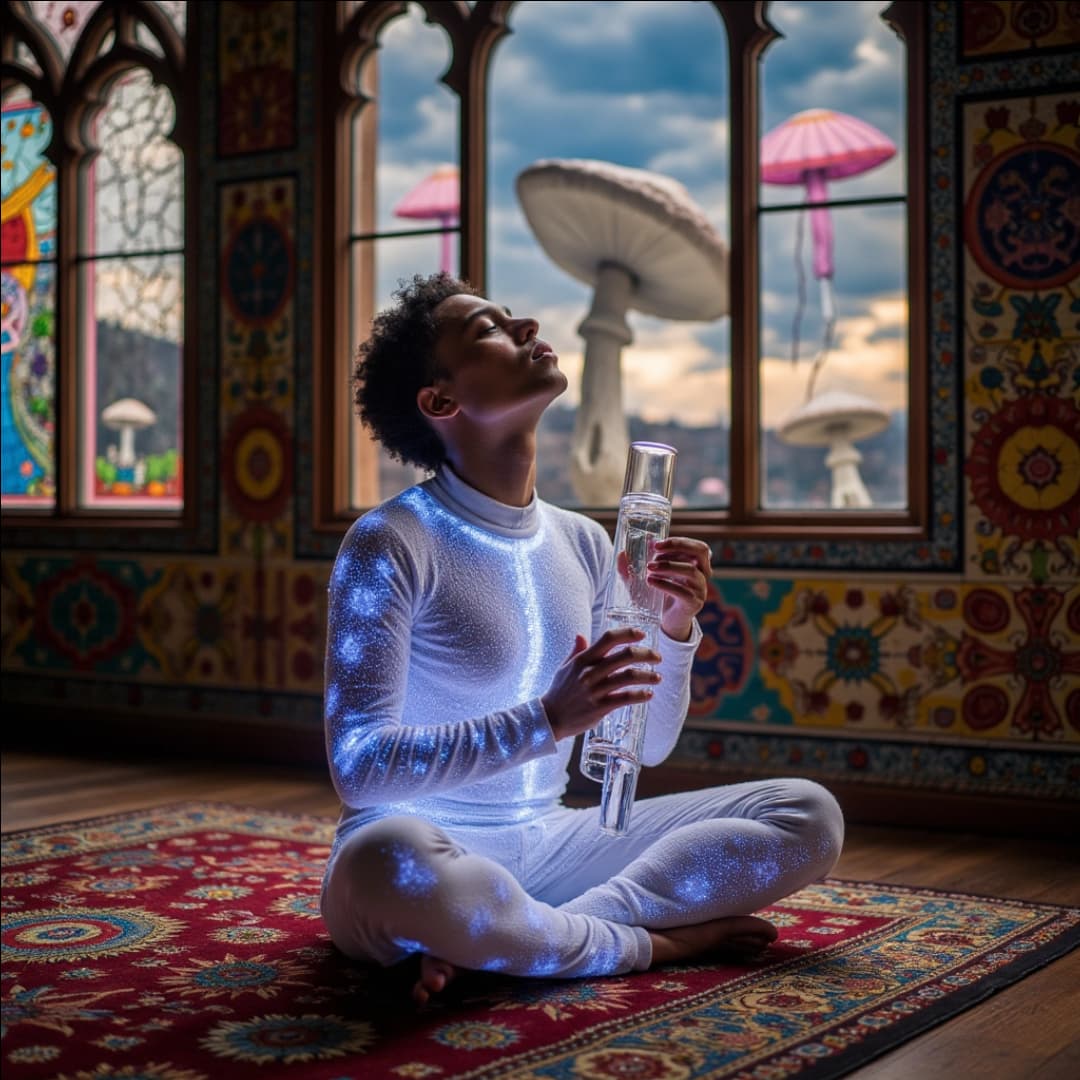
DESCRIPTION:
Circular breathing: Breathing alters states of consciousness, similar to psychedelics! Astonishing research findings on conscious breathing.
Circular breathing and breathing exercises: Can conscious breathing change your consciousness?
Our breathing is much more than just the physiological supply of oxygen. It is the bridge between body and mind. In this article, we delve deep into the world of breathwork. We shed light on the fascinating technique of circular breathing, from its origins in didgeridoo playing to modern therapeutic approaches. Learn how breathing influences what we feel, how special breathing techniques can change consciousness, and why it is worthwhile to relearn how to breathe to find inner balance.
What do we actually mean by breathing, and how does it work?
Breathing is a basic function of living beings. From our first cry to our last breath, breathing accompanies us throughout our lives. On average, we take about 12 to 18 breaths per minute, often without even noticing. This process is mainly controlled by the autonomic nervous system, which means we don't have to think about it to stay alive. But this is precisely where the hidden potential lies: breathing is one of the few bodily functions that can be controlled both autonomously and voluntarily.
When we inhale, the diaphragm lowers, the lungs fill with air, and oxygen enters the blood. When we exhale, the diaphragm relaxes and the air used, enriched with carbon dioxide, leaves the body. This gas exchange is essential for our metabolism. But the way we breathe, whether shallowly into the chest or deeply into the abdomen (abdominal breathing), sends significant signals to our brain.
A calm, deep breathing pattern signals safety to the body. It activates the parasympathetic nervous system, which is responsible for rest and digestion. Hectic, shallow breathing, on the other hand, puts us on alert. If we understand how this mechanism works, we can consciously intervene. We can learn to switch from a state of stress to relaxation through deliberately controlled breathing exercises, or vice versa, to mobilise energy.
How can we breathe consciously and control the nervous system?
Conscious breathing means directing our attention from the outside to the inside. In everyday life, we often breathe shallowly and irregularly, which can exacerbate stress-related symptoms. However, when we begin to consciously pay attention to our inhalation and exhalation, we take control of our nervous system.
A straightforward method is to slow down your breathing rate. Slow breathing (e.g. 6 breaths per minute) synchronises your heart rate and brain waves. This is called coherence. When we practise lengthening our breath, especially our exhalation, we activate our body's "brake lever", the vagus nerve.
But there is also the opposite: techniques that activate the system. This is where mouth breathing often comes into play, as it delivers a higher air volume than nasal breathing. Such methods are frequently used therapeutically to release blockages. It is essential to understand that any change in breathing has a direct effect on our physiology. We can use our breath to calm ourselves, focus, or put ourselves in an energetic state.
What are the historical origins of circular breathing?
The term circular breathing is used today in two very different contexts. Initially, it described a technique that produces a continuous flow of air from the mouth while simultaneously inhaling through the nose. The origins of circular breathing are ancient and closely linked to instrument making and traditional crafts.
The best-known example is the didgeridoo of the Australian Aborigines. Players use this technique to produce the typical, uninterrupted drone tone. But it is also used in Western wind instruments. Historically, however, the method was not only relevant to music. In craftsmanship, circular breathing used to play an important role, for example, in goldsmithing or glassblowing, where a steady flame had to be maintained with a soldering pipe.
An interesting historical detail is the change in this technique in the commercial sector. The use of circular breathing has declined sharply, especially since industrialisation. Especially since the introduction of bottled gases and modern burners, the need to maintain manual (or oral) airflow has become obsolete. While it almost disappeared in crafts, it experienced a renaissance in music, as it allows soloists on instruments such as the oboe or clarinet to play endless phrases without having to pause to breathe.
In the past, orchestras used a different technique: forming larger ensembles and so-called choral breathing enabled a continuous soundscape. In choral breathing, the musicians in a voice group take turns so that they never all take a break at the same time. Circular breathing allows the individual to do this.
How can the technique of circular breathing be practised and learned?
Technical circular breathing can be practised using simple aids. The principle is physically simple, but requires good coordination: with this technique, the person blows air into their puffed-out cheeks. While they push air out of their mouths with their cheek muscles, they inhale new air through their noses at lightning speed.
This can be easily learned with a straw in a glass of water. The aim is to keep the bubbles in the water constant, even while breathing in through the nose. The critical moment is the transition: pushing the air out of the cheeks while simultaneously breathing in through the nose requires the soft palate and tongue muscles to be decoupled.
Not all instruments are equally suitable for circular breathing. Instruments with high blowing resistance (such as the oboe or trumpet) make the process easier, as the counterpressure helps to 'park' the air in the cheeks. Instruments such as the flute or recorder have little resistance; in these instruments, the air escapes very quickly. They only exhibit limited counterpressure behaviour. The technique is therefore more straightforward with instruments that have excellent counterpressure behaviour; with the flute, it is a masterstroke. A sign of a lack of control here would be if the tone wobbles or breaks off during inhalation—those who have mastered this technique separate breathing from the necessary mouth movements almost completely.
Is circular breathing more than just a technique for musicians?
In recent years, and increasingly in the past two decades, the term has changed. When we talk about circular breathing in a therapeutic context or in yoga today, we often mean what is known as high-ventilation breathwork, or "connected breathing". This is not about storing air in the cheeks, but about a seamless breathing rhythm: inhalation and exhalation flow smoothly into each other without pauses.
Circular breathing in this form experienced a resurgence thanks to pioneers of breathwork such as Stanislav Grof (holotropic breathing) and Leonard Orr (rebirthing). Here, breathing is used as a tool for self-exploration. This form of breathwork is practised to release emotional blockages and gain insights.
It is essential to distinguish between these two definitions. While musicians use circular breathing for an external purpose (the infinite tone), psychotherapy and self-awareness use connected breathing for an internal process. The technique of circular breathing can therefore be applied in two completely different ways: once for external art, once for internal healing.
How does breathing affect the body and blood pressure?
In therapeutic circular breathing (connected breathing), we often breathe faster and deeper than usual. This rapid breathing leads to a physiological chain reaction. Increased ventilation causes more carbon dioxide to be exhaled than the body produces during metabolism—the carbon dioxide level in the blood drops (hypocapnia).
This may sound crazy, but although the oxygen content in the blood is usually almost 100% anyway and remains high due to the rapid breathing, the lack of CO₂ causes the blood vessels to constrict. In addition, oxygen binds more tightly to haemoglobin (the Bohr effect) and is less readily released to the tissue.
The effect is noticeable: many people experience tingling in their hands or on their faces. Surprisingly, the heart rate and blood pressure often do not drop; instead, the body enters a state of sympathetic activation, a form of controlled stress. This is intentional to "shake up" the system. It is impressive how purely mechanical breathing triggers biochemical processes that we otherwise only know from extreme situations.
Can breathing techniques change consciousness?
Yes, that is one of the main reasons why people seek out these intensive breathing techniques. The goal is often to change consciousness without taking substances. When the CO₂ level drops as a result of the hyperventilation described above (within a controlled setting), blood flow to the brain changes.
Studies show that activity in the so-called "default mode network" (DMN), the resting state network of our brain responsible for rumination and the ego, is remarkably reduced. At the same time, research shows changes in blood flow in the right amygdala (our fear centre) and the anterior hippocampus (responsible for memory and emotions).
Reduced activity in the "critical mind" (DMN) allows content from the unconscious to surface. The unconscious material, be it repressed memories or emotions, becomes accessible. The bridge between body and mind becomes more permeable. In this state, practitioners often report visual phenomena, profound emotional breakthroughs or spiritual experiences. The altered blood flow and neurochemical changes create a state of increased plasticity, allowing old patterns to be overwritten.
What role do breathing techniques play therapeutically in stress?
When used therapeutically, breathing exercises are a powerful tool. In clinical contexts in Berlin and worldwide, breathwork is often used to support the treatment of anxiety disorders, depression or trauma. But caution is advised: while gentle techniques (long exhalations) have a calming effect, intense circular breathing confronts issues.
Many people also store stress and trauma physically. A chronically tense diaphragm or shallow chest breathing are physical manifestations of psychological stress. Intensive breathing floods the body with energy. This can lead to a cathartic release, whether through crying, laughing or trembling.
This process helps to remove the "charge" from the nervous system. An intensive session is usually followed by a long phase of deep relaxation, during which the parasympathetic system takes over. The positive effects range from a feeling of lightness and reduced anxiety to a deeper understanding of one's own psyche. It is work at the core: the body and psyche are addressed equally.
What happens if you breathe too hard and too shallowly?
Despite the many advantages, caution is advised. If too much carbon dioxide is exhaled too quickly during heavy, shallow breathing, hyperventilation occurs, leading to tetany and the famous "paw position" of the hands (cramps). This is harmless and reversible as soon as you breathe normally. However, it isn’t very comforting.
It becomes difficult when someone panics or experiences retraumatisation because too much material from the subconscious comes up that cannot be integrated. Therefore, intensive breathing work (such as holotropic breathing or rebirthing) should only be practised under the guidance of experienced therapists.
Caution is also advised in cases of pre-existing conditions (cardiovascular disease, epilepsy, pregnancy). The intense physical reaction, the rise (and subsequent fall) in blood pressure and heart rate, places a strain on the body. Lack of control over breathing in everyday life (chronic hyperventilation) is a clinical condition, whereas conscious, temporary use of breathing techniques can be a remedy.
How can I find inner balance through breathing exercises?
It doesn't always have to be an intense, mind-altering session. A few minutes are often enough for daily inner balance. Simple breathing techniques such as 4-7-8 breathing (inhale for 4 seconds, hold for 7, exhale for 8) or box breathing work wonders.
By consciously using breaks in our daily routine to pay attention to our breathing, we anchor ourselves in the here and now. We notice more quickly when we are stressed (shallow breathing) and can counteract it. Deep inhalation and, above all, complete exhalation signal to the body: "Everything is okay."
Conscious breathing increases self-confidence. We are not helplessly at the mercy of our feelings and states of mind. We have a tool right under our noses. Whether we want to learn technical circular breathing to play the didgeridoo or use therapeutic breathing to heal old wounds, breathing is the key. It is the constant that accompanies us and the medium through which we can regulate ourselves.
The most important things at a glance
Duality of the term: Circular breathing technically refers to continuous blowing (in music), therapeutically to connected breathing without pauses.
Physiology: Rapid breathing lowers CO₂ levels, alters pH values and blood flow in the brain (hyperventilation).
Brain: Activity in the default mode network decreases, which can alter consciousness and trigger states of consciousness such as meditation or trance.
Technique: Musical circular breathing uses the cheeks as bellows (air supply) while breathing through the nose (e.g. didgeridoo, transverse flute).
Therapy: Breathing exercises act as a bridge between the body and the psyche, can help release emotions, and can help with stress.
Safety: Due to strong physical reactions (e.g., blood pressure and dizziness), intensive techniques should only be practised under supervision and in good health.
Everyday life: Conscious breathing (a long exhalation) activates the parasympathetic nervous system and promotes inner balance.
RELATED ARTICLES:
DESCRIPTION:
Circular breathing: Breathing alters states of consciousness, similar to psychedelics! Astonishing research findings on conscious breathing.
Circular breathing and breathing exercises: Can conscious breathing change your consciousness?
Our breathing is much more than just the physiological supply of oxygen. It is the bridge between body and mind. In this article, we delve deep into the world of breathwork. We shed light on the fascinating technique of circular breathing, from its origins in didgeridoo playing to modern therapeutic approaches. Learn how breathing influences what we feel, how special breathing techniques can change consciousness, and why it is worthwhile to relearn how to breathe to find inner balance.
What do we actually mean by breathing, and how does it work?
Breathing is a basic function of living beings. From our first cry to our last breath, breathing accompanies us throughout our lives. On average, we take about 12 to 18 breaths per minute, often without even noticing. This process is mainly controlled by the autonomic nervous system, which means we don't have to think about it to stay alive. But this is precisely where the hidden potential lies: breathing is one of the few bodily functions that can be controlled both autonomously and voluntarily.
When we inhale, the diaphragm lowers, the lungs fill with air, and oxygen enters the blood. When we exhale, the diaphragm relaxes and the air used, enriched with carbon dioxide, leaves the body. This gas exchange is essential for our metabolism. But the way we breathe, whether shallowly into the chest or deeply into the abdomen (abdominal breathing), sends significant signals to our brain.
A calm, deep breathing pattern signals safety to the body. It activates the parasympathetic nervous system, which is responsible for rest and digestion. Hectic, shallow breathing, on the other hand, puts us on alert. If we understand how this mechanism works, we can consciously intervene. We can learn to switch from a state of stress to relaxation through deliberately controlled breathing exercises, or vice versa, to mobilise energy.
How can we breathe consciously and control the nervous system?
Conscious breathing means directing our attention from the outside to the inside. In everyday life, we often breathe shallowly and irregularly, which can exacerbate stress-related symptoms. However, when we begin to consciously pay attention to our inhalation and exhalation, we take control of our nervous system.
A straightforward method is to slow down your breathing rate. Slow breathing (e.g. 6 breaths per minute) synchronises your heart rate and brain waves. This is called coherence. When we practise lengthening our breath, especially our exhalation, we activate our body's "brake lever", the vagus nerve.
But there is also the opposite: techniques that activate the system. This is where mouth breathing often comes into play, as it delivers a higher air volume than nasal breathing. Such methods are frequently used therapeutically to release blockages. It is essential to understand that any change in breathing has a direct effect on our physiology. We can use our breath to calm ourselves, focus, or put ourselves in an energetic state.
What are the historical origins of circular breathing?
The term circular breathing is used today in two very different contexts. Initially, it described a technique that produces a continuous flow of air from the mouth while simultaneously inhaling through the nose. The origins of circular breathing are ancient and closely linked to instrument making and traditional crafts.
The best-known example is the didgeridoo of the Australian Aborigines. Players use this technique to produce the typical, uninterrupted drone tone. But it is also used in Western wind instruments. Historically, however, the method was not only relevant to music. In craftsmanship, circular breathing used to play an important role, for example, in goldsmithing or glassblowing, where a steady flame had to be maintained with a soldering pipe.
An interesting historical detail is the change in this technique in the commercial sector. The use of circular breathing has declined sharply, especially since industrialisation. Especially since the introduction of bottled gases and modern burners, the need to maintain manual (or oral) airflow has become obsolete. While it almost disappeared in crafts, it experienced a renaissance in music, as it allows soloists on instruments such as the oboe or clarinet to play endless phrases without having to pause to breathe.
In the past, orchestras used a different technique: forming larger ensembles and so-called choral breathing enabled a continuous soundscape. In choral breathing, the musicians in a voice group take turns so that they never all take a break at the same time. Circular breathing allows the individual to do this.
How can the technique of circular breathing be practised and learned?
Technical circular breathing can be practised using simple aids. The principle is physically simple, but requires good coordination: with this technique, the person blows air into their puffed-out cheeks. While they push air out of their mouths with their cheek muscles, they inhale new air through their noses at lightning speed.
This can be easily learned with a straw in a glass of water. The aim is to keep the bubbles in the water constant, even while breathing in through the nose. The critical moment is the transition: pushing the air out of the cheeks while simultaneously breathing in through the nose requires the soft palate and tongue muscles to be decoupled.
Not all instruments are equally suitable for circular breathing. Instruments with high blowing resistance (such as the oboe or trumpet) make the process easier, as the counterpressure helps to 'park' the air in the cheeks. Instruments such as the flute or recorder have little resistance; in these instruments, the air escapes very quickly. They only exhibit limited counterpressure behaviour. The technique is therefore more straightforward with instruments that have excellent counterpressure behaviour; with the flute, it is a masterstroke. A sign of a lack of control here would be if the tone wobbles or breaks off during inhalation—those who have mastered this technique separate breathing from the necessary mouth movements almost completely.
Is circular breathing more than just a technique for musicians?
In recent years, and increasingly in the past two decades, the term has changed. When we talk about circular breathing in a therapeutic context or in yoga today, we often mean what is known as high-ventilation breathwork, or "connected breathing". This is not about storing air in the cheeks, but about a seamless breathing rhythm: inhalation and exhalation flow smoothly into each other without pauses.
Circular breathing in this form experienced a resurgence thanks to pioneers of breathwork such as Stanislav Grof (holotropic breathing) and Leonard Orr (rebirthing). Here, breathing is used as a tool for self-exploration. This form of breathwork is practised to release emotional blockages and gain insights.
It is essential to distinguish between these two definitions. While musicians use circular breathing for an external purpose (the infinite tone), psychotherapy and self-awareness use connected breathing for an internal process. The technique of circular breathing can therefore be applied in two completely different ways: once for external art, once for internal healing.
How does breathing affect the body and blood pressure?
In therapeutic circular breathing (connected breathing), we often breathe faster and deeper than usual. This rapid breathing leads to a physiological chain reaction. Increased ventilation causes more carbon dioxide to be exhaled than the body produces during metabolism—the carbon dioxide level in the blood drops (hypocapnia).
This may sound crazy, but although the oxygen content in the blood is usually almost 100% anyway and remains high due to the rapid breathing, the lack of CO₂ causes the blood vessels to constrict. In addition, oxygen binds more tightly to haemoglobin (the Bohr effect) and is less readily released to the tissue.
The effect is noticeable: many people experience tingling in their hands or on their faces. Surprisingly, the heart rate and blood pressure often do not drop; instead, the body enters a state of sympathetic activation, a form of controlled stress. This is intentional to "shake up" the system. It is impressive how purely mechanical breathing triggers biochemical processes that we otherwise only know from extreme situations.
Can breathing techniques change consciousness?
Yes, that is one of the main reasons why people seek out these intensive breathing techniques. The goal is often to change consciousness without taking substances. When the CO₂ level drops as a result of the hyperventilation described above (within a controlled setting), blood flow to the brain changes.
Studies show that activity in the so-called "default mode network" (DMN), the resting state network of our brain responsible for rumination and the ego, is remarkably reduced. At the same time, research shows changes in blood flow in the right amygdala (our fear centre) and the anterior hippocampus (responsible for memory and emotions).
Reduced activity in the "critical mind" (DMN) allows content from the unconscious to surface. The unconscious material, be it repressed memories or emotions, becomes accessible. The bridge between body and mind becomes more permeable. In this state, practitioners often report visual phenomena, profound emotional breakthroughs or spiritual experiences. The altered blood flow and neurochemical changes create a state of increased plasticity, allowing old patterns to be overwritten.
What role do breathing techniques play therapeutically in stress?
When used therapeutically, breathing exercises are a powerful tool. In clinical contexts in Berlin and worldwide, breathwork is often used to support the treatment of anxiety disorders, depression or trauma. But caution is advised: while gentle techniques (long exhalations) have a calming effect, intense circular breathing confronts issues.
Many people also store stress and trauma physically. A chronically tense diaphragm or shallow chest breathing are physical manifestations of psychological stress. Intensive breathing floods the body with energy. This can lead to a cathartic release, whether through crying, laughing or trembling.
This process helps to remove the "charge" from the nervous system. An intensive session is usually followed by a long phase of deep relaxation, during which the parasympathetic system takes over. The positive effects range from a feeling of lightness and reduced anxiety to a deeper understanding of one's own psyche. It is work at the core: the body and psyche are addressed equally.
What happens if you breathe too hard and too shallowly?
Despite the many advantages, caution is advised. If too much carbon dioxide is exhaled too quickly during heavy, shallow breathing, hyperventilation occurs, leading to tetany and the famous "paw position" of the hands (cramps). This is harmless and reversible as soon as you breathe normally. However, it isn’t very comforting.
It becomes difficult when someone panics or experiences retraumatisation because too much material from the subconscious comes up that cannot be integrated. Therefore, intensive breathing work (such as holotropic breathing or rebirthing) should only be practised under the guidance of experienced therapists.
Caution is also advised in cases of pre-existing conditions (cardiovascular disease, epilepsy, pregnancy). The intense physical reaction, the rise (and subsequent fall) in blood pressure and heart rate, places a strain on the body. Lack of control over breathing in everyday life (chronic hyperventilation) is a clinical condition, whereas conscious, temporary use of breathing techniques can be a remedy.
How can I find inner balance through breathing exercises?
It doesn't always have to be an intense, mind-altering session. A few minutes are often enough for daily inner balance. Simple breathing techniques such as 4-7-8 breathing (inhale for 4 seconds, hold for 7, exhale for 8) or box breathing work wonders.
By consciously using breaks in our daily routine to pay attention to our breathing, we anchor ourselves in the here and now. We notice more quickly when we are stressed (shallow breathing) and can counteract it. Deep inhalation and, above all, complete exhalation signal to the body: "Everything is okay."
Conscious breathing increases self-confidence. We are not helplessly at the mercy of our feelings and states of mind. We have a tool right under our noses. Whether we want to learn technical circular breathing to play the didgeridoo or use therapeutic breathing to heal old wounds, breathing is the key. It is the constant that accompanies us and the medium through which we can regulate ourselves.
The most important things at a glance
Duality of the term: Circular breathing technically refers to continuous blowing (in music), therapeutically to connected breathing without pauses.
Physiology: Rapid breathing lowers CO₂ levels, alters pH values and blood flow in the brain (hyperventilation).
Brain: Activity in the default mode network decreases, which can alter consciousness and trigger states of consciousness such as meditation or trance.
Technique: Musical circular breathing uses the cheeks as bellows (air supply) while breathing through the nose (e.g. didgeridoo, transverse flute).
Therapy: Breathing exercises act as a bridge between the body and the psyche, can help release emotions, and can help with stress.
Safety: Due to strong physical reactions (e.g., blood pressure and dizziness), intensive techniques should only be practised under supervision and in good health.
Everyday life: Conscious breathing (a long exhalation) activates the parasympathetic nervous system and promotes inner balance.
RELATED ARTICLES:
Newsletter
Would you like to be notified when I publish a new blog post? Sign up here.
Click "Subscribe for free" if you have read and accepted my privacy policy. You can revoke your consent at any time.
Newsletter
Would you like to be notified when I publish a new blog post? Sign up here.
Click "Subscribe for free" if you have read and accepted my privacy policy. You can revoke your consent at any time.