Nonnamaxxing
Nonnamaxxing: The trend on TikTok and Instagram for a healthy Italian-style lifestyle – Grandma as an escape fantasy
Nonnamaxxing: The trend on TikTok and Instagram for a healthy Italian-style lifestyle – Grandma as an escape fantasy
DESCRIPTION:
Nonnamaxxing: Nonnamaxxing is the viral TikTok trend where Gen Z wants to live the way an Italian grandmother imagines – pasta, knitting, the slow life. What’s behind the videos? Is the idea behind it even accurate?
Nonnamaxxing: The TikTok trend of a supposed Italian life – the grandmother as an escape fantasy for the exhausted
The latest self-improvement trend among Gen Z is to become a completely imagined Italian grandmother. Nonnamaxxing – Newsweek and The Conversation have just dedicated front-page stories to the phenomenon. Daydreams completely detached from reality: handmade pasta, long lunches, gardening, knitting and crocheting, church attendance optional, mobile phone far away, cardigan instead of athleisure – but, of course, completely effortless. Young women are staging a life on TikTok that their grandmothers supposedly led, and explicitly framing it as a response to hustle culture and as a question of “what progress and feminism have actually achieved”. You can smile at it. But you should only do so after you’ve understood what’s at stake here, because the Nonna is already the third female dropout figure in three years, and there’s a pattern to this series.
What is Nonnamaxxing, and where does the trend come from?
The term Nonnamaxxing is a combination of the Italian word for grandmother (nonna) and the suffix ‘-maxxing’, which has a long history of its own and constitutes a cultural diagnosis in its own right. It originates from the ‘Looksmaxxing’ scene, where it referred to the aggressive maximisation of one’s own attractiveness: jawlines, skincare regimens, and, in extreme cases, surgical procedures. Then came ‘Solo-Maxxing’: the maximisation of being alone as a response to dating fatigue. Now, then, ‘Nonna’, in the wake of the related trend ‘Nonna Summer’: the maximisation of grandmotherliness. The direction has reversed, away from the market rather than towards it, but the grammar has remained the same. Even opting out is treated as a project, with the aim of maximising and optimising life: routines, aesthetics, and content calendars. Those who opt out do so in front of an audience.
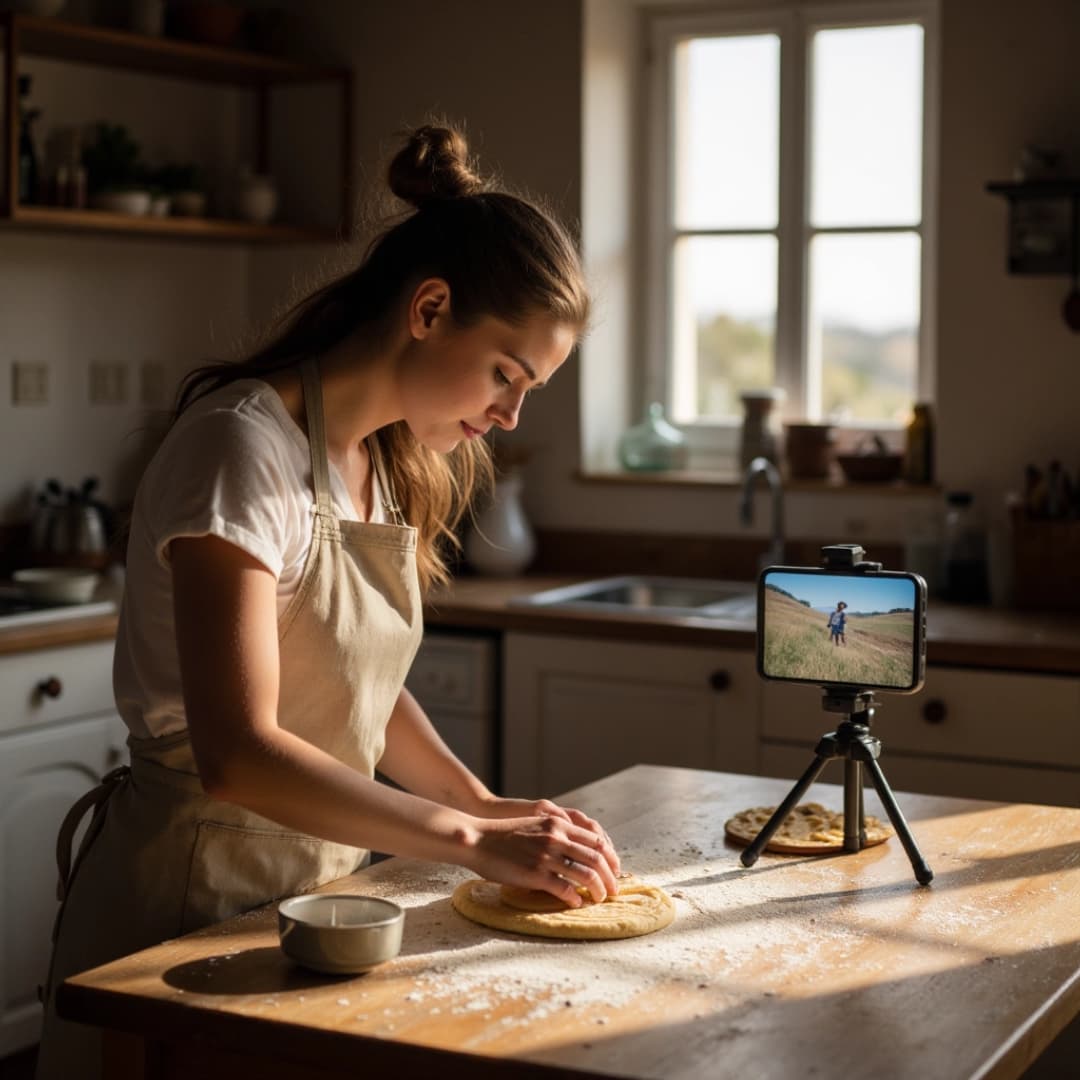
That is what distinguishes this trend from genuine deceleration. The nonna on TikTok and Instagram isn’t simply cooking; she is producing the image of a cook in videos designed to rack up likes. The sugo may be real, but its purpose is the video. It is slowness in high-performance format: meticulously staged, bathed in golden light, algorithmically rewarded. Minimalist ‘screen time as content that takes place on the screen – the contradiction is the whole point. Baudrillard would have been delighted: a life is simulated that never actually existed – more on that later – and the simulation is more successful on social media than any original could ever be.
Is Nonnamaxxing the little sister of the Tradwife?
The kinship is obvious, the difference revealing. The Tradwife wave, with billions of views and its offshoot the Stay-at-Home-Girlfriend, stages the return of women to the kitchen and domestic life as romantic subordination. There is a man who provides, and a woman who surrenders herself. Research and commentary have long interpreted this as fantasy escapism, as an escape fantasy for women stuck in commuting wage jobs and the housing crisis, to whom the narrative “feminism has brought this on you” offers a scapegoat.
The ‘Nonna’ fantasy takes over the idyll and removes the husband. No subordination, no patriarchy, no provider, just the abstruse, genderless image of a woman, a garden, food. This makes it more accessible and ideologically less suspect: a ‘tradwife’ without a marriage certificate. But the operation is the same: an unmanageable present is swapped for an invented past. And what remains is an absurd collective fantasy. In 2026, slowness is a luxury good—those who can afford it either have wealth or are striving for monetisation. The real women who today cook, clean and care for others without pay do not feature in this aesthetic. The ‘Nonna’ performance converts ostentatious leisure into symbolic capital: Look, I can afford not to rush about. Bourdieu’s distinction, genderless, childless, but covered in flour dust.
Which grandmother is actually being imitated here?
The historical punchline: none that ever existed. The real Italian grandmother of the imitated generation did not live a life of deceleration; she did physical labour under conditions that today’s health and safety laws would prohibit: subsistence farming, caring for extended families without machinery, poverty, premature physical wear and tear, hardly any rights of her own, no money of her own. The long lunch that TikTok references was not a mindfulness practice but a break between two unpaid shifts. Laundry and pasta were done by hand because machines were unaffordable, not because manual labour is fulfilling.
The fantasy only works because of this omission. It strips a historical way of life of its hardship and retains the aesthetics, like the farmhouse style, without the smell of the barn. That is not reprehensible; every longing works with idealisation. But it is worth noting that this longing seeks, of all things, a life whose central feature was not slowness, but constraint, hard work, rigid roles, fixed rhythms, fixed ties, and pressure to conform with no room for possibility. The Nonna did not have to figure out who she was. This is precisely what a generation dreams of: a generation that suffers from nothing more than the obligation to become someone constantly.
What we can really learn from the Italian Nonna: the Blue Zone question
This is where the trend becomes more interesting than its critics would admit. The Italian nonna has a genuine scientific basis, and that is called the Blue Zone. Italy is one of the countries with the highest life expectancy in the world, and in Sardinia, in the province of Nuoro, a striking number of people are over 100 years old; the demographer Gianni Pes demonstrated this in studies as early as the 1990s. Sardinia is thus one of the few ‘Blue Zones’ on Earth where reaching the age of 100 is not an isolated case.
The factors described in the longevity research read like a script for Nonnamaxxing: close, shared social connections with family at the centre of life, a predominantly plant-based diet, regular natural exercise rather than the gym, low stress levels, a sense of being needed and useful, and a sense of purpose in life – public health evidence, rather than social media aesthetics. Anyone who strengthens these factors in their life is demonstrably doing something positive for their health; several of these variables are among the best-documented protective factors of all, against cardiovascular disease as well as depression.
However, in the Blue Zone, none of this is an attitude one chooses, and certainly not the content one posts. It is an established fabric of work, duty and belonging into which one is born. The Sardinian centenarian does not engage in ‘Nonnamaxxing’. She lives and works hard. That is precisely what can be learned from her, and that is precisely what cannot be recreated by filming it.
What does the trend say about the exhaustion underlying it?
If you take the series as a whole – Tradwife, Stay-at-Home-Girlfriend, Solo-Maxxing, Micro-Retirement, Nonnamaxxing – the real picture emerges: it is a flood of female fantasies of opting out, and it is rising in proportion to the extent to which the promised paths to a good life are becoming implausible. When paid work no longer reliably provides for prosperity, housing or a pension, the promise of achievement loses its hold, and the psyche seeks counter-images. This strikes a chord in Germany too: the housing crisis, pension anxiety and a society in perpetual optimisation mode form the very same sounding board on which the pressure to be constantly productive turns into a longing for its opposite. It is no coincidence that these counter-images are regressive, that is, they look backwards: the future has failed as a projection screen. Those who can no longer imagine anything ahead turn to the past.
From a clinical perspective, the ‘Nonna fantasy’ is a symptom: a legitimate need for rhythm instead of rhythm, for working with one’s hands, for a low level of stimulation, for an everyday life that is not called into question. This is not about nostalgic fantasies; it is about precisely those factors that exhaustion research recognises as protective factors. But this need is not addressed as a change in one’s own life, but as the consumption of an image. One follows the Nonna instead of becoming one. The fantasy provides relief and thereby cements exactly the state from which it seeks to escape.
How do you distinguish a genuine need from a purchased idyll?
The rule of thumb is that the need is what remains when you turn off the IG camera. Anyone who only kneads the dough as long as the lighting is right has yet another optimisation project, and will repeat the disappointment of the previous one. The questions behind this are uncomfortably concrete: which three hours of my week could I actually slow down, and what would I have to cancel to do so? Which hands-on activity sustains me: cooking, digging, repairing, knitting – as an act in itself, not as a result? And: with whom? The traditional nonna was never alone; the TikTok nonna almost always is. Slowing down without connection is just loneliness in a pretty apron.
The trend is right insofar as it points to a real wound. The answer isn’t in the feed. It lies in the laborious, unphotogenic work, one’s own rhythm of life, manual labour and a sense of belonging, rather than in the aesthetic work of art of the moment. The real Nonna, if she ever existed, would have merely shrugged at the word ‘lifestyle’. She would have asked if you’d eaten yet.
Summary: Nonnamaxxing, Tradwife and the Dropout Fantasy
· Nonnamaxxing (Newsweek, 2026) is the latest TikTok trend centred on the female ‘dropout’ fantasy: Gen Z women are staging a ‘grandmother’s life’ – pasta, gardening, an offline daily routine – as a response to hustle culture and burnout.
· The ‘-maxxing’ suffix has evolved from ‘Looksmaxxing’ (optimisation for the market) via ‘Solo-Maxxing’ (optimised retreat) to ‘Nonnamaxxing’: the direction has reversed, but the grammar of optimisation remains. Even this escape takes place in front of an audience.
· Connection to the ‘tradwife’ wave: the same escape from an unmanageable present into an invented past, but without a husband or subordination, making it ideologically more accessible.
· Class issue: slowness is a luxury good; demonstrative leisure is converted into symbolic capital (Bourdieu). Real-life care workers do not feature in the aesthetic.
· Historically, a grandmother is imitated who never existed: the real life of a nonna was subsistence work, poverty and a structure of duty; the fantasy retains the aesthetic and erases the hardship. What is longed for is not so much slowness as a sense of belonging: not having to become someone constantly.
· The trend series (Tradwife, Solo-Maxxing, Micro-Retirement, Nonna) is growing because the promise of performance is becoming implausible; regressive counter-images emerge where the future fails as a projection screen.
· The true core of the symptom: legitimate needs for rhythm, manual labour, low levels of stimulation and an unquestionable daily routine – empirically known protective factors against exhaustion.
· Blue Zone reference: Italy is among the countries with the highest life expectancy; Sardinia (Nuoro province) is a ‘Blue Zone’ with many people over 100 years old (Gianni Pes). The factors described there – social connectedness, physical activity, low stress, and a sense of purpose – are genuine health-protective factors. Crucial: In the Blue Zone, this is an established way of life, not a lifestyle choice or content to post.
· Rule of thumb: What the camera doesn't see is real. Slowing down with genuine connection rather than consuming an idyll; deceleration without a sense of belonging is merely loneliness dressed up in a pretty apron.
Related
DESCRIPTION:
Nonnamaxxing: Nonnamaxxing is the viral TikTok trend where Gen Z wants to live the way an Italian grandmother imagines – pasta, knitting, the slow life. What’s behind the videos? Is the idea behind it even accurate?
Nonnamaxxing: The TikTok trend of a supposed Italian life – the grandmother as an escape fantasy for the exhausted
The latest self-improvement trend among Gen Z is to become a completely imagined Italian grandmother. Nonnamaxxing – Newsweek and The Conversation have just dedicated front-page stories to the phenomenon. Daydreams completely detached from reality: handmade pasta, long lunches, gardening, knitting and crocheting, church attendance optional, mobile phone far away, cardigan instead of athleisure – but, of course, completely effortless. Young women are staging a life on TikTok that their grandmothers supposedly led, and explicitly framing it as a response to hustle culture and as a question of “what progress and feminism have actually achieved”. You can smile at it. But you should only do so after you’ve understood what’s at stake here, because the Nonna is already the third female dropout figure in three years, and there’s a pattern to this series.
What is Nonnamaxxing, and where does the trend come from?
The term Nonnamaxxing is a combination of the Italian word for grandmother (nonna) and the suffix ‘-maxxing’, which has a long history of its own and constitutes a cultural diagnosis in its own right. It originates from the ‘Looksmaxxing’ scene, where it referred to the aggressive maximisation of one’s own attractiveness: jawlines, skincare regimens, and, in extreme cases, surgical procedures. Then came ‘Solo-Maxxing’: the maximisation of being alone as a response to dating fatigue. Now, then, ‘Nonna’, in the wake of the related trend ‘Nonna Summer’: the maximisation of grandmotherliness. The direction has reversed, away from the market rather than towards it, but the grammar has remained the same. Even opting out is treated as a project, with the aim of maximising and optimising life: routines, aesthetics, and content calendars. Those who opt out do so in front of an audience.
That is what distinguishes this trend from genuine deceleration. The nonna on TikTok and Instagram isn’t simply cooking; she is producing the image of a cook in videos designed to rack up likes. The sugo may be real, but its purpose is the video. It is slowness in high-performance format: meticulously staged, bathed in golden light, algorithmically rewarded. Minimalist ‘screen time as content that takes place on the screen – the contradiction is the whole point. Baudrillard would have been delighted: a life is simulated that never actually existed – more on that later – and the simulation is more successful on social media than any original could ever be.
Is Nonnamaxxing the little sister of the Tradwife?
The kinship is obvious, the difference revealing. The Tradwife wave, with billions of views and its offshoot the Stay-at-Home-Girlfriend, stages the return of women to the kitchen and domestic life as romantic subordination. There is a man who provides, and a woman who surrenders herself. Research and commentary have long interpreted this as fantasy escapism, as an escape fantasy for women stuck in commuting wage jobs and the housing crisis, to whom the narrative “feminism has brought this on you” offers a scapegoat.
The ‘Nonna’ fantasy takes over the idyll and removes the husband. No subordination, no patriarchy, no provider, just the abstruse, genderless image of a woman, a garden, food. This makes it more accessible and ideologically less suspect: a ‘tradwife’ without a marriage certificate. But the operation is the same: an unmanageable present is swapped for an invented past. And what remains is an absurd collective fantasy. In 2026, slowness is a luxury good—those who can afford it either have wealth or are striving for monetisation. The real women who today cook, clean and care for others without pay do not feature in this aesthetic. The ‘Nonna’ performance converts ostentatious leisure into symbolic capital: Look, I can afford not to rush about. Bourdieu’s distinction, genderless, childless, but covered in flour dust.
Which grandmother is actually being imitated here?
The historical punchline: none that ever existed. The real Italian grandmother of the imitated generation did not live a life of deceleration; she did physical labour under conditions that today’s health and safety laws would prohibit: subsistence farming, caring for extended families without machinery, poverty, premature physical wear and tear, hardly any rights of her own, no money of her own. The long lunch that TikTok references was not a mindfulness practice but a break between two unpaid shifts. Laundry and pasta were done by hand because machines were unaffordable, not because manual labour is fulfilling.
The fantasy only works because of this omission. It strips a historical way of life of its hardship and retains the aesthetics, like the farmhouse style, without the smell of the barn. That is not reprehensible; every longing works with idealisation. But it is worth noting that this longing seeks, of all things, a life whose central feature was not slowness, but constraint, hard work, rigid roles, fixed rhythms, fixed ties, and pressure to conform with no room for possibility. The Nonna did not have to figure out who she was. This is precisely what a generation dreams of: a generation that suffers from nothing more than the obligation to become someone constantly.
What we can really learn from the Italian Nonna: the Blue Zone question
This is where the trend becomes more interesting than its critics would admit. The Italian nonna has a genuine scientific basis, and that is called the Blue Zone. Italy is one of the countries with the highest life expectancy in the world, and in Sardinia, in the province of Nuoro, a striking number of people are over 100 years old; the demographer Gianni Pes demonstrated this in studies as early as the 1990s. Sardinia is thus one of the few ‘Blue Zones’ on Earth where reaching the age of 100 is not an isolated case.
The factors described in the longevity research read like a script for Nonnamaxxing: close, shared social connections with family at the centre of life, a predominantly plant-based diet, regular natural exercise rather than the gym, low stress levels, a sense of being needed and useful, and a sense of purpose in life – public health evidence, rather than social media aesthetics. Anyone who strengthens these factors in their life is demonstrably doing something positive for their health; several of these variables are among the best-documented protective factors of all, against cardiovascular disease as well as depression.
However, in the Blue Zone, none of this is an attitude one chooses, and certainly not the content one posts. It is an established fabric of work, duty and belonging into which one is born. The Sardinian centenarian does not engage in ‘Nonnamaxxing’. She lives and works hard. That is precisely what can be learned from her, and that is precisely what cannot be recreated by filming it.
What does the trend say about the exhaustion underlying it?
If you take the series as a whole – Tradwife, Stay-at-Home-Girlfriend, Solo-Maxxing, Micro-Retirement, Nonnamaxxing – the real picture emerges: it is a flood of female fantasies of opting out, and it is rising in proportion to the extent to which the promised paths to a good life are becoming implausible. When paid work no longer reliably provides for prosperity, housing or a pension, the promise of achievement loses its hold, and the psyche seeks counter-images. This strikes a chord in Germany too: the housing crisis, pension anxiety and a society in perpetual optimisation mode form the very same sounding board on which the pressure to be constantly productive turns into a longing for its opposite. It is no coincidence that these counter-images are regressive, that is, they look backwards: the future has failed as a projection screen. Those who can no longer imagine anything ahead turn to the past.
From a clinical perspective, the ‘Nonna fantasy’ is a symptom: a legitimate need for rhythm instead of rhythm, for working with one’s hands, for a low level of stimulation, for an everyday life that is not called into question. This is not about nostalgic fantasies; it is about precisely those factors that exhaustion research recognises as protective factors. But this need is not addressed as a change in one’s own life, but as the consumption of an image. One follows the Nonna instead of becoming one. The fantasy provides relief and thereby cements exactly the state from which it seeks to escape.
How do you distinguish a genuine need from a purchased idyll?
The rule of thumb is that the need is what remains when you turn off the IG camera. Anyone who only kneads the dough as long as the lighting is right has yet another optimisation project, and will repeat the disappointment of the previous one. The questions behind this are uncomfortably concrete: which three hours of my week could I actually slow down, and what would I have to cancel to do so? Which hands-on activity sustains me: cooking, digging, repairing, knitting – as an act in itself, not as a result? And: with whom? The traditional nonna was never alone; the TikTok nonna almost always is. Slowing down without connection is just loneliness in a pretty apron.
The trend is right insofar as it points to a real wound. The answer isn’t in the feed. It lies in the laborious, unphotogenic work, one’s own rhythm of life, manual labour and a sense of belonging, rather than in the aesthetic work of art of the moment. The real Nonna, if she ever existed, would have merely shrugged at the word ‘lifestyle’. She would have asked if you’d eaten yet.
Summary: Nonnamaxxing, Tradwife and the Dropout Fantasy
· Nonnamaxxing (Newsweek, 2026) is the latest TikTok trend centred on the female ‘dropout’ fantasy: Gen Z women are staging a ‘grandmother’s life’ – pasta, gardening, an offline daily routine – as a response to hustle culture and burnout.
· The ‘-maxxing’ suffix has evolved from ‘Looksmaxxing’ (optimisation for the market) via ‘Solo-Maxxing’ (optimised retreat) to ‘Nonnamaxxing’: the direction has reversed, but the grammar of optimisation remains. Even this escape takes place in front of an audience.
· Connection to the ‘tradwife’ wave: the same escape from an unmanageable present into an invented past, but without a husband or subordination, making it ideologically more accessible.
· Class issue: slowness is a luxury good; demonstrative leisure is converted into symbolic capital (Bourdieu). Real-life care workers do not feature in the aesthetic.
· Historically, a grandmother is imitated who never existed: the real life of a nonna was subsistence work, poverty and a structure of duty; the fantasy retains the aesthetic and erases the hardship. What is longed for is not so much slowness as a sense of belonging: not having to become someone constantly.
· The trend series (Tradwife, Solo-Maxxing, Micro-Retirement, Nonna) is growing because the promise of performance is becoming implausible; regressive counter-images emerge where the future fails as a projection screen.
· The true core of the symptom: legitimate needs for rhythm, manual labour, low levels of stimulation and an unquestionable daily routine – empirically known protective factors against exhaustion.
· Blue Zone reference: Italy is among the countries with the highest life expectancy; Sardinia (Nuoro province) is a ‘Blue Zone’ with many people over 100 years old (Gianni Pes). The factors described there – social connectedness, physical activity, low stress, and a sense of purpose – are genuine health-protective factors. Crucial: In the Blue Zone, this is an established way of life, not a lifestyle choice or content to post.
· Rule of thumb: What the camera doesn't see is real. Slowing down with genuine connection rather than consuming an idyll; deceleration without a sense of belonging is merely loneliness dressed up in a pretty apron.
Related
Newsletter
Would you like to be notified when I publish a new blog post? Sign up here.
Click "Subscribe for free" if you have read and accepted my privacy policy. You can revoke your consent at any time.
Newsletter
Would you like to be notified when I publish a new blog post? Sign up here.
Click "Subscribe for free" if you have read and accepted my privacy policy. You can revoke your consent at any time.