The Myth of the Dragon Slayer
The Myth of the Dragon Slayer: A Cultural Analysis
The Myth of the Dragon Slayer: A Cultural Analysis
DESCRIPTION:
The dragon-slayer mythologem in cultures worldwide: An interpretation examines Otto König’s cultural ethology and the comparative mythological research of Dumézil, Watkins, Gunkel and Fontenrose.
The Myth of the Dragon Slayer – A Cultural-Ethological and Mythological Analysis
From the Norse Sigurd to the Germanic Siegfried and the Christian Saint George, from the Babylonian Marduk to the Japanese Susanoo: time and again, a hero slays a monster. Why does this motif appear with astonishing regularity across cultures, eras and religions? A cultural-ethological search for clues.
What is a mythologem – and why specifically the dragon slayer?
The term ‘mythologem’, coined by the religious scholar Karl Kerényi, refers to a recurring narrative building block in mythology: a tiny, meaning-bearing motif found independently in various cultures. Mythologems are narrative cores that condense fundamental human experiences and have spread over millennia.
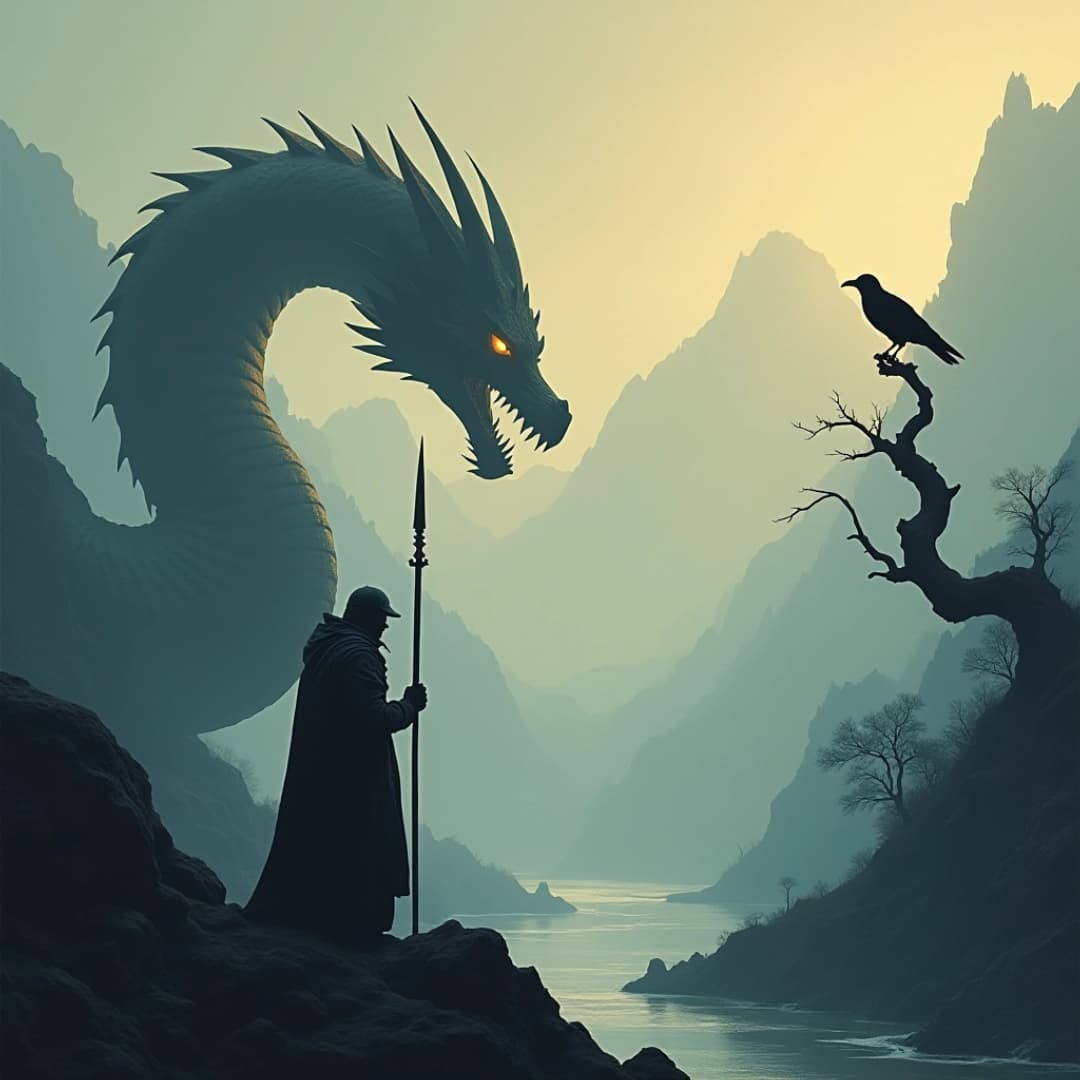
The mythologem of the dragon slayer is one of the most enduring and, at the same time, most enigmatic motifs in world literature. It combines heroism, danger, sexuality (often through the threatened maiden), treasure and transformation into a compact narrative unit. It is precisely its widespread prevalence that makes it a prime example of the question: are such patterns culturally transmitted, or do they reflect deeper biopsychological constants of the human species?
Otto Koenig and cultural ethology: How does one analyse a mythological motif scientifically?
Otto Koenig (1914–1992), a student of Konrad Lorenz and founder of the Wilhelminenberg Biological Station in Vienna, developed cultural ethology as an independent discipline in 1970. Its approach: to examine cultural phenomena – uniforms, masks, rituals, symbols, myths – using the methods of comparative behavioural research. Koenig asked what biological functions underlie cultural forms and which laws of cultural evolution operate by analogy with biological phylogeny.
For a mythologem such as the dragon slayer, this means asking not only ‘What does it mean?’, but also ‘What function does it serve?’ What social functions – group identity, demarcation from the foreign, apotropaic magic (protective spells), status marking – does the narrative of the heroic struggle against the monster fulfil? Koenig’s method works deductively, by deriving hypotheses from biological theories, and inductively, by seeking regularities in cultural objects and processes.
The Indo-European formula of the dragon-slayer: Calvert Watkins
The most striking parallel has been reconstructed by Indo-European philology. In 1995, in ‘How to Kill a Dragon: Aspects of Indo-European Poetics’, Calvert Watkins demonstrated a poetic formula dating back to Proto-Indo-European: HERO STRIKES SERPENT, reconstructed from the root *gʷhen- (‘to strike, to slay’) combined with *ogʷhi- (‘serpent’). The same formula is found in Vedic hymns (Indra slays Vṛtra with the vajra), in Hittite cult myths (the storm god slays Illuyanka), in Greek local myths (Apollo slays Python in Delphi), in Germanic heroic poetry (Sigurd slays Fáfnir) and in numerous other daughter traditions.
The parallels between Siegfried and Indra are thus a formulaic language that can be reconstructed philologically and has been genealogically transmitted since around 4000 BC. Georges Dumézil’s comparative studies on Indo-European mythology support this finding through the reconstruction of shared narrative and social structures – such as his trifunctional hypothesis, which identifies three basic social functions (priesthood, warfare, productivity) in the Indo-European worlds of gods and heroes. What at first glance appears to be a mystical universal of the archetypal kind proves to be a verifiable line of cultural transmission.
The struggle against chaos in the Ancient Near East: Hermann Gunkel’s legacy
Independent of the Indo-European tradition, a second strand of tradition can be identified. In 1895, in ‘Creation and Chaos in Primordial and End Times’, Hermann Gunkel coined the term ‘chaos struggle’ for the ancient Near Eastern narrative of the creator god’s battle against the chaos monster. In the Babylonian Enūma eliš, Marduk cuts Tiamat in two and forms the world from her body; in the Ugaritic texts, Baal defeats the sea god Yamm; and in Job and the Psalms, YHWH subdues Leviathan and Rahab. These narratives encapsulate the cosmogonic moment: order arises through the overcoming of chaos.
Recent research – by John Day, Frank Moore Cross and Mark S. Smith – has substantially corroborated Gunkel’s thesis through cuneiform and Ugaritic findings. Biblical monotheism adopts this motif and reshapes it; the Christian iconography surrounding the Archangel Michael and the dragon in the Apocalypse follows this tradition. The dragon-slayer mythological motif of the European Middle Ages is a hybrid of Germanic heroic legend, ancient Near Eastern cosmogony, and Christian soteriology.
Joseph Fontenrose and the structural morphology of the combat myth
In 1959, Joseph Fontenrose provided the most thorough comparative study of the combat myth to date in ‘Python: A Study of Delphic Myth and Its Origins’. He identified a recurring structural framework: a monstrous antagonist (often a hybrid creature combining a snake, reptile and underworld symbol), its association with water, a cave or a borderland, its dominion over a territory, the threat to a community, the arrival of the hero, the battle in several stages, the support of divine or magical helpers, victory, the reordering of the world, and the founding of a cult or a city.
Fontenrose’s morphology allows for precise comparison. It shows that narratives which at first glance appear different are based on the same structural framework. Combined with Vladimir Propp’s functional analysis of the miracle tale (‘Morphology of the Folktale’, 1928), this yields a tool that reveals the narrative deep structure of the dragon-slayer mythologem – philologically, ethologically, and structurally - without resorting to speculative postulates of a collective unconscious.
Ritualisation and pseudo-speciation: cultural-ethological mechanisms
Koenig and his students described central processes that also help to explain the dragon-slayer mythologem. Ritualisation means that an originally functional action is stylised and imbued with symbolic meaning over generations until its expressive function outweighs its practical one. In the dragon-slayer motif, this is evident in the highly formalised sequence of encounter, trial, slaying, reward – a narrative choreography in which each stage is symbolically overdetermined.
Cultural pseudo-speciation, a term coined by Konrad Lorenz and made fruitful for cultural-ethological questions by Koenig, describes the tendency of human groups to distinguish themselves from one another as biological species do – through costume, language, and ritual. The dragon-slayer mythological motif provides such groups with a founding hero and a common enemy. It marks the boundary between the civilised and the Other, appearing as a dragon. Therein lies the political dark side of the motif.
Why is the dragon benevolent in the East? Phylogenetic myth analysis
This cross-cultural finding is brought into sharper focus by recent mythological research. In the Western tradition – Indo-European, ancient Oriental, Christian – the dragon is an enemy to be slain, the embodiment of chaos that is transformed into order through heroic deeds. In many East Asian traditions, the dragon is regarded as benevolent, wise, and a bringer of rain; one makes peace with it or is accompanied by it.
The Japanese myth of Susanoo, who slays the eight-headed dragon Yamata-no-Orochi, shows, however, that the combat mythological motif also exists in East Asia; there, it is embedded in a mythology that interprets dragons more ambivalently overall. Julien d’Huys’ phylogenetic analyses (from 2013 onwards), using statistical methods from evolutionary biology, suggest that the divergence between ‘hostile’ and ‘benevolent’ dragons may have occurred as early as the Early Stone Age – long before any written records. The Western ‘hero versus monster’ reflex thus proves to be a culturally coherent response to the uncanny, with a reconstructable phylogenetic and historical aetiology of diffusion.
The dragon slayer in advertising, film and politics: modern transformations
The mythological motif has long since left the Middle Ages behind. It can be found in Hollywood blockbusters, in superhero comics, in political rhetoric when opponents are stylised as monsters, and in brand communication that stages its products as dragon slayers – be it against limescale, illness or the competition. Advertising designers draw on the same formulaic narrative framework that was already available to the singers of the Nibelungenlied.
From a cultural-ethological perspective, this continuity is no coincidence. The mythological motif provides a deeply rooted, emotionally charged perceptual template that can be rapidly activated. The use of this template is ambivalent: it can mobilise and de-differentiate. Those who employ it should be aware of its effect; those exposed to it should critically examine the reflex to see the dragon-like in their counterpart.
Is the mythological motif of the dragon slayer still relevant today?
The question is justified. In a world that relies on cooperation, tolerance of uncertainty and integration, the dualistic schema of hero and monster seems archaic, even dangerous. The political instrumentalisation of the motif in the 20th and 21st centuries – from the construction of enemy stereotypes by totalitarian regimes to populist propaganda aesthetics – provides ample illustrative material.
The scholarly classification provided by cultural ethology and comparative mythological research serves an enlightening purpose here. The mythological motif proves to be a historically anchored narrative framework with a reconstructable history of transmission: as an Indo-European legacy, ancient Oriental cosmogony, Christian history of salvation, and a product of ritualisation within cultural ethology. Those who know the origins are less likely to fall prey to the spellbinding power of images. Great myths serve as tools for self- and cultural understanding as soon as they are read philologically, ethologically and structurally – and stripped of their speculative mystification.
The key findings at a glance
• The dragon-slayer mythological motif encapsulates fundamental experiences of danger, transformation and the establishment of order, and is attested in numerous cultures.
• Otto König’s cultural ethology provides the tools to situate such motifs between biological predisposition and cultural expression.
• Calvert Watkins’ Indo-European philology reconstructs a poetic formula dating back to Proto-Indo-European: HERO BEATS SERPENT; a tradition of kinship links Siegfried and Indra.
• Hermann Gunkel’s ‘chaos struggle’ thesis explains the ancient Near Eastern parallels from Marduk to Leviathan; the Christian image of the dragon is a hybrid of Indo-European and ancient Near Eastern strands.
• Joseph Fontenrose’s morphological study and Vladimir Propp’s functional analysis make the narrative deep structure precisely comparable.
• Ritualisation and cultural pseudo-speciation explain why heroic tales forge identity and distinguish groups from one another.
• Julien d’Huys’ phylogenetic analyses trace the divergence between hostile and benevolent dragons back to the Upper Palaeolithic period.
• In advertising, politics and popular culture, the mythological motif lives on; knowing its origins immunises one against its suggestive power.
RELATED ARTICLES:
Against Fear: Rituals Against Fear Anxiety And Panic Origin And Evolution
Judith With The Head Of Holofernes Psychoanalysis Meets Art And Religion
The Case Of Alice In Wonderland Lewis Carroll Laudanum And Victorian Social Criticism
The Secret Symbols Of The Middle Ages What Medieval Illuminators Wanted To Tell Us
DESCRIPTION:
The dragon-slayer mythologem in cultures worldwide: An interpretation examines Otto König’s cultural ethology and the comparative mythological research of Dumézil, Watkins, Gunkel and Fontenrose.
The Myth of the Dragon Slayer – A Cultural-Ethological and Mythological Analysis
From the Norse Sigurd to the Germanic Siegfried and the Christian Saint George, from the Babylonian Marduk to the Japanese Susanoo: time and again, a hero slays a monster. Why does this motif appear with astonishing regularity across cultures, eras and religions? A cultural-ethological search for clues.
What is a mythologem – and why specifically the dragon slayer?
The term ‘mythologem’, coined by the religious scholar Karl Kerényi, refers to a recurring narrative building block in mythology: a tiny, meaning-bearing motif found independently in various cultures. Mythologems are narrative cores that condense fundamental human experiences and have spread over millennia.
The mythologem of the dragon slayer is one of the most enduring and, at the same time, most enigmatic motifs in world literature. It combines heroism, danger, sexuality (often through the threatened maiden), treasure and transformation into a compact narrative unit. It is precisely its widespread prevalence that makes it a prime example of the question: are such patterns culturally transmitted, or do they reflect deeper biopsychological constants of the human species?
Otto Koenig and cultural ethology: How does one analyse a mythological motif scientifically?
Otto Koenig (1914–1992), a student of Konrad Lorenz and founder of the Wilhelminenberg Biological Station in Vienna, developed cultural ethology as an independent discipline in 1970. Its approach: to examine cultural phenomena – uniforms, masks, rituals, symbols, myths – using the methods of comparative behavioural research. Koenig asked what biological functions underlie cultural forms and which laws of cultural evolution operate by analogy with biological phylogeny.
For a mythologem such as the dragon slayer, this means asking not only ‘What does it mean?’, but also ‘What function does it serve?’ What social functions – group identity, demarcation from the foreign, apotropaic magic (protective spells), status marking – does the narrative of the heroic struggle against the monster fulfil? Koenig’s method works deductively, by deriving hypotheses from biological theories, and inductively, by seeking regularities in cultural objects and processes.
The Indo-European formula of the dragon-slayer: Calvert Watkins
The most striking parallel has been reconstructed by Indo-European philology. In 1995, in ‘How to Kill a Dragon: Aspects of Indo-European Poetics’, Calvert Watkins demonstrated a poetic formula dating back to Proto-Indo-European: HERO STRIKES SERPENT, reconstructed from the root *gʷhen- (‘to strike, to slay’) combined with *ogʷhi- (‘serpent’). The same formula is found in Vedic hymns (Indra slays Vṛtra with the vajra), in Hittite cult myths (the storm god slays Illuyanka), in Greek local myths (Apollo slays Python in Delphi), in Germanic heroic poetry (Sigurd slays Fáfnir) and in numerous other daughter traditions.
The parallels between Siegfried and Indra are thus a formulaic language that can be reconstructed philologically and has been genealogically transmitted since around 4000 BC. Georges Dumézil’s comparative studies on Indo-European mythology support this finding through the reconstruction of shared narrative and social structures – such as his trifunctional hypothesis, which identifies three basic social functions (priesthood, warfare, productivity) in the Indo-European worlds of gods and heroes. What at first glance appears to be a mystical universal of the archetypal kind proves to be a verifiable line of cultural transmission.
The struggle against chaos in the Ancient Near East: Hermann Gunkel’s legacy
Independent of the Indo-European tradition, a second strand of tradition can be identified. In 1895, in ‘Creation and Chaos in Primordial and End Times’, Hermann Gunkel coined the term ‘chaos struggle’ for the ancient Near Eastern narrative of the creator god’s battle against the chaos monster. In the Babylonian Enūma eliš, Marduk cuts Tiamat in two and forms the world from her body; in the Ugaritic texts, Baal defeats the sea god Yamm; and in Job and the Psalms, YHWH subdues Leviathan and Rahab. These narratives encapsulate the cosmogonic moment: order arises through the overcoming of chaos.
Recent research – by John Day, Frank Moore Cross and Mark S. Smith – has substantially corroborated Gunkel’s thesis through cuneiform and Ugaritic findings. Biblical monotheism adopts this motif and reshapes it; the Christian iconography surrounding the Archangel Michael and the dragon in the Apocalypse follows this tradition. The dragon-slayer mythological motif of the European Middle Ages is a hybrid of Germanic heroic legend, ancient Near Eastern cosmogony, and Christian soteriology.
Joseph Fontenrose and the structural morphology of the combat myth
In 1959, Joseph Fontenrose provided the most thorough comparative study of the combat myth to date in ‘Python: A Study of Delphic Myth and Its Origins’. He identified a recurring structural framework: a monstrous antagonist (often a hybrid creature combining a snake, reptile and underworld symbol), its association with water, a cave or a borderland, its dominion over a territory, the threat to a community, the arrival of the hero, the battle in several stages, the support of divine or magical helpers, victory, the reordering of the world, and the founding of a cult or a city.
Fontenrose’s morphology allows for precise comparison. It shows that narratives which at first glance appear different are based on the same structural framework. Combined with Vladimir Propp’s functional analysis of the miracle tale (‘Morphology of the Folktale’, 1928), this yields a tool that reveals the narrative deep structure of the dragon-slayer mythologem – philologically, ethologically, and structurally - without resorting to speculative postulates of a collective unconscious.
Ritualisation and pseudo-speciation: cultural-ethological mechanisms
Koenig and his students described central processes that also help to explain the dragon-slayer mythologem. Ritualisation means that an originally functional action is stylised and imbued with symbolic meaning over generations until its expressive function outweighs its practical one. In the dragon-slayer motif, this is evident in the highly formalised sequence of encounter, trial, slaying, reward – a narrative choreography in which each stage is symbolically overdetermined.
Cultural pseudo-speciation, a term coined by Konrad Lorenz and made fruitful for cultural-ethological questions by Koenig, describes the tendency of human groups to distinguish themselves from one another as biological species do – through costume, language, and ritual. The dragon-slayer mythological motif provides such groups with a founding hero and a common enemy. It marks the boundary between the civilised and the Other, appearing as a dragon. Therein lies the political dark side of the motif.
Why is the dragon benevolent in the East? Phylogenetic myth analysis
This cross-cultural finding is brought into sharper focus by recent mythological research. In the Western tradition – Indo-European, ancient Oriental, Christian – the dragon is an enemy to be slain, the embodiment of chaos that is transformed into order through heroic deeds. In many East Asian traditions, the dragon is regarded as benevolent, wise, and a bringer of rain; one makes peace with it or is accompanied by it.
The Japanese myth of Susanoo, who slays the eight-headed dragon Yamata-no-Orochi, shows, however, that the combat mythological motif also exists in East Asia; there, it is embedded in a mythology that interprets dragons more ambivalently overall. Julien d’Huys’ phylogenetic analyses (from 2013 onwards), using statistical methods from evolutionary biology, suggest that the divergence between ‘hostile’ and ‘benevolent’ dragons may have occurred as early as the Early Stone Age – long before any written records. The Western ‘hero versus monster’ reflex thus proves to be a culturally coherent response to the uncanny, with a reconstructable phylogenetic and historical aetiology of diffusion.
The dragon slayer in advertising, film and politics: modern transformations
The mythological motif has long since left the Middle Ages behind. It can be found in Hollywood blockbusters, in superhero comics, in political rhetoric when opponents are stylised as monsters, and in brand communication that stages its products as dragon slayers – be it against limescale, illness or the competition. Advertising designers draw on the same formulaic narrative framework that was already available to the singers of the Nibelungenlied.
From a cultural-ethological perspective, this continuity is no coincidence. The mythological motif provides a deeply rooted, emotionally charged perceptual template that can be rapidly activated. The use of this template is ambivalent: it can mobilise and de-differentiate. Those who employ it should be aware of its effect; those exposed to it should critically examine the reflex to see the dragon-like in their counterpart.
Is the mythological motif of the dragon slayer still relevant today?
The question is justified. In a world that relies on cooperation, tolerance of uncertainty and integration, the dualistic schema of hero and monster seems archaic, even dangerous. The political instrumentalisation of the motif in the 20th and 21st centuries – from the construction of enemy stereotypes by totalitarian regimes to populist propaganda aesthetics – provides ample illustrative material.
The scholarly classification provided by cultural ethology and comparative mythological research serves an enlightening purpose here. The mythological motif proves to be a historically anchored narrative framework with a reconstructable history of transmission: as an Indo-European legacy, ancient Oriental cosmogony, Christian history of salvation, and a product of ritualisation within cultural ethology. Those who know the origins are less likely to fall prey to the spellbinding power of images. Great myths serve as tools for self- and cultural understanding as soon as they are read philologically, ethologically and structurally – and stripped of their speculative mystification.
The key findings at a glance
• The dragon-slayer mythological motif encapsulates fundamental experiences of danger, transformation and the establishment of order, and is attested in numerous cultures.
• Otto König’s cultural ethology provides the tools to situate such motifs between biological predisposition and cultural expression.
• Calvert Watkins’ Indo-European philology reconstructs a poetic formula dating back to Proto-Indo-European: HERO BEATS SERPENT; a tradition of kinship links Siegfried and Indra.
• Hermann Gunkel’s ‘chaos struggle’ thesis explains the ancient Near Eastern parallels from Marduk to Leviathan; the Christian image of the dragon is a hybrid of Indo-European and ancient Near Eastern strands.
• Joseph Fontenrose’s morphological study and Vladimir Propp’s functional analysis make the narrative deep structure precisely comparable.
• Ritualisation and cultural pseudo-speciation explain why heroic tales forge identity and distinguish groups from one another.
• Julien d’Huys’ phylogenetic analyses trace the divergence between hostile and benevolent dragons back to the Upper Palaeolithic period.
• In advertising, politics and popular culture, the mythological motif lives on; knowing its origins immunises one against its suggestive power.
RELATED ARTICLES:
Against Fear: Rituals Against Fear Anxiety And Panic Origin And Evolution
Judith With The Head Of Holofernes Psychoanalysis Meets Art And Religion
The Case Of Alice In Wonderland Lewis Carroll Laudanum And Victorian Social Criticism
The Secret Symbols Of The Middle Ages What Medieval Illuminators Wanted To Tell Us
Newsletter
Would you like to be notified when I publish a new blog post? Sign up here.
Click "Subscribe for free" if you have read and accepted my privacy policy. You can revoke your consent at any time.
Newsletter
Would you like to be notified when I publish a new blog post? Sign up here.
Click "Subscribe for free" if you have read and accepted my privacy policy. You can revoke your consent at any time.