The Princess and the Pea
The Princess and the Pea: a fairy tale for children and adults by Hans Christian Andersen
The Princess and the Pea: a fairy tale for children and adults by Hans Christian Andersen
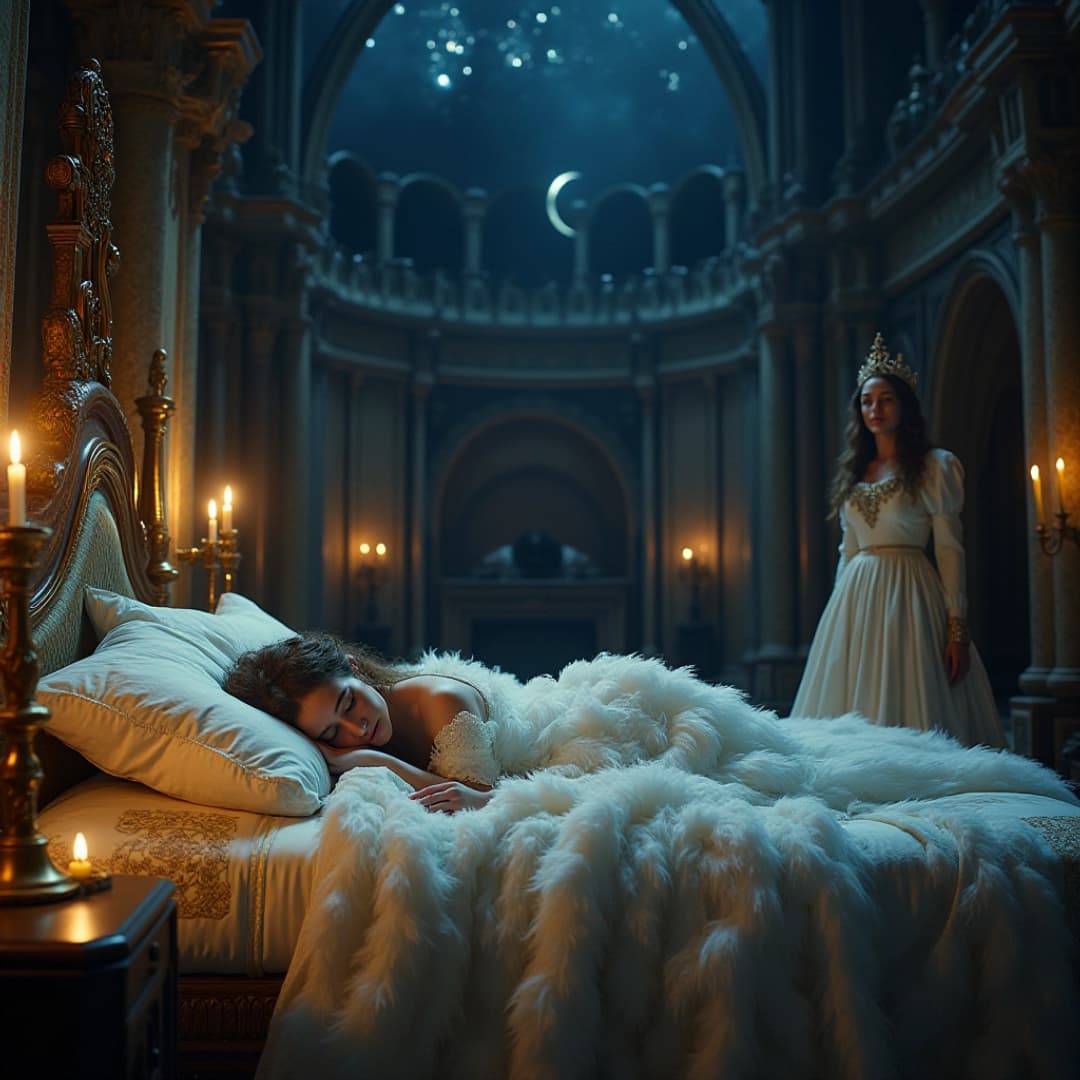
DESCRIPTION:
The Princess and the Pea: the whole world of an enchanting fairy tale by the Danish writer, as it should be, with a queen and king, a real princess and a disappointed prince, and its psychological interpretation.
The Princess and the Pea, fairy tales for children, Hans Christian Andersen and the Pea Princess: fairy tales and the psyche
A fairy tale that most people know, but hardly anyone really understands. The story of The Princess and the Pea is considered one of the shortest and best-known of the stories by Danish poet Hans Christian Andersen (1835). At first glance, it is about a hypersensitive princess who proves her authenticity through a cunning test. At second glance, the psychological one tells of the consciousness's search for the real, the power of the unconscious, the wisdom of inner authorities, and the deep wisdom of the body. In this article, we approach the fairy tale with the tools of depth psychology and ask: What can the pea, the storm and the mattresses tell us about our own psyche?
C. G. Jung – What does psychology have to do with fairy tales?
According to C. G. Jung, fairy tales are not harmless entertainment stories, but "the purest and simplest expression of collective unconscious psychological processes," as his student Marie-Louise von Franz, who dedicated her life to depth-psychological fairy-tale research, put it. Fairy tales do not contain individual biographies, but archetypal patterns: characters such as kings, queens, princes and princesses are not concrete persons, but representations of collective psychological entities. They represent what is alive in the collective unconscious of all human beings.
The Jungian method invites us to expand these symbols: a storm in a fairy tale is not a meteorological event, but an outburst of emotional forces. A bed is not just a place to sleep, but the place where we are most vulnerable and most authentic. This method allows us not only to read fairy tales, but also to inhabit them psychologically and to recognise our own inner life in their symbols.
Fairy tales are valuable for therapeutic work because they offer a protective distance: the unconscious can be reflected in the symbolic space of the fairy tale without immediate threat. Especially for people with trauma or neurodivergence, or for anyone who struggles with their own perception, fairy tales open a path to self-knowledge.
Who is the prince, and why can't he recognise the real one?
The prince travels the world in search of a "real princess". He finds many, but none of them feels real. Jungian readers immediately notice that the problem here is not an external deficiency but an internal one. The prince has not yet learned to distinguish between the façade, courtly etiquette, social standing, external beauty, and the essence beneath. His search is sincere, but his judgment is blind.
In analytical psychology, the prince represents the ego consciousness in its immature form. He has potential and is noble by nature, but he is not yet king: he cannot yet rule. To become king, he needs a partner, not as a romantic accessory, but as a psychological complement, as an anima in the Jungian sense: the female pole of his soul, which gives him feeling, depth and connection to his inner truth.
Psychologically speaking, we often encounter the prince in everyday life: people who repeatedly choose the wrong thing in relationships, not because they are stupid, but because they have not developed an inner authority that distinguishes the real from the fake. This ability to distinguish is one of the central tasks of individuation. According to Carl Gustav Jung, this individuation is the central psychological process of becoming oneself.
What does the storm mean as a psychological symbol, and what does it have to do with the unconscious?
On a stormy evening, a young woman appears at the castle gate. She is soaked, her hair is stuck to her face, her clothes are torn – not a picture of royal dignity. The storm has stripped her of her courtly exterior. From a Jungian perspective, the storm is an eruption of the unconscious: an emotional eruption that breaks down plans, facades and structures. It refers to the anima mundi, the world soul, which cannot be stopped when the time is right.
The unconscious does not wait for a favourable opportunity. It breaks through when the ego is least prepared. For the princess, the storm presents her as a raw fact, beyond all social staging. Paradoxically, this is her strength, not her weakness. For only those who recognise her in this state have truly seen her.
In life, we encounter such storms in the form of crises, breakdowns, unexpected separations or physical symptoms: moments when our carefully constructed self-image no longer holds. From Jung's point of view, these are not disasters, but invitations to encounter the real. The storm is not an enemy; it is a messenger.
The gate as a psychological threshold: what happens at the boundary between inside and outside?
The king personally opens the gate. This is no small matter: the king, in Jungian symbolism, a representation of the self and integrated consciousness, welcomes the stranger despite her outward appearance. He does not make a diagnosis or judge, and he reacts intuitively. The gate, as a threshold symbol, is a classic motif in fairy tales and myths: it separates the known from the unknown, the ego from the self, and the conscious from the unconscious.
Psychologically, the decision to open the gate is a decision to be open to the unexpected. Those who keep their inner gates closed out of fear, shame, or control prevent the real from entering. Therapeutic work often consists of opening this gate just a little: letting in the vulnerable aspect that is standing outside in the storm.
What the royal family demonstrates is hospitality combined with scrutiny.
The king and queen as figures of inner wisdom: what can we learn from them?
In many fairy tales, parental figures represent older, more mature principles of consciousness. The king and queen are not only rulers, but embodiments of mature judgment. While the prince still doubts, they act. The king opens the gate. The queen invents the test. Both recognise in the chaotic princess a possibility hidden from the young self.
The queen in particular deserves attention: she speaks little, but she acts precisely. Her test springs from a deep understanding of the nature of authenticity. She knows that authenticity is not revealed through appearance or assertions, but through the physical reaction to truth. This quiet wisdom embodies what Jung calls the mature anima or the archetypal sage, those inner authorities that guide us when the ego is overwhelmed.
Psychologically, the fairy tale invites us to develop our own inner figures of wisdom. In Jungian analysis, this is also called access to the self: that deep, non-rational orientation that transcends the ego’s short-term judgements. The work in therapy and self-reflection often consists of finding access to this inner queen or inner king.
Peas and legumes in mythology and folk beliefs – what is inside this little pod?
It is no coincidence that Hans Christian Andersen chose a pea of all things. In European mythology and folk beliefs, the legume has had a symbolic significance for thousands of years that goes far beyond the culinary. Even the Pythagoreans in ancient Greece associated beans and peas with the souls of the dead – Pythagoras is said to have forbidden his students from eating legumes because he believed that the human soul continued to dwell in them. This idea seems curious to us today, but it reveals an archaic way of thinking: the pod as a container, a place of sleep and waiting. A seed in which life waits – invisible, but present.
In ancient Rome, this belief in souls was practised ritually. During the annual Lemuria festival – a night-time purification ritual to appease restless spirits of the dead, the Lemures – the master of the house would rise at midnight, wash his hands and throw black beans over his shoulder. Nine times he recited the formula: "Haec ego mitto; his redimo meque meosque fabis" – "I throw these away; with these beans I redeem myself and my loved ones." The legume acted as a bridge between the worlds: offered to the dead, it protected the living. It was both a symbol of fertility and an offering to the dead – a paradox that can be interpreted in Jungian psychology as coniunctio oppositorum, the union of opposites.
In fairy tale symbolism, the pea is a primal substance with inherent creative potential. In a creation myth from the Bering Strait, the first human is said to have been born from a pea pod. In the Greek folk tale of the man with the many peas, multiplying peas become a metaphor for the fertility of the psyche and the hero's inner potential for development. Jack and the Beanstalk and several other folk tales tell of magic beans that grow overnight into a vine reaching up to the sky – the insignificant pod becomes a path to ascension. In German folk tales such as The Twelve Hunters or The Robber Bridegroom, scattered peas reveal the truth: they mark a trail that brings guilt or identity to light. According to the Brothers Grimm, pea purée was the favourite food of dwarves and brownies – mythical creatures who worked in secret and whose power lay in the small and invisible.
All these images share a basic structure: the tiny as the bearer of the essential. The pea is closed, impenetrable, small – and yet contains the complete building plan of a plant. In alchemy, to which Jung referred extensively, this image corresponds to the grain or seed as a symbol of the self: the archetypal centre of the soul, hidden, compressed, waiting to unfold. Whether consciously or not, Andersen drew on one of the oldest deep structures of European symbolic history with the pea. The fact that this pea lies under twenty mattresses and yet still has an effect is the mythologically condensed statement: the essential cannot be buried.
What does the pea symbolise in depth psychology – a small object with great significance?
A pea is tiny. It fits in the palm of your hand and seems ridiculously small. And yet it decides everything. This is no coincidence – other fairy tales also deliberately use the small, the overlooked, the seemingly unimportant as carriers of the deepest truth. The pea is a seed: it holds dormant potential. If it falls into the right soil, it grows into something significant. In the wrong place – under 20 mattresses in a strange bed – it remains a source of irritation that gives no peace.
In Jungian terms, the pea symbolises the self: the small, hidden core of authenticity that lies beneath layers of conditioning, conformity, and social expectations. The self cannot be permanently concealed. It pushes through dreams, physical symptoms, restlessness, the persistent feeling that something is wrong – even if you cannot explain what it is.
In today's everyday psychology, the pea appears when a person cannot sleep because something "doesn't fit" – at work, in a relationship, in their identity. The people who come often don't know what is bothering them. They only know that something lies beneath everything else. That is exactly what the pea describes. The fairy tale encourages us not to throw another mattress on top, but to take a closer look.
What do 20 mattresses mean as a defence mechanism? How do we shield ourselves from the truth?
Twenty mattresses and twenty eiderdown duvets, a total of forty layers between the princess and the pea. The fairy tale deliberately exaggerates. And it is precisely in this exaggeration that the psychological message lies: we are masters at covering up unpleasant inner truths. Each mattress is a defence mechanism: rationalisation, repression, projection, distraction, consumption, overwork – we always find another layer.
In cognitive behavioural therapy, one would speak of maladaptive avoidance strategies. In Jungian thinking, it is called the complex. A complex is an emotionally charged group of ideas that develops an autonomous life of its own and influences the ego without the ego noticing, just like the pea: invisible, but effective. The more mattresses we pile on, the greater the pressure from below becomes.
The number is also interesting: 20 plus 20 = 40. In many spiritual and psychological traditions, 40 is a period of trial and transformation (40 days and nights in the desert, 40 days of mourning, etc.). The long night on the mountain of mattresses is a night of trial for the soul. The question is not: Do you sleep well? But: Can you feel the truth, no matter how well it is hidden?
A. Lorenzer – Who decides who is real?
Alfred Lorenzer's depth hermeneutics offers a different interpretation from Jungian analysis – critical social theory, body-centred, and with an eye to power relations. Lorenzer treats literary and cultural texts like psychoanalytic session notes: he reads them for the unconscious scenarios encoded in the forms of interaction depicted. Fairy tales offer condensed material for this. Storm, gate, bed, morning – each of these scenes is not a narrative accessory, but a solidified pattern of social relationship practice. The central scenario is: a female subject must suffer to be recognised as real. It is not enough to assert oneself. The body must be a witness, and this witness is presented to an institution for examination.
In Lorenzer’s triad of cliché, language game and living symbol, the surface reading of the fairy tale – "sensitive princess proves her authenticity" – corresponds to the cliché: a rigid, socially acceptable form of interpretation that defends the underlying conflict. The living symbol is the pea, not as the core of the self (Jung), but as the pain that provides social legitimacy. The pea is a condition of belonging. Those who cannot feel it – or cannot prove that they can feel it – remain outside in the rain. This is not a symbolic image of inner maturity, but a description of a selection mechanism.
Lorenzer’s critical-theoretical added value over Jung is evident in the figure of the queen. She is not primarily an anima figure or an inner source of wisdom – she is the socialising authority, the institutionalised view that decides what counts as a "real princess". She invents the test, lays out the pea, and is the only one who knows the test arrangement. The subject is not recognised – it is tested. Deep hermeneutics asks here: What social practice is normalised by this fairy tale? The answer is uncomfortable: the practice holds that social belonging and the ability to love are linked to a willingness to suffer, as assessed by a higher authority. Pain becomes a passport.
Lorenzer’s concept of bodily memory is particularly revealing: early experiences of interaction leave their mark on the body as pre-symbolic forms, even before language. The scene in which the princess is black and blue in the morning is interpreted by depth hermeneutics not as a metaphor for authenticity, but as bodily memory under duress: the body stores the injury in what it cannot integrate. Crucially, the princess has no control over this evidence. The bruises appear whether she wants them to or not. The sensory system is not a tool of self-definition – it is the only credible witness in a society that does not trust the speaking subject.
Lorenzer’s interpretation raises a different clinical question than Jung's: not "Who are you really?" but "Who do you need to certify that you are real?" Patients who embody the pea constellation often seek precisely that – an authority that accepts pain as proof of authenticity. The therapeutic work then aims to make this pattern conscious and dissolve it: away from suffering as a passport, towards a self-image that no longer requires a night of testing. The fairy tale ends with a wedding – Lorenzer would ask whether this is really liberation, or successful integration into the very system that designed the test.
Conclusion: An overview of the most important insights
Fairy tales are not childhood memories; they are psychological lessons from the collective unconscious. The Princess and the Pea holds up a mirror to us: who are you really when the storm has washed away your layers?
Unlike fantasy literature, fairy tales, according to C. G. Jung and Marie-Louise von Franz, are archetypal mirrors of the collective psyche rather than harmless children's stories.
• The prince represents the young self, which has not yet developed an inner authority to distinguish between authenticity and façade.
• The storm symbolises a breakthrough of the unconscious, breaking down facades and revealing what is real.
• The gate is a psychological threshold between the conscious and the unconscious; opening it is an act of courage.
• The king and queen embody mature inner authorities of wisdom; they recognise potential where the immature ego still doubts.
• The pea is a symbol of the self: the hidden but inevitable core of authenticity and potential.
• The 20 mattresses represent psychological defence mechanisms; the more layers, the stronger the pressure from below.
• The individuation process (Jung) follows the same path as the fairy tale: search, crisis, trial, insight, integration.
• Authenticity does not come from perfection or conformity, but from the courage to show what lies beneath the mattresses.
RELATED ARTICLES:
Carl Gustav Jung’s Analytical Psychology: Individuation in Midlife
Self-Perception, Identity and Mirror Images
Jacques Lacan’s Psychoanalysis: The Unconscious, Mirror Stage, Language and Subject Formation
Wilfred Bion and Emotions: Containment, Self-Containment, Identity
DESCRIPTION:
The Princess and the Pea: the whole world of an enchanting fairy tale by the Danish writer, as it should be, with a queen and king, a real princess and a disappointed prince, and its psychological interpretation.
The Princess and the Pea, fairy tales for children, Hans Christian Andersen and the Pea Princess: fairy tales and the psyche
A fairy tale that most people know, but hardly anyone really understands. The story of The Princess and the Pea is considered one of the shortest and best-known of the stories by Danish poet Hans Christian Andersen (1835). At first glance, it is about a hypersensitive princess who proves her authenticity through a cunning test. At second glance, the psychological one tells of the consciousness's search for the real, the power of the unconscious, the wisdom of inner authorities, and the deep wisdom of the body. In this article, we approach the fairy tale with the tools of depth psychology and ask: What can the pea, the storm and the mattresses tell us about our own psyche?
C. G. Jung – What does psychology have to do with fairy tales?
According to C. G. Jung, fairy tales are not harmless entertainment stories, but "the purest and simplest expression of collective unconscious psychological processes," as his student Marie-Louise von Franz, who dedicated her life to depth-psychological fairy-tale research, put it. Fairy tales do not contain individual biographies, but archetypal patterns: characters such as kings, queens, princes and princesses are not concrete persons, but representations of collective psychological entities. They represent what is alive in the collective unconscious of all human beings.
The Jungian method invites us to expand these symbols: a storm in a fairy tale is not a meteorological event, but an outburst of emotional forces. A bed is not just a place to sleep, but the place where we are most vulnerable and most authentic. This method allows us not only to read fairy tales, but also to inhabit them psychologically and to recognise our own inner life in their symbols.
Fairy tales are valuable for therapeutic work because they offer a protective distance: the unconscious can be reflected in the symbolic space of the fairy tale without immediate threat. Especially for people with trauma or neurodivergence, or for anyone who struggles with their own perception, fairy tales open a path to self-knowledge.
Who is the prince, and why can't he recognise the real one?
The prince travels the world in search of a "real princess". He finds many, but none of them feels real. Jungian readers immediately notice that the problem here is not an external deficiency but an internal one. The prince has not yet learned to distinguish between the façade, courtly etiquette, social standing, external beauty, and the essence beneath. His search is sincere, but his judgment is blind.
In analytical psychology, the prince represents the ego consciousness in its immature form. He has potential and is noble by nature, but he is not yet king: he cannot yet rule. To become king, he needs a partner, not as a romantic accessory, but as a psychological complement, as an anima in the Jungian sense: the female pole of his soul, which gives him feeling, depth and connection to his inner truth.
Psychologically speaking, we often encounter the prince in everyday life: people who repeatedly choose the wrong thing in relationships, not because they are stupid, but because they have not developed an inner authority that distinguishes the real from the fake. This ability to distinguish is one of the central tasks of individuation. According to Carl Gustav Jung, this individuation is the central psychological process of becoming oneself.
What does the storm mean as a psychological symbol, and what does it have to do with the unconscious?
On a stormy evening, a young woman appears at the castle gate. She is soaked, her hair is stuck to her face, her clothes are torn – not a picture of royal dignity. The storm has stripped her of her courtly exterior. From a Jungian perspective, the storm is an eruption of the unconscious: an emotional eruption that breaks down plans, facades and structures. It refers to the anima mundi, the world soul, which cannot be stopped when the time is right.
The unconscious does not wait for a favourable opportunity. It breaks through when the ego is least prepared. For the princess, the storm presents her as a raw fact, beyond all social staging. Paradoxically, this is her strength, not her weakness. For only those who recognise her in this state have truly seen her.
In life, we encounter such storms in the form of crises, breakdowns, unexpected separations or physical symptoms: moments when our carefully constructed self-image no longer holds. From Jung's point of view, these are not disasters, but invitations to encounter the real. The storm is not an enemy; it is a messenger.
The gate as a psychological threshold: what happens at the boundary between inside and outside?
The king personally opens the gate. This is no small matter: the king, in Jungian symbolism, a representation of the self and integrated consciousness, welcomes the stranger despite her outward appearance. He does not make a diagnosis or judge, and he reacts intuitively. The gate, as a threshold symbol, is a classic motif in fairy tales and myths: it separates the known from the unknown, the ego from the self, and the conscious from the unconscious.
Psychologically, the decision to open the gate is a decision to be open to the unexpected. Those who keep their inner gates closed out of fear, shame, or control prevent the real from entering. Therapeutic work often consists of opening this gate just a little: letting in the vulnerable aspect that is standing outside in the storm.
What the royal family demonstrates is hospitality combined with scrutiny.
The king and queen as figures of inner wisdom: what can we learn from them?
In many fairy tales, parental figures represent older, more mature principles of consciousness. The king and queen are not only rulers, but embodiments of mature judgment. While the prince still doubts, they act. The king opens the gate. The queen invents the test. Both recognise in the chaotic princess a possibility hidden from the young self.
The queen in particular deserves attention: she speaks little, but she acts precisely. Her test springs from a deep understanding of the nature of authenticity. She knows that authenticity is not revealed through appearance or assertions, but through the physical reaction to truth. This quiet wisdom embodies what Jung calls the mature anima or the archetypal sage, those inner authorities that guide us when the ego is overwhelmed.
Psychologically, the fairy tale invites us to develop our own inner figures of wisdom. In Jungian analysis, this is also called access to the self: that deep, non-rational orientation that transcends the ego’s short-term judgements. The work in therapy and self-reflection often consists of finding access to this inner queen or inner king.
Peas and legumes in mythology and folk beliefs – what is inside this little pod?
It is no coincidence that Hans Christian Andersen chose a pea of all things. In European mythology and folk beliefs, the legume has had a symbolic significance for thousands of years that goes far beyond the culinary. Even the Pythagoreans in ancient Greece associated beans and peas with the souls of the dead – Pythagoras is said to have forbidden his students from eating legumes because he believed that the human soul continued to dwell in them. This idea seems curious to us today, but it reveals an archaic way of thinking: the pod as a container, a place of sleep and waiting. A seed in which life waits – invisible, but present.
In ancient Rome, this belief in souls was practised ritually. During the annual Lemuria festival – a night-time purification ritual to appease restless spirits of the dead, the Lemures – the master of the house would rise at midnight, wash his hands and throw black beans over his shoulder. Nine times he recited the formula: "Haec ego mitto; his redimo meque meosque fabis" – "I throw these away; with these beans I redeem myself and my loved ones." The legume acted as a bridge between the worlds: offered to the dead, it protected the living. It was both a symbol of fertility and an offering to the dead – a paradox that can be interpreted in Jungian psychology as coniunctio oppositorum, the union of opposites.
In fairy tale symbolism, the pea is a primal substance with inherent creative potential. In a creation myth from the Bering Strait, the first human is said to have been born from a pea pod. In the Greek folk tale of the man with the many peas, multiplying peas become a metaphor for the fertility of the psyche and the hero's inner potential for development. Jack and the Beanstalk and several other folk tales tell of magic beans that grow overnight into a vine reaching up to the sky – the insignificant pod becomes a path to ascension. In German folk tales such as The Twelve Hunters or The Robber Bridegroom, scattered peas reveal the truth: they mark a trail that brings guilt or identity to light. According to the Brothers Grimm, pea purée was the favourite food of dwarves and brownies – mythical creatures who worked in secret and whose power lay in the small and invisible.
All these images share a basic structure: the tiny as the bearer of the essential. The pea is closed, impenetrable, small – and yet contains the complete building plan of a plant. In alchemy, to which Jung referred extensively, this image corresponds to the grain or seed as a symbol of the self: the archetypal centre of the soul, hidden, compressed, waiting to unfold. Whether consciously or not, Andersen drew on one of the oldest deep structures of European symbolic history with the pea. The fact that this pea lies under twenty mattresses and yet still has an effect is the mythologically condensed statement: the essential cannot be buried.
What does the pea symbolise in depth psychology – a small object with great significance?
A pea is tiny. It fits in the palm of your hand and seems ridiculously small. And yet it decides everything. This is no coincidence – other fairy tales also deliberately use the small, the overlooked, the seemingly unimportant as carriers of the deepest truth. The pea is a seed: it holds dormant potential. If it falls into the right soil, it grows into something significant. In the wrong place – under 20 mattresses in a strange bed – it remains a source of irritation that gives no peace.
In Jungian terms, the pea symbolises the self: the small, hidden core of authenticity that lies beneath layers of conditioning, conformity, and social expectations. The self cannot be permanently concealed. It pushes through dreams, physical symptoms, restlessness, the persistent feeling that something is wrong – even if you cannot explain what it is.
In today's everyday psychology, the pea appears when a person cannot sleep because something "doesn't fit" – at work, in a relationship, in their identity. The people who come often don't know what is bothering them. They only know that something lies beneath everything else. That is exactly what the pea describes. The fairy tale encourages us not to throw another mattress on top, but to take a closer look.
What do 20 mattresses mean as a defence mechanism? How do we shield ourselves from the truth?
Twenty mattresses and twenty eiderdown duvets, a total of forty layers between the princess and the pea. The fairy tale deliberately exaggerates. And it is precisely in this exaggeration that the psychological message lies: we are masters at covering up unpleasant inner truths. Each mattress is a defence mechanism: rationalisation, repression, projection, distraction, consumption, overwork – we always find another layer.
In cognitive behavioural therapy, one would speak of maladaptive avoidance strategies. In Jungian thinking, it is called the complex. A complex is an emotionally charged group of ideas that develops an autonomous life of its own and influences the ego without the ego noticing, just like the pea: invisible, but effective. The more mattresses we pile on, the greater the pressure from below becomes.
The number is also interesting: 20 plus 20 = 40. In many spiritual and psychological traditions, 40 is a period of trial and transformation (40 days and nights in the desert, 40 days of mourning, etc.). The long night on the mountain of mattresses is a night of trial for the soul. The question is not: Do you sleep well? But: Can you feel the truth, no matter how well it is hidden?
A. Lorenzer – Who decides who is real?
Alfred Lorenzer's depth hermeneutics offers a different interpretation from Jungian analysis – critical social theory, body-centred, and with an eye to power relations. Lorenzer treats literary and cultural texts like psychoanalytic session notes: he reads them for the unconscious scenarios encoded in the forms of interaction depicted. Fairy tales offer condensed material for this. Storm, gate, bed, morning – each of these scenes is not a narrative accessory, but a solidified pattern of social relationship practice. The central scenario is: a female subject must suffer to be recognised as real. It is not enough to assert oneself. The body must be a witness, and this witness is presented to an institution for examination.
In Lorenzer’s triad of cliché, language game and living symbol, the surface reading of the fairy tale – "sensitive princess proves her authenticity" – corresponds to the cliché: a rigid, socially acceptable form of interpretation that defends the underlying conflict. The living symbol is the pea, not as the core of the self (Jung), but as the pain that provides social legitimacy. The pea is a condition of belonging. Those who cannot feel it – or cannot prove that they can feel it – remain outside in the rain. This is not a symbolic image of inner maturity, but a description of a selection mechanism.
Lorenzer’s critical-theoretical added value over Jung is evident in the figure of the queen. She is not primarily an anima figure or an inner source of wisdom – she is the socialising authority, the institutionalised view that decides what counts as a "real princess". She invents the test, lays out the pea, and is the only one who knows the test arrangement. The subject is not recognised – it is tested. Deep hermeneutics asks here: What social practice is normalised by this fairy tale? The answer is uncomfortable: the practice holds that social belonging and the ability to love are linked to a willingness to suffer, as assessed by a higher authority. Pain becomes a passport.
Lorenzer’s concept of bodily memory is particularly revealing: early experiences of interaction leave their mark on the body as pre-symbolic forms, even before language. The scene in which the princess is black and blue in the morning is interpreted by depth hermeneutics not as a metaphor for authenticity, but as bodily memory under duress: the body stores the injury in what it cannot integrate. Crucially, the princess has no control over this evidence. The bruises appear whether she wants them to or not. The sensory system is not a tool of self-definition – it is the only credible witness in a society that does not trust the speaking subject.
Lorenzer’s interpretation raises a different clinical question than Jung's: not "Who are you really?" but "Who do you need to certify that you are real?" Patients who embody the pea constellation often seek precisely that – an authority that accepts pain as proof of authenticity. The therapeutic work then aims to make this pattern conscious and dissolve it: away from suffering as a passport, towards a self-image that no longer requires a night of testing. The fairy tale ends with a wedding – Lorenzer would ask whether this is really liberation, or successful integration into the very system that designed the test.
Conclusion: An overview of the most important insights
Fairy tales are not childhood memories; they are psychological lessons from the collective unconscious. The Princess and the Pea holds up a mirror to us: who are you really when the storm has washed away your layers?
Unlike fantasy literature, fairy tales, according to C. G. Jung and Marie-Louise von Franz, are archetypal mirrors of the collective psyche rather than harmless children's stories.
• The prince represents the young self, which has not yet developed an inner authority to distinguish between authenticity and façade.
• The storm symbolises a breakthrough of the unconscious, breaking down facades and revealing what is real.
• The gate is a psychological threshold between the conscious and the unconscious; opening it is an act of courage.
• The king and queen embody mature inner authorities of wisdom; they recognise potential where the immature ego still doubts.
• The pea is a symbol of the self: the hidden but inevitable core of authenticity and potential.
• The 20 mattresses represent psychological defence mechanisms; the more layers, the stronger the pressure from below.
• The individuation process (Jung) follows the same path as the fairy tale: search, crisis, trial, insight, integration.
• Authenticity does not come from perfection or conformity, but from the courage to show what lies beneath the mattresses.
RELATED ARTICLES:
Carl Gustav Jung’s Analytical Psychology: Individuation in Midlife
Self-Perception, Identity and Mirror Images
Jacques Lacan’s Psychoanalysis: The Unconscious, Mirror Stage, Language and Subject Formation
Wilfred Bion and Emotions: Containment, Self-Containment, Identity
Newsletter
Would you like to be notified when I publish a new blog post? Sign up here.
Click "Subscribe for free" if you have read and accepted my privacy policy. You can revoke your consent at any time.
Newsletter
Would you like to be notified when I publish a new blog post? Sign up here.
Click "Subscribe for free" if you have read and accepted my privacy policy. You can revoke your consent at any time.