Medieval
DESCRIPTION:
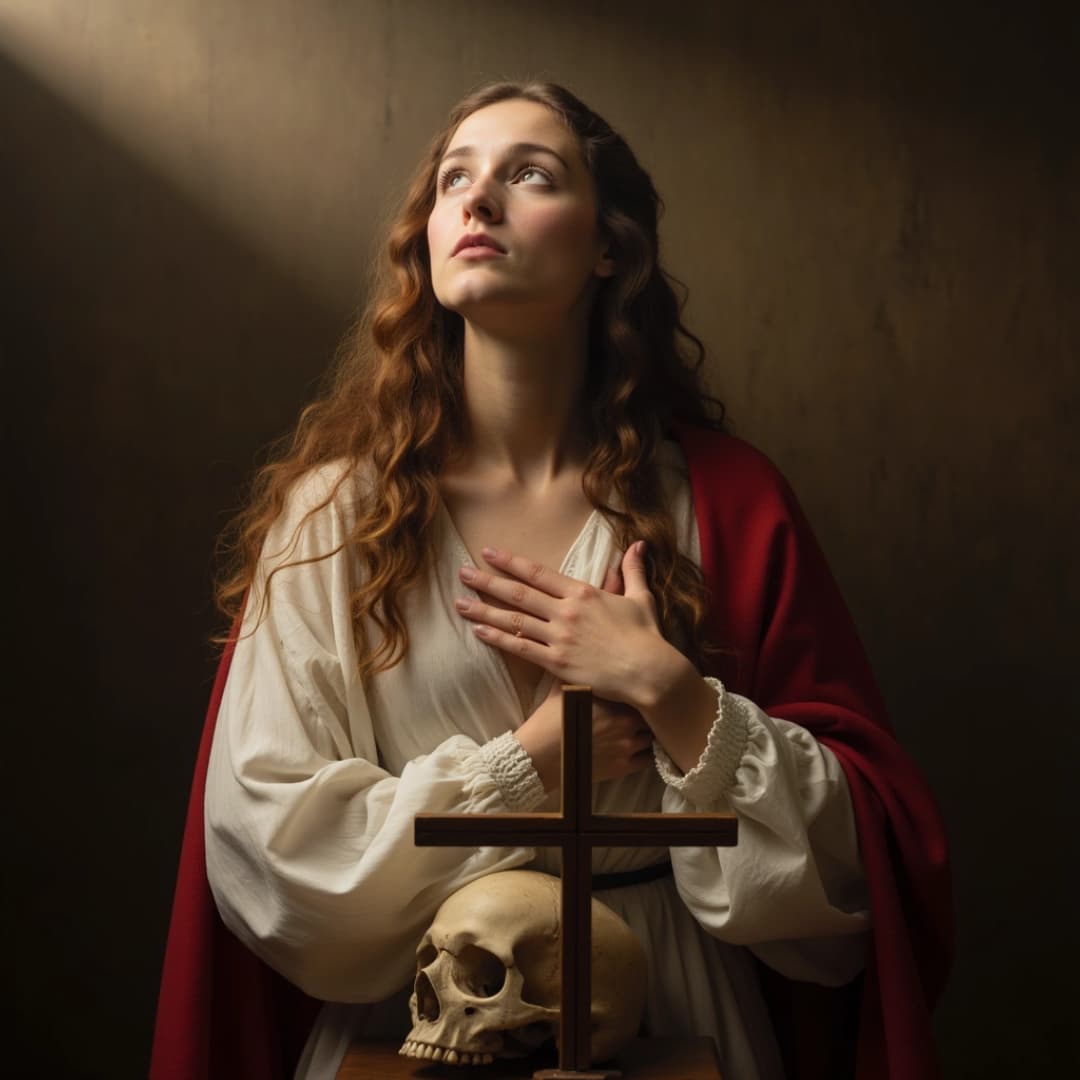
Medieval female mystics and their longing for death: Why did medieval female mystics long for death? A psychological look at female mysticism, projection and the spirituality of medieval female mystics.
Death wish among medieval mystics: What female mysticism, Helfta and the history of holy women teach us about dying.
Medieval mystics longed for death – so the story goes. But whose story is it really? This post reads the texts against the grain: behind the pious narratives of churchmen, behind the mystical language of renunciation, it asks what these women might really have experienced. What becomes apparent is not just a historical problem. It is profoundly human.
What happens when we reconstruct the scene: not just the medieval text?
Anyone who reads medieval hagiographies encounters a fixed image: the pious woman, emaciated by asceticism, longingly awaiting death, which will finally lead her to God. This image is clear, coherent and suspiciously complete. Perfect facades are often a sign that something is wrong.
What emerges when one not only reads what the text says, but also reconstructs what took place in it? When one asks: Which bodies are present here? Who is speaking, and who is being made to speak? Who actually created this scene – and for what purpose? Then the picture shifts considerably. The dying saint is suddenly no longer a simple witness to her own mystical longing, but a character in a production whose directors often sat somewhere else entirely.
Jessica Barr (Medieval Holy Women and the Desire for Death, University of Notre Dame Press, 2026) asks precisely these questions and finds answers that point far beyond the Middle Ages.
The language of female mystics: female mysticism between revelation and ecclesiastical control
Medieval female mysticism arose in a social space that certainly included women – but as functions, not as subjects. This applies not only to the mystical sphere but also to the entire medieval social system: women were indispensable as mothers, nuns, saints, or sinners – but they were defined in instrumental terms, not as autonomous beings. Latin was the language of theology, and women had no official access to it. But the problem ran deeper: even the concepts, images and patterns in which religious experience could be expressed were prescribed by the Church – an institution ruled by men that expected female piety to fit within a very specific theological framework.
These patterns had a clear grammar: body equals sin, suffering equals holiness, death equals salvation. Anyone who wanted to gain legitimacy as a holy woman had to speak in this grammar. This does not mean that women lied. It means that their most authentic experiences of faith had to pass through a language that already shaped and sometimes distorted those experiences. Church teachers such as Bernard of Clairvaux and Thomas Aquinas had helped shape the theological framework in which female mystics also had to express their experiences.
The ecclesiastical reports that have been handed down, therefore, contain double messages: they show what was allowed to be said and give an idea of what lay behind it. When Mechthild of Magdeburg writes that she longs for death as a bride longs for her bridegroom, it is a vivid, mystically charged metaphor. When a cleric transfers the same statement into a saint's biography and turns it into a lesson about pious dying, something essential is lost: the subject who had this experience.
Helfta Abbey and the medieval spirituality of the body
Nowhere is the tension between external expectations and inner experience more evident than in the body, and rarely was this tension lived out as impressively in the Middle Ages as in Helfta Abbey. This Cistercian convent in Thuringia is considered the centre of 13th-century German mysticism. Gertrude of Helfta and Mechthild of Hackeborn worked here, and their mystical revelations were read far beyond their own time. Abbess Gertrude of Hackeborn led the monastic life there to an intellectual and spiritual flowering that was unparalleled in the religious culture of the late Middle Ages.
Helfta was not a place of passive religiosity. It was here that devotional books, theological treatises and visionary texts were written: documents of a mysticism that was at once scholarly, emotional and physical. The nuns of Helfta did not write about death because they rejected life. They wrote because writing itself was a form of mystical living: a practice through which contemplation and scholarship became inseparably linked.
The medieval church was hostile to the body yet fascinated by it. Abstinence, flagellation, fasting, sleep deprivation, ecstatic experiences: these practices produced altered states of consciousness that could be experienced as the deity's light. It was no un e coincidence that such states were attributed primarily to women. It was the only form of ecclesiastical visibility open to women, and they used it creatively.
Hildegard von Bingen, Beguines and the women of the Middle Ages: Whose death wish?
This is where the most psychologically explosive point lies. Hagiographers repeatedly emphasised the intense desire for death of their female protagonists. But was this the experience of the women themselves or the theological ideal of their male biographers?
Hildegard von Bingen, abbess and teacher of the Church, wrote about the Trinity, medicine, music, and her mystical visions – with a clarity and authority that drew on Augustine of Hippo and attracted papal attention. Hildegard was not a woman who waited for death. She was a woman who corresponded with popes, emperors and church teachers and taught and composed until old age. Her mysticism was vitality, not a longing for death.
The same applies to the Beguine movement: those women of the Middle Ages who lived outside convents, in religious communities, and were least subject to ecclesiastical control. Beatrijs of Nazareth described seven stages of mystical love of God in her treatise Van seven manieren van minne: a text full of intensity and precision that presents the love of God as a dynamic experience, not as a longing for dissolution. Margaretha Ebner, the Dominican nun from the late Middle Ages, also spoke in revelations with a very personal voice. And Teresa of Ávila: although she lived in the early modern period, she stands in this tradition of female mystics as a theologically minded authority, not as a passive dying woman.
The Beguines lived outside traditional church structures and consequently created some of the most idiosyncratic mystical texts ever written – including works that are still regarded today as relics of free religious thought.
When others determine what we feel: a timeless pattern
The dynamic that Barr describes for the Middle Ages is not a historical curiosity. It is one of the fundamental experiences of people in power relations: that others define what one feels, desires or needs, and that these definitions eventually become so deeply ingrained that one can hardly distinguish them from one's own feelings.
In medieval ecclesiastical culture, this meant specifically that a clergyman (confessor, pastor, biographer) interpreted the inner life of a nun, a Beguine, or a mystic. His theologically shaped categories determined what went into the text. What he described as a mystical longing for death may have been something else entirely: exhaustion, a longing for silence, a desire for a life beyond constant control.
What the memoria – the spiritual remembering and writing down of visions – achieved in this context was not just piety. It was self-assertion. Mechthild of Magdeburg, who wrote down her mystical experiences even though church authorities urged her to remain silent, essentially carried out a therapeutically familiar movement: the recovery of her own narrative in the face of a system that threatened to overwrite it.
Mystical revelations as a survival strategy: what mysticism achieves psychologically in the Middle Ages
It would be a mistake to interpret the spiritual practices of female mystics primarily as a symptom. They were also – and perhaps above all – an achievement: the achievement of finding meaning, dignity and inner authority in a system that left women little room to do so.
Visionary writing, contemplation, mystical revelations: from today's perspective, these are forms of affect regulation and meaning construction. Medieval spirituality gave women – nuns, Beguines, Tertiaries – access to education and theological thinking that would otherwise have been closed to them. The new mysticism of the 13th and 14th centuries was largely carried by women: by Beguines, by Cistercian nuns such as those from Helfta, by Dominican nuns such as Ebner – not by chance, but as a structural response to structural exclusion.
It is no coincidence that these women of Christianity left behind texts that are still read today. It is the result of a persistent mystical practice that withstood external pressure to interpret. Their works are not farewell. They are testimonies of people who preserved and articulated an authentic inner life under the most difficult conditions.
Classifying death wish clinically: context before medieval diagnosis
There is a great temptation to pathologise the medieval death wish directly. From a modern psychiatric perspective, many of the practices described would be considered clinically abnormal: severe eating disorders, sleep deprivation, dissociation, and passive desire to die. This is not wrong, but it is incomplete.
A passive death wish is a signal that asks for meaning: what is this person carrying? In what religious and theological framework does this desire make sense? What distress underlies it, and what longing for connection or salvation might it contain? The theological tradition of the Middle Ages certainly made its own distinctions: between the mystica (those mystically gifted with experiences close to God) and the simple exhaustion of an overburdened nun in a strict convent.
What remains is the question these women ask.
Mechthild of Magdeburg, Juliana of Norwich, Gertrude of Helfta, Hildegard: these women are not interesting because they thought about death. They are interesting because they wrote despite everything. Despite a church system that sought to shape, limit, and, often enough, overwrite their mystical experiences, they left behind texts that are still readable today and that still communicate something beyond what was prescribed.
This is the real message of Barr's research: there is always a space between the narrative told about a person and what that person really experienced. Opening up this space – in medieval texts on female mysticism, in therapeutic conversations, in one's own self-perception – is not only scientifically relevant. It is a deeply human necessity.
The mystics of the late Middle Ages filled this space with language, images and revelations. Their legacy is not the death wish that was attributed to them. Their legacy is the tenacity with which they asserted their own experiences despite everything.
The most important points at a glance
· Texts reveal more than they say: what is written in hagiographic accounts of holy women often reflects the ideal of the authors – not the mystical experiences of the women themselves.
· The body carries social history: asceticism and death wish are not only individual, but they also arise in ecclesiastical and religious systems that shape female spirituality.
· Helfta Abbey stands for a female mysticism that was a life force: the mystics there wrote, taught, led and lived their mysticism as an active spiritual practice.
· Hildegard von Bingen, Ebner, and Mechthild von Magdeburg all show that the medieval mystic was not a passive object, but a theologically thinking subject.
· External attribution vs personal experience is a timeless pattern – in medieval biographies of saints as well as in modern therapeutic contexts.
· Death wish needs context, not a quick diagnosis: the first question is not: how pathological is it? But rather: what does it mean for this person in this life?
· Regaining one's own voice – against external ecclesiastical and theological influence – is both the silent theme of these medieval texts and a central task of psychotherapy.
RELATED ARTICLES:
St. Nicholas Day: Nicholas of Myra – Date, Customs and Significance
The Origins and History of Christmas
Anger in History: Symbolism, Madness and Morality in the Middle Ages
DESCRIPTION:
Medieval female mystics and their longing for death: Why did medieval female mystics long for death? A psychological look at female mysticism, projection and the spirituality of medieval female mystics.
Death wish among medieval mystics: What female mysticism, Helfta and the history of holy women teach us about dying.
Medieval mystics longed for death – so the story goes. But whose story is it really? This post reads the texts against the grain: behind the pious narratives of churchmen, behind the mystical language of renunciation, it asks what these women might really have experienced. What becomes apparent is not just a historical problem. It is profoundly human.
What happens when we reconstruct the scene: not just the medieval text?
Anyone who reads medieval hagiographies encounters a fixed image: the pious woman, emaciated by asceticism, longingly awaiting death, which will finally lead her to God. This image is clear, coherent and suspiciously complete. Perfect facades are often a sign that something is wrong.
What emerges when one not only reads what the text says, but also reconstructs what took place in it? When one asks: Which bodies are present here? Who is speaking, and who is being made to speak? Who actually created this scene – and for what purpose? Then the picture shifts considerably. The dying saint is suddenly no longer a simple witness to her own mystical longing, but a character in a production whose directors often sat somewhere else entirely.
Jessica Barr (Medieval Holy Women and the Desire for Death, University of Notre Dame Press, 2026) asks precisely these questions and finds answers that point far beyond the Middle Ages.
The language of female mystics: female mysticism between revelation and ecclesiastical control
Medieval female mysticism arose in a social space that certainly included women – but as functions, not as subjects. This applies not only to the mystical sphere but also to the entire medieval social system: women were indispensable as mothers, nuns, saints, or sinners – but they were defined in instrumental terms, not as autonomous beings. Latin was the language of theology, and women had no official access to it. But the problem ran deeper: even the concepts, images and patterns in which religious experience could be expressed were prescribed by the Church – an institution ruled by men that expected female piety to fit within a very specific theological framework.
These patterns had a clear grammar: body equals sin, suffering equals holiness, death equals salvation. Anyone who wanted to gain legitimacy as a holy woman had to speak in this grammar. This does not mean that women lied. It means that their most authentic experiences of faith had to pass through a language that already shaped and sometimes distorted those experiences. Church teachers such as Bernard of Clairvaux and Thomas Aquinas had helped shape the theological framework in which female mystics also had to express their experiences.
The ecclesiastical reports that have been handed down, therefore, contain double messages: they show what was allowed to be said and give an idea of what lay behind it. When Mechthild of Magdeburg writes that she longs for death as a bride longs for her bridegroom, it is a vivid, mystically charged metaphor. When a cleric transfers the same statement into a saint's biography and turns it into a lesson about pious dying, something essential is lost: the subject who had this experience.
Helfta Abbey and the medieval spirituality of the body
Nowhere is the tension between external expectations and inner experience more evident than in the body, and rarely was this tension lived out as impressively in the Middle Ages as in Helfta Abbey. This Cistercian convent in Thuringia is considered the centre of 13th-century German mysticism. Gertrude of Helfta and Mechthild of Hackeborn worked here, and their mystical revelations were read far beyond their own time. Abbess Gertrude of Hackeborn led the monastic life there to an intellectual and spiritual flowering that was unparalleled in the religious culture of the late Middle Ages.
Helfta was not a place of passive religiosity. It was here that devotional books, theological treatises and visionary texts were written: documents of a mysticism that was at once scholarly, emotional and physical. The nuns of Helfta did not write about death because they rejected life. They wrote because writing itself was a form of mystical living: a practice through which contemplation and scholarship became inseparably linked.
The medieval church was hostile to the body yet fascinated by it. Abstinence, flagellation, fasting, sleep deprivation, ecstatic experiences: these practices produced altered states of consciousness that could be experienced as the deity's light. It was no un e coincidence that such states were attributed primarily to women. It was the only form of ecclesiastical visibility open to women, and they used it creatively.
Hildegard von Bingen, Beguines and the women of the Middle Ages: Whose death wish?
This is where the most psychologically explosive point lies. Hagiographers repeatedly emphasised the intense desire for death of their female protagonists. But was this the experience of the women themselves or the theological ideal of their male biographers?
Hildegard von Bingen, abbess and teacher of the Church, wrote about the Trinity, medicine, music, and her mystical visions – with a clarity and authority that drew on Augustine of Hippo and attracted papal attention. Hildegard was not a woman who waited for death. She was a woman who corresponded with popes, emperors and church teachers and taught and composed until old age. Her mysticism was vitality, not a longing for death.
The same applies to the Beguine movement: those women of the Middle Ages who lived outside convents, in religious communities, and were least subject to ecclesiastical control. Beatrijs of Nazareth described seven stages of mystical love of God in her treatise Van seven manieren van minne: a text full of intensity and precision that presents the love of God as a dynamic experience, not as a longing for dissolution. Margaretha Ebner, the Dominican nun from the late Middle Ages, also spoke in revelations with a very personal voice. And Teresa of Ávila: although she lived in the early modern period, she stands in this tradition of female mystics as a theologically minded authority, not as a passive dying woman.
The Beguines lived outside traditional church structures and consequently created some of the most idiosyncratic mystical texts ever written – including works that are still regarded today as relics of free religious thought.
When others determine what we feel: a timeless pattern
The dynamic that Barr describes for the Middle Ages is not a historical curiosity. It is one of the fundamental experiences of people in power relations: that others define what one feels, desires or needs, and that these definitions eventually become so deeply ingrained that one can hardly distinguish them from one's own feelings.
In medieval ecclesiastical culture, this meant specifically that a clergyman (confessor, pastor, biographer) interpreted the inner life of a nun, a Beguine, or a mystic. His theologically shaped categories determined what went into the text. What he described as a mystical longing for death may have been something else entirely: exhaustion, a longing for silence, a desire for a life beyond constant control.
What the memoria – the spiritual remembering and writing down of visions – achieved in this context was not just piety. It was self-assertion. Mechthild of Magdeburg, who wrote down her mystical experiences even though church authorities urged her to remain silent, essentially carried out a therapeutically familiar movement: the recovery of her own narrative in the face of a system that threatened to overwrite it.
Mystical revelations as a survival strategy: what mysticism achieves psychologically in the Middle Ages
It would be a mistake to interpret the spiritual practices of female mystics primarily as a symptom. They were also – and perhaps above all – an achievement: the achievement of finding meaning, dignity and inner authority in a system that left women little room to do so.
Visionary writing, contemplation, mystical revelations: from today's perspective, these are forms of affect regulation and meaning construction. Medieval spirituality gave women – nuns, Beguines, Tertiaries – access to education and theological thinking that would otherwise have been closed to them. The new mysticism of the 13th and 14th centuries was largely carried by women: by Beguines, by Cistercian nuns such as those from Helfta, by Dominican nuns such as Ebner – not by chance, but as a structural response to structural exclusion.
It is no coincidence that these women of Christianity left behind texts that are still read today. It is the result of a persistent mystical practice that withstood external pressure to interpret. Their works are not farewell. They are testimonies of people who preserved and articulated an authentic inner life under the most difficult conditions.
Classifying death wish clinically: context before medieval diagnosis
There is a great temptation to pathologise the medieval death wish directly. From a modern psychiatric perspective, many of the practices described would be considered clinically abnormal: severe eating disorders, sleep deprivation, dissociation, and passive desire to die. This is not wrong, but it is incomplete.
A passive death wish is a signal that asks for meaning: what is this person carrying? In what religious and theological framework does this desire make sense? What distress underlies it, and what longing for connection or salvation might it contain? The theological tradition of the Middle Ages certainly made its own distinctions: between the mystica (those mystically gifted with experiences close to God) and the simple exhaustion of an overburdened nun in a strict convent.
What remains is the question these women ask.
Mechthild of Magdeburg, Juliana of Norwich, Gertrude of Helfta, Hildegard: these women are not interesting because they thought about death. They are interesting because they wrote despite everything. Despite a church system that sought to shape, limit, and, often enough, overwrite their mystical experiences, they left behind texts that are still readable today and that still communicate something beyond what was prescribed.
This is the real message of Barr's research: there is always a space between the narrative told about a person and what that person really experienced. Opening up this space – in medieval texts on female mysticism, in therapeutic conversations, in one's own self-perception – is not only scientifically relevant. It is a deeply human necessity.
The mystics of the late Middle Ages filled this space with language, images and revelations. Their legacy is not the death wish that was attributed to them. Their legacy is the tenacity with which they asserted their own experiences despite everything.
The most important points at a glance
· Texts reveal more than they say: what is written in hagiographic accounts of holy women often reflects the ideal of the authors – not the mystical experiences of the women themselves.
· The body carries social history: asceticism and death wish are not only individual, but they also arise in ecclesiastical and religious systems that shape female spirituality.
· Helfta Abbey stands for a female mysticism that was a life force: the mystics there wrote, taught, led and lived their mysticism as an active spiritual practice.
· Hildegard von Bingen, Ebner, and Mechthild von Magdeburg all show that the medieval mystic was not a passive object, but a theologically thinking subject.
· External attribution vs personal experience is a timeless pattern – in medieval biographies of saints as well as in modern therapeutic contexts.
· Death wish needs context, not a quick diagnosis: the first question is not: how pathological is it? But rather: what does it mean for this person in this life?
· Regaining one's own voice – against external ecclesiastical and theological influence – is both the silent theme of these medieval texts and a central task of psychotherapy.
RELATED ARTICLES:
St. Nicholas Day: Nicholas of Myra – Date, Customs and Significance
The Origins and History of Christmas
Anger in History: Symbolism, Madness and Morality in the Middle Ages
Newsletter
Would you like to be notified when I publish a new blog post? Sign up here.
Click "Subscribe for free" if you have read and accepted my privacy policy. You can revoke your consent at any time.
Newsletter
Would you like to be notified when I publish a new blog post? Sign up here.
Click "Subscribe for free" if you have read and accepted my privacy policy. You can revoke your consent at any time.