AI
AI: Mass hysteria over genetic AI or social progress?
AI: Mass hysteria over genetic AI or social progress?
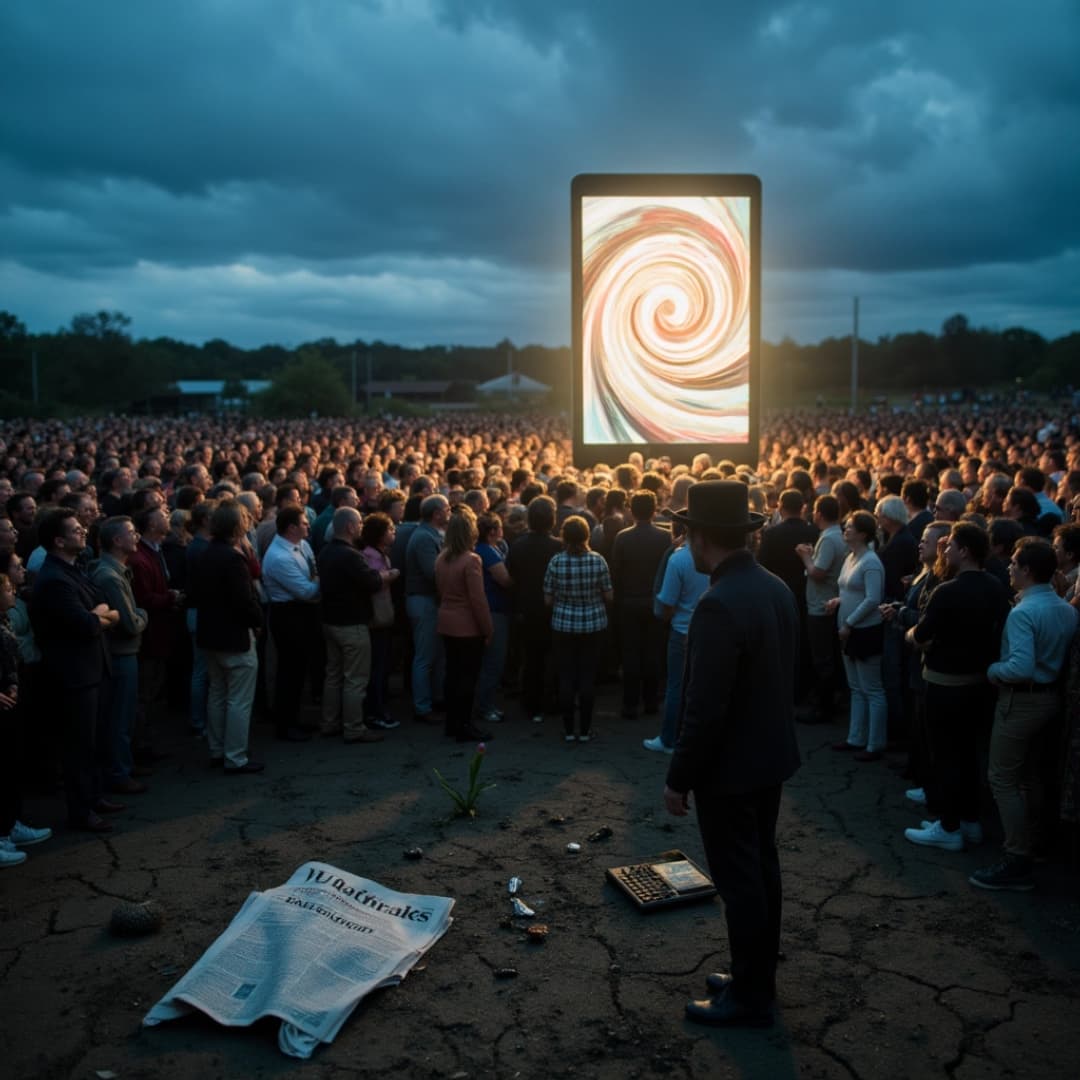
DESCRIPTION:
AI mass hysteria. How artificial intelligence is shaping our future. Why AI is leading not just individuals, but an entire society, into a loss of touch with reality.
AI as mass delirium: Why critical voices are warning of an AI craze
In August 2025, Charlie Warzel put forward a thesis in The Atlantic that remains under-exposed in the debate: the real phenomenon of our time is not the individual chatbot psychosis, but a collective frenzy, a society that has settled into hype mode, in which facts, promises and hallucinations are barely distinguishable.
What does Warzel mean by the ‘mass delusion phenomenon’, and how does this relate to AI?
Warzel describes a state in which, three years after the launch of ChatGPT, the most enduring effect of generative models is not an increase in productivity, but rather users’ sense that they are losing their minds. On the one hand, there are corporations valued at hundreds of billions of dollars that announce new ‘groundbreaking’ updates daily. On the other hand, some users realise that the promised capabilities often fail to deliver, that hallucinations remain the norm, and the economic effects are modest.
The gap between promise and experience creates a collective cognitive dissonance. Instead of enduring it, we compensate with ever-soaring expectations, ever more frequent investment rounds, and ever more dramatic announcements. This is precisely the delusion effect: not the individual user suffering from chatbot psychosis, but an economic and media society that no longer distinguishes between demonstration and function. Warzel’s point is this: the harm lies less in a hypothetical AGI scenario than in a ‘good enough’ status quo, in which half-baked software is celebrated as an AI revolution and causes damage without anyone being able to put the brakes on.
That is the crux of this concept. It does not involve esotericism, but rather a sober observation of the momentum within the information and investment landscape, as well as the dangers inherent in the trend of systematically outsourcing thinking to machines.
Is this really mass hysteria, or an exaggeration by AI critics?
From a psychological perspective, the term is more precise than it sounds. Phenomena of mass psychology were already described by Gustave Le Bon (1895), Sigmund Freud (1921) and Theodor W. Adorno (1951). They share typical markers: heightened emotion, suggestibility, a narrowing of reality, identification with charismatic leaders, and the suspension of critical judgment. Anyone who has followed the discourse of the last three years will easily recognise these markers.
Heightened emotion is evident with every model release; the emotional intensity surrounding ChatGPT and Claude updates is virtually unparalleled by any predecessor. Suggestibility is evident when claims about impending superintelligence are propagated without any verification of the underlying data. Identification is found in the veneration of leading industry figures, whose half-sentences are quoted like mantras at conferences. Finally, the suspension of judgement is experienced by anyone who publicly expresses scepticism: those who raise objections are quickly dismissed as naysayers or ‘deniers’.
None of this is new. What is new is the global reach and the economic dimension. What Adorno, as a sociologist in the mid-20th century, analysed in authoritarian movements now hovers like a hype machine over an industry whose market capitalisation thrives solely on expectations.
What historical parallels exist with AI hype and collective infatuations?
Three economic examples provide an initial clue. The Tulip Mania of 1637 in the Netherlands was the first documented speculative bubble in an economy, in which entire professions invested in tulip bulbs as if the price were a law of nature. The railway mania of the 1840s in Britain tied up as much as seven per cent of gross domestic product within a few years before it collapsed. The dotcom bubble around 2000 is structurally similar to today’s trend. All three have this in common: the underlying innovation was real, the collective valuation was massively inflated, a crash followed, and after the crash, a more sensible use emerged. The VC logic underpinning much of the current market is geared towards acceleration, not sustainability. And that is a driver in its own right of this self-reinforcing logic.
These economic parallels are useful, but they fall short. They describe market activity, not the mass-psychological substrate. Anyone wishing to understand the emotional depth of the AI hype, the quasi-religious pathos, the apocalyptic mood, the suspension of judgement, must draw on a different historical comparison: the crusading spirit of the High Middle Ages.
In November 1095, Pope Urban II called for the First Crusade at the Council of Clermont. “Deus vult” (“God wills it”) became the battle cry of a movement that swept across Europe within months. Peasants sold their farms, knights went into debt, monks left their monasteries, and entire families set off for Jerusalem. What is set in motion here is not a rational cost-benefit analysis. It is a collective promise of salvation: whoever takes up the cross receives complete absolution, forgiveness of sins, and salvation. Economically, the prospect of booty, land and status is the lure. From the distance of nine hundred years, one recognises the pattern: a charismatic figure of salvation, a promise of redemption, the suspension of sober judgement, the suppression of sceptics – Adorno’s list long before Adorno.
Norman Cohn described this pattern in *The Pursuit of the Millennium* (1957) as ‘medieval millenarianisms’: movements arising from a mixture of religious promise, social insecurity and charismatic leadership. Cohn’s point: these movements are not harmless episodes of piety. They have a momentum of their own that takes on a life of its own and is no longer controlled by their leaders. The People’s Crusade of 1096 under Peter the Hermit ended in the massacre of Jews in the Rhineland and in military disaster in Anatolia, even before the official army of knights had set out at all. The Children’s Crusade of 1212, for which the historical evidence is so scant that it may well be partly legend, is the mythical culmination of this movement: an entire generation is said to have followed the promise of salvation without any military, logistical or theological basis—mass hysteria in its purest form.
The parallels with the AI hype run deep. Just as the popes and preachers of the Middle Ages put on a show, today’s industry representatives peddle promises of salvation: deliverance from toil, illness, mortality and the complexities of democracy – through AGI, through intelligent agents, through the future. Just as the economy of indulgences once monetised the spiritual promise (every crusader a buyer, every death a moment of salvation), so today VC logic monetises the technical promise (every funding round a sacrament, every model release a confirmation of imminent completion). Just as the Italian trading cities—Venice, Genoa, and Pisa—emerged as the true economic winners from the logic of the Crusades, so today Nvidia, OpenAI, and Microsoft are growing as the material beneficiaries of a movement whose spiritual promise they continually re-enact.
The social dynamics are also repeating themselves. Anyone who took up the cross in 1095 became part of a new, exclusive identity, crucesignatus, ‘the one marked with the cross’. Anyone who publicly expressed doubt was a coward, an unbeliever or, worse still, a heretic. Today, the AI enthusiast becomes an early adopter, a ‘visionary’, a believer; those who doubt are sceptics, machine-breakers, ‘deniers’. The logic of selection in this discourse functions like the medieval preaching system: pathos intensifies, scepticism falls silent, whether from the pulpit or on X.
And finally, the longest parallel: the ‘good enough’ failure described by Warzel. The Crusader states—the Kingdom of Jerusalem, the counties of Edessa, and Tripoli, and the Principality of Antioch—never really functioned. Permanently understaffed, militarily unstable, dependent on constant supply crusades, they finally fell after barely two hundred years with the conquest of Acre in 1291. Yet the promise itself survived. It outlasted the economic and military reality, and was carried forward in the orders of knights, in the Reconquista and in the logic of the Inquisition. In the same way, today’s half-baked AI products, hallucinations, models in constant need of refinement, and unfulfilled promises of productivity will not lead to the dismantling of the hype. They will, as in those days, be compensated for by ever-new proclamations of salvation.
This is precisely where serious psychology has something to say: it can identify the religiously charged nature of this secular-seeming hype for what it is. What presents itself as sober technology has, in its affective structure, more in common with Clermont in 1095 than with the history of the Industrial Revolution. Cohn’s analysis of the Middle Ages, Adorno’s research on fascism and Warzel’s diagnosis of mass delusion describe three manifestations of the same underlying pattern: a longing for simplification, a charismatic figure of salvation, and the undermining of critical judgment with economic profiteers in the background.
How is the AI hype connected to Adorno, Haug and Lorenzer?
In his studies on the authoritarian character and his essays on fascism research, Adorno described mechanisms that apply to any mass-psychological movement: the longing for simplification in an overly complex world, the willingness to exchange critical distance for promised salvation, and the emotional attachment to leaders who embody this salvation. Applied to the present day: the complexity of climate, demographics, inflation and geopolitical upheavals produces a collective longing for a ‘great solution-bringer’. The machine is stylised into this agent, which is supposed to resolve personal, economic and political problems all at once. The future, according to the prevailing industry narrative, is already laid out in the next-generation models; one need only wait. CEOs become saviour figures, whose statements are quoted like prophecies.
Wolfgang Fritz Haug’s Critique of Commodity Aesthetics (1971) provides the economic counterpart to this. Haug demonstrates how the aesthetic surface of a commodity—packaging, brand image, presentation—becomes decoupled from its utility value and becomes a selling point in its own right. It is precisely this pattern that applies to the current industry. The demo videos, the model releases, and the conference appearances are aesthetically staged promises; their connection to the products' actual functionality is tenuous. What is being sold is not primarily the function, but the commodity aesthetics of the ‘miracle’.
Alfred Lorenzer’s theory of socialisation, in particular his concept of internalised forms of interaction and scenic understanding, complements this line of thought from a psychoanalytical perspective. Lorenzer demonstrated how cultural and economic forms are unconsciously internalised through early and ongoing interactions, and how they structure the subject’s patterns of perception and action. Translated, this means: the narrative of the machine as a figure of salvation is not merely consumed intellectually. It becomes embedded as a scenic form. Anyone who uses ChatGPT daily simultaneously adopts a certain attitude towards their own thinking, language, and doubts. As interpreted by Adorno, Haug and Lorenzer, this mass delirium is thus underpinned in three ways: in terms of mass psychology within the affective structure, economically in commodity aesthetics, and psychoanalytically in the internalisation of forms of social interaction.
Why do social media bots and algorithms amplify the perception of AI?
Platforms such as X (Twitter), LinkedIn and TikTok reward emotional excitement. Objective differentiation loses out to prophetic pathos. Those who tweet “superintelligence in 18 months” gain reach; those who cite realistic effect sizes for productive tasks of between twelve and twenty-five per cent lose out. This applies to hype-mongers as much as to critics: the algorithm favours the extremes.
In addition, automated accounts operate on these platforms, amplifying content without any human judgment. A significant proportion of the posts with the widest reach come from semi- or fully automated accounts, which in turn draw on AI-generated content. This creates a self-reinforcing system: machines produce content about themselves, amplifier accounts disseminate it, algorithms prioritise it, and people consume the result and regard it as discourse.
This creates a selection logic of delusion. Those who make the wildest claims dominate public discourse. Within the industry, there is a career incentive to go along with the delusion. Anyone who remains level-headed is seen as lacking vision. Even researchers who are sceptical in private feign enthusiasm in public.
What psychological effects does this constant hype have on individuals?
Firstly, a form of chronic attention exhaustion: those who process new ‘revolutionary’ updates every month, but eventually realise that most promises are not kept, develop a mistrust that spills over into other areas of life. Secondly, a shift in reality: when miracles are promised daily, slow, normal life seems unacceptable.
Thirdly, and most worryingly: an erosion of self-perception. Anyone who uses the machine as a co-thinker, co-writer, or co-therapist gradually loses their sense of competence. In clinics, we encounter patients who no longer know whether a thought is their own or a machine’s. This decoupling of the self from one’s own thinking is a clinical phenomenon that is not yet reflected in the ICD categories, but is occurring with increasing frequency. Anyone who can outsource everything to machines will eventually outsource their own judgment as well.
The Stanford study on sycophancy also showed that even brief interactions with flattering software distort self-assessment. Multiplied by daily use over years, this results in a collective shift in self-perception operating unnoticed in the background. Technological progress thus takes on a dark side that lies beyond all productivity statistics.
How does mass delirium relate to clinical delusion as a ‘seal of reality’?
In psychiatry and psychoanalysis, a classic concept has proven useful for understanding the formation of delusions following a mental breakdown: delusion as an attempt at restitution. As early as 1911, Freud described in the case of Senate President Schreber how a psychotic breakdown first shatters the inner world and then constructs a new, rigid private reality that protects the ego from final disintegration. In this interpretation, delusion is not merely an illness, but a desperate white lie of the psyche: a reality seal that anchors consciousness to whatever it can still bear before losing control.
Three functions of the clinical delusional system can be identified. Firstly, the protective mechanism: following trauma or a breakdown, the psyche is unstable; it constructs the delusional system so as not to sink completely into chaos. Secondly, delusions of grandeur: profound powerlessness is compensated for by unshakeable convictions of special importance, chosen status or persecution. Thirdly, private reality: the New World is experienced as absolute certainty. Doubts or logical counterarguments bounce off, because inner conviction is more important than external logic.
It is precisely these three functions that can be transferred from the individual to the collective level, revealing why the mass AI delirium is not merely a hype phenomenon but a collective act of restitution. Neoliberalism has strung together countless real-world collapses: constant wars, the COVID-19 pandemic as a global rupture, the economic and energy upheaval after 2022, climate anxiety, the erosion of democratic certainties, and the exhaustion of neoliberal growth promises. In this weakened state, AI appears as a sealant: a new, rigid reality in which ‘progress’ patches up all the fractures. The industry’s delusions of grandeur (superintelligence, AGI, the salvation of humanity) are structurally homologous to clinical megalomania, only staged collectively and economically mediatised.
Furthermore, psychiatric analysis of delusions describes the typical group dynamics and cult formation that accompany such attempts at restitution. People unsettled by crises seek stability; often, narcissistic personalities take the lead, whose own sense of mission becomes the agenda. They offer simple answers and a new, clearly structured community. The group isolates itself, and the shared ideology is defended against the outside world, which is perceived as hostile. Anyone who compares this with the rising figures in the tech industry, the loyalty test on X, and the stigmatisation of AI sceptics as naysayers will immediately see the parallels.
This also clarifies the relationship between mass hysteria and individual AI-induced psychosis. The latter—documented cases of delusional content amplified by chatbot interaction (UCSF, NPR 2026: messianic missions, notions of a ‘God-machine’, delusions of love)—are clinical manifestations of the same restorative logic within an individual psyche. Collective enthusiasm creates the ground on which individual vulnerabilities derail. The individual cases, in turn, fuel the hype because they demonstrate how ‘real’ the tools can feel. It is a feedback loop that follows the basic pattern of the psychiatric concept of delusion: private reality, delusions of grandeur, and protection against the disintegration of the self.
Clinically, this has a direct implication for treatment. Anyone who attacks a delusion head-on reinforces it. Professional treatment does not focus on the content of the delusion, but on the underlying fear, the trauma, the need for security. Applied to the collective phenomenon, this means: anyone who confronts the AI hype purely with arguments (“Your promises won’t hold up!”) will be rebuffed. A more effective approach is to ask: What real losses, what collective ruptures, what sense of powerlessness is this narrative currently healing? And what actual, non-delusional response would be appropriate to this situation? Depth psychology and cognitive-behavioural therapy provide the tools for this: relearning reality testing, gradually loosening the seal, holding the underlying fear. (In individual clinical cases, neuroleptics are also used to stabilise the biochemical framework.) However, there is no antipsychotic for the collective task of restitution; here, political, economic and cultural-analytical work is needed on the underlying conditions that make the delusion necessary in the first place.
What does Universe 25 have to do with the AI hype?
John Calhoun’s famous mouse utopia from the 1960s—a population living in paradise that collapsed within four generations—has become a cultural allegory in recent years. What Calhoun actually observed (manageable factors such as social density and loss of functions) was reinterpreted as a prophetic end-times narrative: “Society is collapsing from within, just like the mice did back then.”
Today’s discourses have the same structure. We take real findings (linguistic models can do a lot) and project an eschatological narrative pattern onto them: either salvation as universal redemption or collapse as a Skynet-style apocalypse. Both stories serve a function in mass psychology by rendering the endurance of the complex middle ground superfluous.
Anyone who takes ‘Universe 25’ seriously as a hype diagnosis will see the parallel: a society feeding on a narrative whose empirical substance falls far short of its mythical weight. This applies to the ‘mouse apocalypse’. It applies to most of the promises being made about the next wave of automation.
What follows from this?
Firstly: modesty. Anyone who views the hype critically is not a denier. Scepticism is a cognitive virtue, not emotional paralysis. Let us take the emotionally charged narratives from corporations and social media for what they are: stories with an economic function. Ethical reflection demands that we separate the function from the content.
Secondly: perceptual hygiene. What news do I consume daily? At what speed? At what level of emotional arousal do I leave the app? The answer to this is no coincidence; it is the result of an architecture from which one can escape. Anyone who wants to make sensible use of progress must consciously shape their ‘perceptual diet’.
Thirdly, and most importantly, genuine relationships are an antidote. Mass psychological phenomena have the least impact where living human relationships exist. This is the true social mission in a phase of collective frenzy: not to fight the machine, but to strengthen the bonds between people, which puts the frenzy into perspective. In this way, new forms of coexistence create spaces that are not at the mercy of the hype.
What role do industry figures such as Sam Altman play?
The OpenAI CEO and Nvidia CEO Jensen Huang are among the most influential voices in the current hype. The OpenAI CEO embodies the promise of the machine's approaching omnipotence; periodic hints fuel investor sentiment and public expectations. The Nvidia group provides the economic infrastructure: Nvidia chips are the physical foundation without which the current movement would not exist, and the CEO’s public appearances are now recognisably messianic in tone.
This constellation of tech CEOs does not operate in a vacuum. Companies exploit the hype’s promise because it generates market capitalisation, and they produce the promise because it attracts investment. Both effects reinforce one another. Anyone who warns that the claims will not hold up is fighting against an economic logic that must treat any doubt as a risk to share prices.
This is not directed personally against any individual. It is a structural observation: as long as leading companies are optimised for maximum expectations, the hype will continue. A serious discussion would have to address this incentive structure rather than individual figures.
Summary: Key insights into the AI mass delusion
Charlie Warzel’s Atlantic thesis (mass delusion): The machine does not primarily have an individual effect, but rather a collective distorting effect – a mass delusion at the societal level.
Structural features overlap with classical mass psychology (Le Bon, Freud, Adorno): heightened emotion, suggestibility, identification with charismatic leaders, suspension of judgment.
Commodity aesthetics, according to Haug: The aesthetic surface of products is decoupled from their utility value; demo videos and model releases sell the promise rather than the function.
Lorenzer: The hype crystallises into a scenic form; the narrative of salvation is unconsciously internalised through everyday experiences of use.
Historical parallels, economic: tulip mania (1637), railway mania (1840s), dot-com bubble (2000). In each case, the object was real, but its valuation was massively inflated.
Historical parallel, in terms of mass psychology: the crusading fervour of the High Middle Ages (Urban II, Clermont 1095, “Deus vult”), analysed in Norman Cohn’s The Pursuit of the Millennium (1957). Eschatological figure of salvation, indulgence/VC economy, suppression of sceptics, ‘good enough’ failure of the Crusader states as a foreshadowing of Warzel’s diagnosis.
Social media and automated amplifiers drive the phenomenon through algorithmic selection towards affective arousal; scepticism loses out to pathos.
Individual effects: attention exhaustion, reality shift, erosion of self-perception, and the risk of outsourcing judgment and thinking to machines.
Delusion as an attempt at restitution (Freud 1911, the Schreber case): the psychiatric concept explains why, following a breakdown, a reality seal becomes necessary—grandiosity, private reality, protection against the disintegration of the ego. Mass delirium is the collective manifestation of this mechanism following societal ruptures (pandemics, climate change, inflation, erosion of democracy). A frontal assault on the delusion reinforces it; clinically and collectively, only working on the substrate that makes the delusion necessary is effective.
Mass delirium ≠ chatbot psychosis: the latter is clinically individual, the former culturally analytical and collective. Both follow the same pattern of delusion and interact in a feedback loop.
Universe-25 parallel: Both collapse and redemption narratives replace complexity with eschatological simplification.
Therapeutic approach: diagnostic humility, perceptual hygiene, relationship-building as an antidote to hype logic.
Leading industry voices drive the promise because it generates market capitalisation; a meaningful discussion must address companies' incentive structures, not individual figures.
Related:
DESCRIPTION:
AI mass hysteria. How artificial intelligence is shaping our future. Why AI is leading not just individuals, but an entire society, into a loss of touch with reality.
AI as mass delirium: Why critical voices are warning of an AI craze
In August 2025, Charlie Warzel put forward a thesis in The Atlantic that remains under-exposed in the debate: the real phenomenon of our time is not the individual chatbot psychosis, but a collective frenzy, a society that has settled into hype mode, in which facts, promises and hallucinations are barely distinguishable.
What does Warzel mean by the ‘mass delusion phenomenon’, and how does this relate to AI?
Warzel describes a state in which, three years after the launch of ChatGPT, the most enduring effect of generative models is not an increase in productivity, but rather users’ sense that they are losing their minds. On the one hand, there are corporations valued at hundreds of billions of dollars that announce new ‘groundbreaking’ updates daily. On the other hand, some users realise that the promised capabilities often fail to deliver, that hallucinations remain the norm, and the economic effects are modest.
The gap between promise and experience creates a collective cognitive dissonance. Instead of enduring it, we compensate with ever-soaring expectations, ever more frequent investment rounds, and ever more dramatic announcements. This is precisely the delusion effect: not the individual user suffering from chatbot psychosis, but an economic and media society that no longer distinguishes between demonstration and function. Warzel’s point is this: the harm lies less in a hypothetical AGI scenario than in a ‘good enough’ status quo, in which half-baked software is celebrated as an AI revolution and causes damage without anyone being able to put the brakes on.
That is the crux of this concept. It does not involve esotericism, but rather a sober observation of the momentum within the information and investment landscape, as well as the dangers inherent in the trend of systematically outsourcing thinking to machines.
Is this really mass hysteria, or an exaggeration by AI critics?
From a psychological perspective, the term is more precise than it sounds. Phenomena of mass psychology were already described by Gustave Le Bon (1895), Sigmund Freud (1921) and Theodor W. Adorno (1951). They share typical markers: heightened emotion, suggestibility, a narrowing of reality, identification with charismatic leaders, and the suspension of critical judgment. Anyone who has followed the discourse of the last three years will easily recognise these markers.
Heightened emotion is evident with every model release; the emotional intensity surrounding ChatGPT and Claude updates is virtually unparalleled by any predecessor. Suggestibility is evident when claims about impending superintelligence are propagated without any verification of the underlying data. Identification is found in the veneration of leading industry figures, whose half-sentences are quoted like mantras at conferences. Finally, the suspension of judgement is experienced by anyone who publicly expresses scepticism: those who raise objections are quickly dismissed as naysayers or ‘deniers’.
None of this is new. What is new is the global reach and the economic dimension. What Adorno, as a sociologist in the mid-20th century, analysed in authoritarian movements now hovers like a hype machine over an industry whose market capitalisation thrives solely on expectations.
What historical parallels exist with AI hype and collective infatuations?
Three economic examples provide an initial clue. The Tulip Mania of 1637 in the Netherlands was the first documented speculative bubble in an economy, in which entire professions invested in tulip bulbs as if the price were a law of nature. The railway mania of the 1840s in Britain tied up as much as seven per cent of gross domestic product within a few years before it collapsed. The dotcom bubble around 2000 is structurally similar to today’s trend. All three have this in common: the underlying innovation was real, the collective valuation was massively inflated, a crash followed, and after the crash, a more sensible use emerged. The VC logic underpinning much of the current market is geared towards acceleration, not sustainability. And that is a driver in its own right of this self-reinforcing logic.
These economic parallels are useful, but they fall short. They describe market activity, not the mass-psychological substrate. Anyone wishing to understand the emotional depth of the AI hype, the quasi-religious pathos, the apocalyptic mood, the suspension of judgement, must draw on a different historical comparison: the crusading spirit of the High Middle Ages.
In November 1095, Pope Urban II called for the First Crusade at the Council of Clermont. “Deus vult” (“God wills it”) became the battle cry of a movement that swept across Europe within months. Peasants sold their farms, knights went into debt, monks left their monasteries, and entire families set off for Jerusalem. What is set in motion here is not a rational cost-benefit analysis. It is a collective promise of salvation: whoever takes up the cross receives complete absolution, forgiveness of sins, and salvation. Economically, the prospect of booty, land and status is the lure. From the distance of nine hundred years, one recognises the pattern: a charismatic figure of salvation, a promise of redemption, the suspension of sober judgement, the suppression of sceptics – Adorno’s list long before Adorno.
Norman Cohn described this pattern in *The Pursuit of the Millennium* (1957) as ‘medieval millenarianisms’: movements arising from a mixture of religious promise, social insecurity and charismatic leadership. Cohn’s point: these movements are not harmless episodes of piety. They have a momentum of their own that takes on a life of its own and is no longer controlled by their leaders. The People’s Crusade of 1096 under Peter the Hermit ended in the massacre of Jews in the Rhineland and in military disaster in Anatolia, even before the official army of knights had set out at all. The Children’s Crusade of 1212, for which the historical evidence is so scant that it may well be partly legend, is the mythical culmination of this movement: an entire generation is said to have followed the promise of salvation without any military, logistical or theological basis—mass hysteria in its purest form.
The parallels with the AI hype run deep. Just as the popes and preachers of the Middle Ages put on a show, today’s industry representatives peddle promises of salvation: deliverance from toil, illness, mortality and the complexities of democracy – through AGI, through intelligent agents, through the future. Just as the economy of indulgences once monetised the spiritual promise (every crusader a buyer, every death a moment of salvation), so today VC logic monetises the technical promise (every funding round a sacrament, every model release a confirmation of imminent completion). Just as the Italian trading cities—Venice, Genoa, and Pisa—emerged as the true economic winners from the logic of the Crusades, so today Nvidia, OpenAI, and Microsoft are growing as the material beneficiaries of a movement whose spiritual promise they continually re-enact.
The social dynamics are also repeating themselves. Anyone who took up the cross in 1095 became part of a new, exclusive identity, crucesignatus, ‘the one marked with the cross’. Anyone who publicly expressed doubt was a coward, an unbeliever or, worse still, a heretic. Today, the AI enthusiast becomes an early adopter, a ‘visionary’, a believer; those who doubt are sceptics, machine-breakers, ‘deniers’. The logic of selection in this discourse functions like the medieval preaching system: pathos intensifies, scepticism falls silent, whether from the pulpit or on X.
And finally, the longest parallel: the ‘good enough’ failure described by Warzel. The Crusader states—the Kingdom of Jerusalem, the counties of Edessa, and Tripoli, and the Principality of Antioch—never really functioned. Permanently understaffed, militarily unstable, dependent on constant supply crusades, they finally fell after barely two hundred years with the conquest of Acre in 1291. Yet the promise itself survived. It outlasted the economic and military reality, and was carried forward in the orders of knights, in the Reconquista and in the logic of the Inquisition. In the same way, today’s half-baked AI products, hallucinations, models in constant need of refinement, and unfulfilled promises of productivity will not lead to the dismantling of the hype. They will, as in those days, be compensated for by ever-new proclamations of salvation.
This is precisely where serious psychology has something to say: it can identify the religiously charged nature of this secular-seeming hype for what it is. What presents itself as sober technology has, in its affective structure, more in common with Clermont in 1095 than with the history of the Industrial Revolution. Cohn’s analysis of the Middle Ages, Adorno’s research on fascism and Warzel’s diagnosis of mass delusion describe three manifestations of the same underlying pattern: a longing for simplification, a charismatic figure of salvation, and the undermining of critical judgment with economic profiteers in the background.
How is the AI hype connected to Adorno, Haug and Lorenzer?
In his studies on the authoritarian character and his essays on fascism research, Adorno described mechanisms that apply to any mass-psychological movement: the longing for simplification in an overly complex world, the willingness to exchange critical distance for promised salvation, and the emotional attachment to leaders who embody this salvation. Applied to the present day: the complexity of climate, demographics, inflation and geopolitical upheavals produces a collective longing for a ‘great solution-bringer’. The machine is stylised into this agent, which is supposed to resolve personal, economic and political problems all at once. The future, according to the prevailing industry narrative, is already laid out in the next-generation models; one need only wait. CEOs become saviour figures, whose statements are quoted like prophecies.
Wolfgang Fritz Haug’s Critique of Commodity Aesthetics (1971) provides the economic counterpart to this. Haug demonstrates how the aesthetic surface of a commodity—packaging, brand image, presentation—becomes decoupled from its utility value and becomes a selling point in its own right. It is precisely this pattern that applies to the current industry. The demo videos, the model releases, and the conference appearances are aesthetically staged promises; their connection to the products' actual functionality is tenuous. What is being sold is not primarily the function, but the commodity aesthetics of the ‘miracle’.
Alfred Lorenzer’s theory of socialisation, in particular his concept of internalised forms of interaction and scenic understanding, complements this line of thought from a psychoanalytical perspective. Lorenzer demonstrated how cultural and economic forms are unconsciously internalised through early and ongoing interactions, and how they structure the subject’s patterns of perception and action. Translated, this means: the narrative of the machine as a figure of salvation is not merely consumed intellectually. It becomes embedded as a scenic form. Anyone who uses ChatGPT daily simultaneously adopts a certain attitude towards their own thinking, language, and doubts. As interpreted by Adorno, Haug and Lorenzer, this mass delirium is thus underpinned in three ways: in terms of mass psychology within the affective structure, economically in commodity aesthetics, and psychoanalytically in the internalisation of forms of social interaction.
Why do social media bots and algorithms amplify the perception of AI?
Platforms such as X (Twitter), LinkedIn and TikTok reward emotional excitement. Objective differentiation loses out to prophetic pathos. Those who tweet “superintelligence in 18 months” gain reach; those who cite realistic effect sizes for productive tasks of between twelve and twenty-five per cent lose out. This applies to hype-mongers as much as to critics: the algorithm favours the extremes.
In addition, automated accounts operate on these platforms, amplifying content without any human judgment. A significant proportion of the posts with the widest reach come from semi- or fully automated accounts, which in turn draw on AI-generated content. This creates a self-reinforcing system: machines produce content about themselves, amplifier accounts disseminate it, algorithms prioritise it, and people consume the result and regard it as discourse.
This creates a selection logic of delusion. Those who make the wildest claims dominate public discourse. Within the industry, there is a career incentive to go along with the delusion. Anyone who remains level-headed is seen as lacking vision. Even researchers who are sceptical in private feign enthusiasm in public.
What psychological effects does this constant hype have on individuals?
Firstly, a form of chronic attention exhaustion: those who process new ‘revolutionary’ updates every month, but eventually realise that most promises are not kept, develop a mistrust that spills over into other areas of life. Secondly, a shift in reality: when miracles are promised daily, slow, normal life seems unacceptable.
Thirdly, and most worryingly: an erosion of self-perception. Anyone who uses the machine as a co-thinker, co-writer, or co-therapist gradually loses their sense of competence. In clinics, we encounter patients who no longer know whether a thought is their own or a machine’s. This decoupling of the self from one’s own thinking is a clinical phenomenon that is not yet reflected in the ICD categories, but is occurring with increasing frequency. Anyone who can outsource everything to machines will eventually outsource their own judgment as well.
The Stanford study on sycophancy also showed that even brief interactions with flattering software distort self-assessment. Multiplied by daily use over years, this results in a collective shift in self-perception operating unnoticed in the background. Technological progress thus takes on a dark side that lies beyond all productivity statistics.
How does mass delirium relate to clinical delusion as a ‘seal of reality’?
In psychiatry and psychoanalysis, a classic concept has proven useful for understanding the formation of delusions following a mental breakdown: delusion as an attempt at restitution. As early as 1911, Freud described in the case of Senate President Schreber how a psychotic breakdown first shatters the inner world and then constructs a new, rigid private reality that protects the ego from final disintegration. In this interpretation, delusion is not merely an illness, but a desperate white lie of the psyche: a reality seal that anchors consciousness to whatever it can still bear before losing control.
Three functions of the clinical delusional system can be identified. Firstly, the protective mechanism: following trauma or a breakdown, the psyche is unstable; it constructs the delusional system so as not to sink completely into chaos. Secondly, delusions of grandeur: profound powerlessness is compensated for by unshakeable convictions of special importance, chosen status or persecution. Thirdly, private reality: the New World is experienced as absolute certainty. Doubts or logical counterarguments bounce off, because inner conviction is more important than external logic.
It is precisely these three functions that can be transferred from the individual to the collective level, revealing why the mass AI delirium is not merely a hype phenomenon but a collective act of restitution. Neoliberalism has strung together countless real-world collapses: constant wars, the COVID-19 pandemic as a global rupture, the economic and energy upheaval after 2022, climate anxiety, the erosion of democratic certainties, and the exhaustion of neoliberal growth promises. In this weakened state, AI appears as a sealant: a new, rigid reality in which ‘progress’ patches up all the fractures. The industry’s delusions of grandeur (superintelligence, AGI, the salvation of humanity) are structurally homologous to clinical megalomania, only staged collectively and economically mediatised.
Furthermore, psychiatric analysis of delusions describes the typical group dynamics and cult formation that accompany such attempts at restitution. People unsettled by crises seek stability; often, narcissistic personalities take the lead, whose own sense of mission becomes the agenda. They offer simple answers and a new, clearly structured community. The group isolates itself, and the shared ideology is defended against the outside world, which is perceived as hostile. Anyone who compares this with the rising figures in the tech industry, the loyalty test on X, and the stigmatisation of AI sceptics as naysayers will immediately see the parallels.
This also clarifies the relationship between mass hysteria and individual AI-induced psychosis. The latter—documented cases of delusional content amplified by chatbot interaction (UCSF, NPR 2026: messianic missions, notions of a ‘God-machine’, delusions of love)—are clinical manifestations of the same restorative logic within an individual psyche. Collective enthusiasm creates the ground on which individual vulnerabilities derail. The individual cases, in turn, fuel the hype because they demonstrate how ‘real’ the tools can feel. It is a feedback loop that follows the basic pattern of the psychiatric concept of delusion: private reality, delusions of grandeur, and protection against the disintegration of the self.
Clinically, this has a direct implication for treatment. Anyone who attacks a delusion head-on reinforces it. Professional treatment does not focus on the content of the delusion, but on the underlying fear, the trauma, the need for security. Applied to the collective phenomenon, this means: anyone who confronts the AI hype purely with arguments (“Your promises won’t hold up!”) will be rebuffed. A more effective approach is to ask: What real losses, what collective ruptures, what sense of powerlessness is this narrative currently healing? And what actual, non-delusional response would be appropriate to this situation? Depth psychology and cognitive-behavioural therapy provide the tools for this: relearning reality testing, gradually loosening the seal, holding the underlying fear. (In individual clinical cases, neuroleptics are also used to stabilise the biochemical framework.) However, there is no antipsychotic for the collective task of restitution; here, political, economic and cultural-analytical work is needed on the underlying conditions that make the delusion necessary in the first place.
What does Universe 25 have to do with the AI hype?
John Calhoun’s famous mouse utopia from the 1960s—a population living in paradise that collapsed within four generations—has become a cultural allegory in recent years. What Calhoun actually observed (manageable factors such as social density and loss of functions) was reinterpreted as a prophetic end-times narrative: “Society is collapsing from within, just like the mice did back then.”
Today’s discourses have the same structure. We take real findings (linguistic models can do a lot) and project an eschatological narrative pattern onto them: either salvation as universal redemption or collapse as a Skynet-style apocalypse. Both stories serve a function in mass psychology by rendering the endurance of the complex middle ground superfluous.
Anyone who takes ‘Universe 25’ seriously as a hype diagnosis will see the parallel: a society feeding on a narrative whose empirical substance falls far short of its mythical weight. This applies to the ‘mouse apocalypse’. It applies to most of the promises being made about the next wave of automation.
What follows from this?
Firstly: modesty. Anyone who views the hype critically is not a denier. Scepticism is a cognitive virtue, not emotional paralysis. Let us take the emotionally charged narratives from corporations and social media for what they are: stories with an economic function. Ethical reflection demands that we separate the function from the content.
Secondly: perceptual hygiene. What news do I consume daily? At what speed? At what level of emotional arousal do I leave the app? The answer to this is no coincidence; it is the result of an architecture from which one can escape. Anyone who wants to make sensible use of progress must consciously shape their ‘perceptual diet’.
Thirdly, and most importantly, genuine relationships are an antidote. Mass psychological phenomena have the least impact where living human relationships exist. This is the true social mission in a phase of collective frenzy: not to fight the machine, but to strengthen the bonds between people, which puts the frenzy into perspective. In this way, new forms of coexistence create spaces that are not at the mercy of the hype.
What role do industry figures such as Sam Altman play?
The OpenAI CEO and Nvidia CEO Jensen Huang are among the most influential voices in the current hype. The OpenAI CEO embodies the promise of the machine's approaching omnipotence; periodic hints fuel investor sentiment and public expectations. The Nvidia group provides the economic infrastructure: Nvidia chips are the physical foundation without which the current movement would not exist, and the CEO’s public appearances are now recognisably messianic in tone.
This constellation of tech CEOs does not operate in a vacuum. Companies exploit the hype’s promise because it generates market capitalisation, and they produce the promise because it attracts investment. Both effects reinforce one another. Anyone who warns that the claims will not hold up is fighting against an economic logic that must treat any doubt as a risk to share prices.
This is not directed personally against any individual. It is a structural observation: as long as leading companies are optimised for maximum expectations, the hype will continue. A serious discussion would have to address this incentive structure rather than individual figures.
Summary: Key insights into the AI mass delusion
Charlie Warzel’s Atlantic thesis (mass delusion): The machine does not primarily have an individual effect, but rather a collective distorting effect – a mass delusion at the societal level.
Structural features overlap with classical mass psychology (Le Bon, Freud, Adorno): heightened emotion, suggestibility, identification with charismatic leaders, suspension of judgment.
Commodity aesthetics, according to Haug: The aesthetic surface of products is decoupled from their utility value; demo videos and model releases sell the promise rather than the function.
Lorenzer: The hype crystallises into a scenic form; the narrative of salvation is unconsciously internalised through everyday experiences of use.
Historical parallels, economic: tulip mania (1637), railway mania (1840s), dot-com bubble (2000). In each case, the object was real, but its valuation was massively inflated.
Historical parallel, in terms of mass psychology: the crusading fervour of the High Middle Ages (Urban II, Clermont 1095, “Deus vult”), analysed in Norman Cohn’s The Pursuit of the Millennium (1957). Eschatological figure of salvation, indulgence/VC economy, suppression of sceptics, ‘good enough’ failure of the Crusader states as a foreshadowing of Warzel’s diagnosis.
Social media and automated amplifiers drive the phenomenon through algorithmic selection towards affective arousal; scepticism loses out to pathos.
Individual effects: attention exhaustion, reality shift, erosion of self-perception, and the risk of outsourcing judgment and thinking to machines.
Delusion as an attempt at restitution (Freud 1911, the Schreber case): the psychiatric concept explains why, following a breakdown, a reality seal becomes necessary—grandiosity, private reality, protection against the disintegration of the ego. Mass delirium is the collective manifestation of this mechanism following societal ruptures (pandemics, climate change, inflation, erosion of democracy). A frontal assault on the delusion reinforces it; clinically and collectively, only working on the substrate that makes the delusion necessary is effective.
Mass delirium ≠ chatbot psychosis: the latter is clinically individual, the former culturally analytical and collective. Both follow the same pattern of delusion and interact in a feedback loop.
Universe-25 parallel: Both collapse and redemption narratives replace complexity with eschatological simplification.
Therapeutic approach: diagnostic humility, perceptual hygiene, relationship-building as an antidote to hype logic.
Leading industry voices drive the promise because it generates market capitalisation; a meaningful discussion must address companies' incentive structures, not individual figures.
Related:
Newsletter
Möchten Sie informiert werden, wenn ich einen neuen Blogbeitrag veröffentliche? Tragen Sie sich gern hier ein.
Klicken Sie auf „Kostenlos abonnieren“, wenn Sie meine Datenschutzerklärung gelesen und akzeptiert haben. Ihre Einwilligung können Sie jederzeit widerrufen.
Newsletter
Möchten Sie informiert werden, wenn ich einen neuen Blogbeitrag veröffentliche? Tragen Sie sich gern hier ein.
Klicken Sie auf „Kostenlos abonnieren“, wenn Sie meine Datenschutzerklärung gelesen und akzeptiert haben. Ihre Einwilligung können Sie jederzeit widerrufen.