Mindfulness, Buddhism, Capitalism
Mindfulness, Buddhism, Capitalism: Purser's Critique of Spirituality
Mindfulness, Buddhism, Capitalism: Purser's Critique of Spirituality
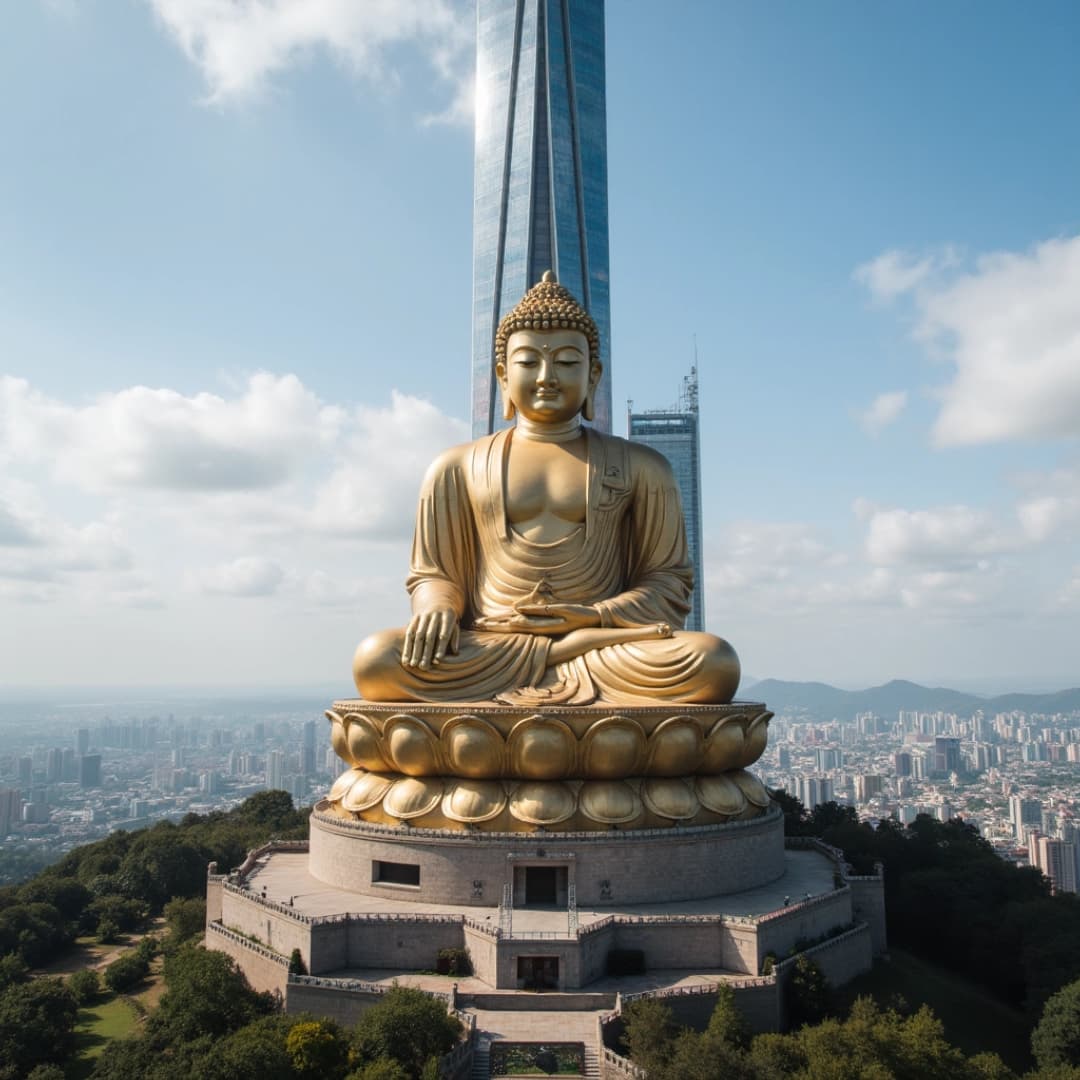
DESCRIPTION:
Has mindfulness become a banal form of spirituality in capitalism? A critical examination.
Mindfulness, capitalism and spirituality: how meditation stabilises the system
Mindfulness has become a banal form of spirituality in capitalism. What was once a profound contemplative tradition has evolved into a tool for self-optimisation and big business, finding its way into companies, the military and everyday culture. Ronald E. Purser, professor of management at San Francisco State University and ordained Zen Buddhist, shakes the foundations of the mindfulness movement with his scathing criticism. And Slovenian philosopher Slavoj Žižek goes even further: Western Buddhism is not the answer to the late modern system, but its paradigmatic ideology.
Purser and McMindfulness: Mindfulness as a product of neoliberalism
In his book McMindfulness: How Mindfulness Became the New Capitalist Spirituality (2019), Purser comprehensively examines how the concept of mindfulness has been detached from its Buddhist context and become a product of the global economy. As a scholar at San Francisco State University, he is familiar with both the academic and contemplative perspectives. As an ordained Buddhist, he incisively analyses how meditative practice has been marketed and made marketable.
The core of his social critique is that modern mindfulness practice is based on radical depoliticisation. Stress, burnout and stress-related illnesses are framed as individual problems, as deficits of the individual, not as symptoms of a system under constant pressure to perform. He speaks of systematic pathologisation: it is not the conditions of working life that are the problem, but the individual's lack of resilience. Contemplative practices become an instrument with which neoliberalism keeps its workers functioning.
He also highlights the historical dimension: Mindfulness-Based Stress Reduction (MBSR), developed by Jon Kabat-Zinn, was deliberately separated from its ethical foundations to make it compatible with mainstream practice. What was lost in the process was the teaching of compassion, the aspect that actively calls for social and political change. What remained was a practice of inner optimisation without an ethical compass.
In his earlier essay, Beyond McMindfulness, he had already argued, with David Loy, that this gutted practice was not harmless but actively prevented social change. Neoliberal appropriation replaces structural criticism with individual adaptation and self-discipline.
Žižek: Western Buddhism as fetishistic denial
Slavoj Žižek provides the philosophical foundation. In his essay From Western Marxism to Western Buddhism (2001), he formulates a thesis that is more relevant than ever two decades later: the Western appropriation of Buddhist and Taoist traditions does not function as an antidote, but as an ideological supplement to the neoliberal system.
Žižek argues using a psychoanalytical concept: fetishistic denial. The formula is: "I know very well that I am fully participating in the system, but my true self is elsewhere, untouched." This split is not a mistake. It is what makes participation bearable.
This is where the difference to classical ideology criticism lies: traditional analysis describes symptoms, cracks in the world view through which repressed truths return. The fetish works in reverse: one accepts reality completely, rationally, soberly, and at the same time clings to an object that allows one not to feel the full force of it. Here, this fetish is the idea of an inner self in which one can maintain inner peace and serenity, untouched by external pressure.
Žižek dares to revive the old Marxist cliché: religion as the "opium of the people". But he gives the idea a more precise twist. The meditative attitude, he argues, is the most efficient way to participate fully in economic dynamics while maintaining the appearance of mental health.
"Future Shock": Mindfulness in uncertain times
Žižek refers to the concept of future shock: psychological overload caused by the pace of technological and social change. Before one has become accustomed to a technology, it has already been replaced by the next. Elementary cognitive mapping, the ability to orient oneself in one's own life situation, is lost.
Turning to Taoism or Eastern teachings offers a way out that works better than a desperate return to old traditions: instead of trying to keep up with the pace, one gives up trying to control it altogether. One lets oneself drift, maintaining inner distance and indifference towards the accelerated process, supported by the insight that all this upheaval is ultimately just a substance-less proliferation of illusory phenomena that does not affect the innermost core of our being.
This is ideological in a specific sense: it is an attitude that does not deny the suffering generated by the system, but declares it irrelevant. Michel Foucault would speak here of neoliberal subjectification, the production of a subject who sees himself as an entrepreneur of his own resources and completely internalises responsibility for structurally generated stress.
The Japanese counterexample: Zen, military and corporate meditation
Žižek dispels a convenient excuse: one cannot simply contrast this Western appropriation with its "authentic" Eastern version. Japan provides the historically decisive proof.
Not only is there a widespread phenomenon among Japanese top managers today known as corporate Zen, a corporate practice that uses meditation as a productivity tool. Over the last 150 years, Japan's rapid industrialisation and militarisation have been supported by the vast majority of Zen thinkers. D. T. Suzuki himself, the Zen guru of the American counterculture of the 1960s, supported the spirit of absolute self-discipline and military expansion in his youth in Japan in the 1930s.
This was not a contradiction or a perversion of an "actually compassionate" teaching. Still, a direct consequence: the attitude of total immersion in the selfless present, in which reflexive distance disappears, legitimises subordination to any social machinery. Žižek's pointed conclusion: if external reality is ultimately only a transient phenomenon, then even the system's everyday actions are irrelevant, and with them any demand for change.
Max Weber 2.0: From the Protestant to the Taoist Ethics of Capitalism
Žižek's most brilliant comparison leads to Max Weber. In The Protestant Ethic and the Spirit of Capitalism (1905), Weber showed how the Calvinist doctrine of predestination gave rise to a specifically capitalist work ethic: people worked because they could never be sure of their salvation.
Western Buddhism produces a structurally analogous but updated counterpart. Not the drive to prove oneself through work, but the ability to endure work by undermining one's attachment to it. Both produce the same disciplined, productive human being. Only the inner mechanisms differ.
If Weber were alive today, Žižek writes, he would write a supplementary volume: Taoist Ethics and the Spirit of Global Capitalism.
What does this mean for clinical practice?
From a clinical perspective, this analysis is directly relevant. In psychotherapy and coaching, one regularly encounters the pattern of clients who use mindfulness as an avoidance strategy. They meditate to avoid feeling. They cultivate inner distance to avoid addressing structural problems, internal or external.
Research on spiritual bypassing (John Welwood, 1984) precisely describes this phenomenon: the use of spiritual practices to circumvent psychological wounds, unresolved developmental tasks, and emotional conflicts. What Purser and Žižek add is the social dimension: it is not just a matter of individual defence, but a cultural pattern that has a system-stabilising effect. Neoliberalism needs resilient workers, and meditation programmes in companies provide them with that resilience.
Evidence-based psychotherapy, therefore, always asks: What function does this practice have in the client's overall system? Mindfulness can be a valuable therapeutic tool, for example, in MBSR or MBCT for relapse prevention in depression. Its effectiveness is well-documented empirically. But without questioning its function, any technique becomes a potential defence mechanism.
The uncomfortable question
Žižek asks a question that everyone should ask themselves regularly:
Where is your fetish? What is your preferred illusory emergency exit?
If the answer is "mindfulness" and at the same time nothing changes in the stressful circumstances – no setting of boundaries, no change of job, no confrontation with dysfunctional relationships – then the practice may not be working against the problem. Instead, it may be working as the problem.
This does not mean that meditation is worthless. It means that any practice that systematically prevents us from addressing the root causes of suffering, whether psychological, economic or political, must be critically questioned. Purser puts it this way: we must first overcome neoliberalism before mindfulness can fully unfold. Žižek would add: and without the fetish that makes us believe we have already done so.
Sources:
· Žižek, S. (2001). From Western Marxism to Western Buddhism. The Gazette, Israel, 27 August 2001. Full text: lacan.com.
· Purser, R. E. (2019). McMindfulness: How Mindfulness Became the New Capitalist Spirituality. London: Repeater Books.
· Purser, R. E. & Loy, D. (2013). Beyond McMindfulness. Huffington Post.
· Weber, M. (1905). The Protestant Ethic and the Spirit of Capitalism.
· Welwood, J. (2000). Toward a Psychology of Awakening.
· Kabat-Zinn, J. (1990). Full Catastrophe Living.
Verwandte Artikel:
Wellness trends for 2026: longevity and mindfulness shape regeneration
The Diderot effect: The consumer trap and its impact explained simply
Coping strategies: Psychology of coping strategies complementary to psychotherapy
Criticism of neuromarketing: Ethical concerns and limitations of neuromarketing
DESCRIPTION:
Has mindfulness become a banal form of spirituality in capitalism? A critical examination.
Mindfulness, capitalism and spirituality: how meditation stabilises the system
Mindfulness has become a banal form of spirituality in capitalism. What was once a profound contemplative tradition has evolved into a tool for self-optimisation and big business, finding its way into companies, the military and everyday culture. Ronald E. Purser, professor of management at San Francisco State University and ordained Zen Buddhist, shakes the foundations of the mindfulness movement with his scathing criticism. And Slovenian philosopher Slavoj Žižek goes even further: Western Buddhism is not the answer to the late modern system, but its paradigmatic ideology.
Purser and McMindfulness: Mindfulness as a product of neoliberalism
In his book McMindfulness: How Mindfulness Became the New Capitalist Spirituality (2019), Purser comprehensively examines how the concept of mindfulness has been detached from its Buddhist context and become a product of the global economy. As a scholar at San Francisco State University, he is familiar with both the academic and contemplative perspectives. As an ordained Buddhist, he incisively analyses how meditative practice has been marketed and made marketable.
The core of his social critique is that modern mindfulness practice is based on radical depoliticisation. Stress, burnout and stress-related illnesses are framed as individual problems, as deficits of the individual, not as symptoms of a system under constant pressure to perform. He speaks of systematic pathologisation: it is not the conditions of working life that are the problem, but the individual's lack of resilience. Contemplative practices become an instrument with which neoliberalism keeps its workers functioning.
He also highlights the historical dimension: Mindfulness-Based Stress Reduction (MBSR), developed by Jon Kabat-Zinn, was deliberately separated from its ethical foundations to make it compatible with mainstream practice. What was lost in the process was the teaching of compassion, the aspect that actively calls for social and political change. What remained was a practice of inner optimisation without an ethical compass.
In his earlier essay, Beyond McMindfulness, he had already argued, with David Loy, that this gutted practice was not harmless but actively prevented social change. Neoliberal appropriation replaces structural criticism with individual adaptation and self-discipline.
Žižek: Western Buddhism as fetishistic denial
Slavoj Žižek provides the philosophical foundation. In his essay From Western Marxism to Western Buddhism (2001), he formulates a thesis that is more relevant than ever two decades later: the Western appropriation of Buddhist and Taoist traditions does not function as an antidote, but as an ideological supplement to the neoliberal system.
Žižek argues using a psychoanalytical concept: fetishistic denial. The formula is: "I know very well that I am fully participating in the system, but my true self is elsewhere, untouched." This split is not a mistake. It is what makes participation bearable.
This is where the difference to classical ideology criticism lies: traditional analysis describes symptoms, cracks in the world view through which repressed truths return. The fetish works in reverse: one accepts reality completely, rationally, soberly, and at the same time clings to an object that allows one not to feel the full force of it. Here, this fetish is the idea of an inner self in which one can maintain inner peace and serenity, untouched by external pressure.
Žižek dares to revive the old Marxist cliché: religion as the "opium of the people". But he gives the idea a more precise twist. The meditative attitude, he argues, is the most efficient way to participate fully in economic dynamics while maintaining the appearance of mental health.
"Future Shock": Mindfulness in uncertain times
Žižek refers to the concept of future shock: psychological overload caused by the pace of technological and social change. Before one has become accustomed to a technology, it has already been replaced by the next. Elementary cognitive mapping, the ability to orient oneself in one's own life situation, is lost.
Turning to Taoism or Eastern teachings offers a way out that works better than a desperate return to old traditions: instead of trying to keep up with the pace, one gives up trying to control it altogether. One lets oneself drift, maintaining inner distance and indifference towards the accelerated process, supported by the insight that all this upheaval is ultimately just a substance-less proliferation of illusory phenomena that does not affect the innermost core of our being.
This is ideological in a specific sense: it is an attitude that does not deny the suffering generated by the system, but declares it irrelevant. Michel Foucault would speak here of neoliberal subjectification, the production of a subject who sees himself as an entrepreneur of his own resources and completely internalises responsibility for structurally generated stress.
The Japanese counterexample: Zen, military and corporate meditation
Žižek dispels a convenient excuse: one cannot simply contrast this Western appropriation with its "authentic" Eastern version. Japan provides the historically decisive proof.
Not only is there a widespread phenomenon among Japanese top managers today known as corporate Zen, a corporate practice that uses meditation as a productivity tool. Over the last 150 years, Japan's rapid industrialisation and militarisation have been supported by the vast majority of Zen thinkers. D. T. Suzuki himself, the Zen guru of the American counterculture of the 1960s, supported the spirit of absolute self-discipline and military expansion in his youth in Japan in the 1930s.
This was not a contradiction or a perversion of an "actually compassionate" teaching. Still, a direct consequence: the attitude of total immersion in the selfless present, in which reflexive distance disappears, legitimises subordination to any social machinery. Žižek's pointed conclusion: if external reality is ultimately only a transient phenomenon, then even the system's everyday actions are irrelevant, and with them any demand for change.
Max Weber 2.0: From the Protestant to the Taoist Ethics of Capitalism
Žižek's most brilliant comparison leads to Max Weber. In The Protestant Ethic and the Spirit of Capitalism (1905), Weber showed how the Calvinist doctrine of predestination gave rise to a specifically capitalist work ethic: people worked because they could never be sure of their salvation.
Western Buddhism produces a structurally analogous but updated counterpart. Not the drive to prove oneself through work, but the ability to endure work by undermining one's attachment to it. Both produce the same disciplined, productive human being. Only the inner mechanisms differ.
If Weber were alive today, Žižek writes, he would write a supplementary volume: Taoist Ethics and the Spirit of Global Capitalism.
What does this mean for clinical practice?
From a clinical perspective, this analysis is directly relevant. In psychotherapy and coaching, one regularly encounters the pattern of clients who use mindfulness as an avoidance strategy. They meditate to avoid feeling. They cultivate inner distance to avoid addressing structural problems, internal or external.
Research on spiritual bypassing (John Welwood, 1984) precisely describes this phenomenon: the use of spiritual practices to circumvent psychological wounds, unresolved developmental tasks, and emotional conflicts. What Purser and Žižek add is the social dimension: it is not just a matter of individual defence, but a cultural pattern that has a system-stabilising effect. Neoliberalism needs resilient workers, and meditation programmes in companies provide them with that resilience.
Evidence-based psychotherapy, therefore, always asks: What function does this practice have in the client's overall system? Mindfulness can be a valuable therapeutic tool, for example, in MBSR or MBCT for relapse prevention in depression. Its effectiveness is well-documented empirically. But without questioning its function, any technique becomes a potential defence mechanism.
The uncomfortable question
Žižek asks a question that everyone should ask themselves regularly:
Where is your fetish? What is your preferred illusory emergency exit?
If the answer is "mindfulness" and at the same time nothing changes in the stressful circumstances – no setting of boundaries, no change of job, no confrontation with dysfunctional relationships – then the practice may not be working against the problem. Instead, it may be working as the problem.
This does not mean that meditation is worthless. It means that any practice that systematically prevents us from addressing the root causes of suffering, whether psychological, economic or political, must be critically questioned. Purser puts it this way: we must first overcome neoliberalism before mindfulness can fully unfold. Žižek would add: and without the fetish that makes us believe we have already done so.
Sources:
· Žižek, S. (2001). From Western Marxism to Western Buddhism. The Gazette, Israel, 27 August 2001. Full text: lacan.com.
· Purser, R. E. (2019). McMindfulness: How Mindfulness Became the New Capitalist Spirituality. London: Repeater Books.
· Purser, R. E. & Loy, D. (2013). Beyond McMindfulness. Huffington Post.
· Weber, M. (1905). The Protestant Ethic and the Spirit of Capitalism.
· Welwood, J. (2000). Toward a Psychology of Awakening.
· Kabat-Zinn, J. (1990). Full Catastrophe Living.
Verwandte Artikel:
Wellness trends for 2026: longevity and mindfulness shape regeneration
The Diderot effect: The consumer trap and its impact explained simply
Coping strategies: Psychology of coping strategies complementary to psychotherapy
Criticism of neuromarketing: Ethical concerns and limitations of neuromarketing
Newsletter
Möchten Sie informiert werden, wenn ich einen neuen Blogbeitrag veröffentliche? Tragen Sie sich gern hier ein.
Klicken Sie auf „Kostenlos abonnieren“, wenn Sie meine Datenschutzerklärung gelesen und akzeptiert haben. Ihre Einwilligung können Sie jederzeit widerrufen.
Newsletter
Möchten Sie informiert werden, wenn ich einen neuen Blogbeitrag veröffentliche? Tragen Sie sich gern hier ein.
Klicken Sie auf „Kostenlos abonnieren“, wenn Sie meine Datenschutzerklärung gelesen und akzeptiert haben. Ihre Einwilligung können Sie jederzeit widerrufen.