Alcohol as a cultural asset
Alcohol as a cultural asset: Alcohol consumption and its social role in Western societies
Alcohol as a cultural asset: Alcohol consumption and its social role in Western societies
DESCRIPTION:
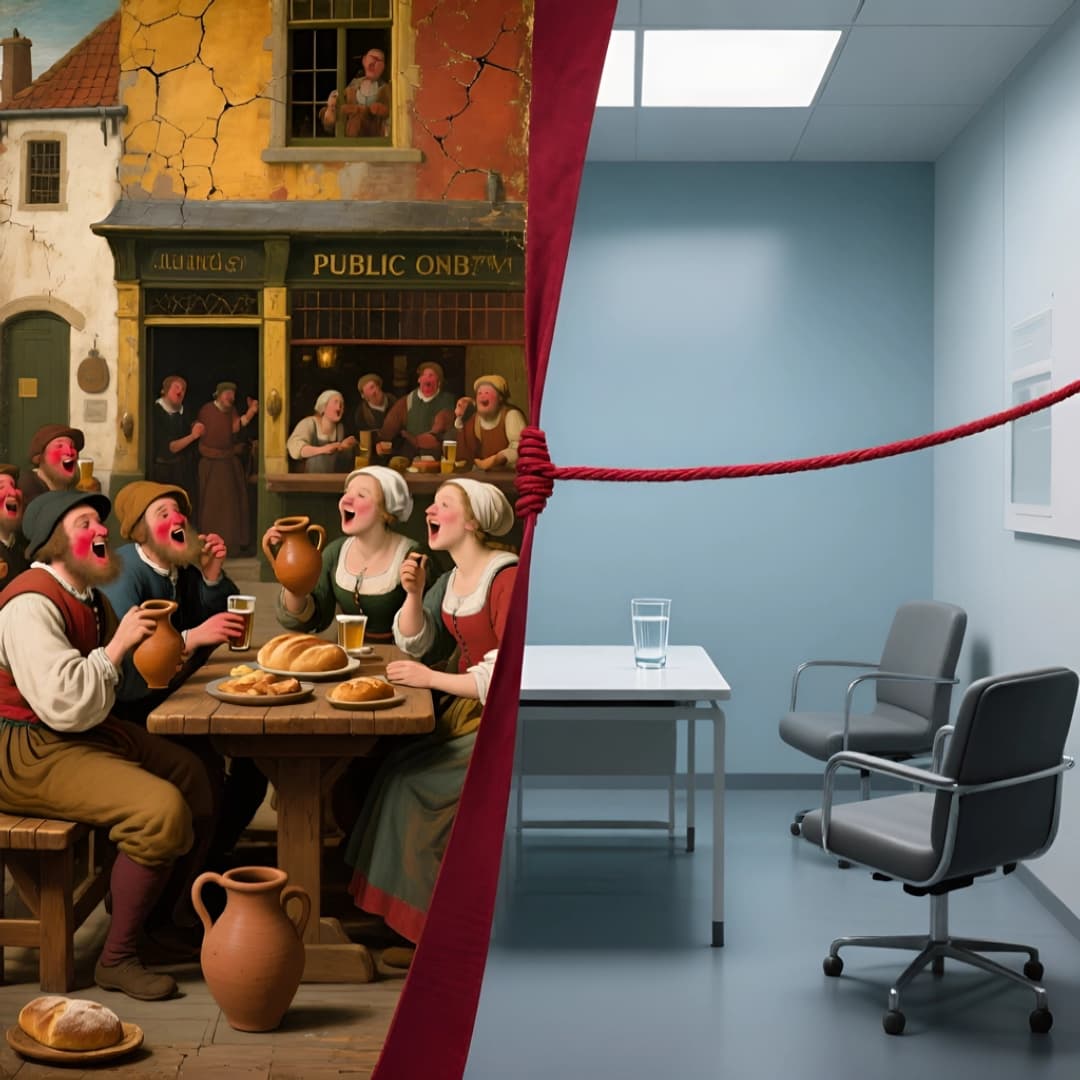
Alcohol has a long history. The social function of drinking stretches back through the Middle Ages and the colonial era to the present day. Yet, it is systematically ignored by the current temperance movement—a historical-anthropological and therapeutic perspective on alcohol consumption.
Alcohol as a cultural asset: Historical-anthropological and therapeutic perspectives on alcohol consumption and its social role in Western societies
At a site in modern-day Turkey, Göbekli Tepe, dating back 11,000 years, archaeologists discovered fermentation vessels used for communal brewing. It is therefore likely that collective drinking also took place. In his book ‘Drunk’ (2021), the philosopher Edward Slingerland draws a conclusion from this that is more uncomfortable than all the debates on abstinence put together. Despite its disinhibiting effect, alcohol has survived throughout human history. It has helped shape it. A historical-anthropological and therapeutic perspective on alcohol consumption and its social role in Western societies, therefore, does not begin with the first patient in rehab, but with the question: What does a completely abstinent society put at risk?
Alcohol as a staple: what came before abstinence
Alcohol as a cultural asset sounds like an excuse. But alcohol is cultural history. After all, fermented drinks were among the few hygienically safe liquids available at the time. Beer and wine killed pathogens more or less reliably, unlike the available water. Declaring alcohol a staple food is therefore not a trivialisation. Out of necessity, alcohol was drunk everywhere in the early modern period: in taverns, private households, monasteries, and workplaces.
What interests Slingerland, however, is not the caloric or hygienic function. It is the social one. Alcohol, as a staple food, was always embedded in rituals that regulated its consumption and simultaneously made it productive: it fostered trust, created equality in the moment of shared drinking, and reduced that evolutionary hostility towards strangers, without which social cooperation on a larger scale would scarcely have been possible. The historian Spode and the sociologist of drug use Schmidt-Semisch, whose works have been influential in the German-speaking world—including analyses published by Suhrkamp Verlag—emphasise the same point: the social context regulates consumption.
From the outset, therefore, alcohol’s social role in Western societies was twofold: as a glue that binds communities together, and as a danger as soon as that glue is left unregulated.
In vino veritas: Why drunkenness was historically regarded as a medium of truth
A Chinese text on bamboo strips from the 4th or 3rd century BC explains: harmony between states arises through shared wine-drinking. The Roman historian Tacitus reports that the Germanic tribes would discuss political decisions whilst intoxicated and decide upon them whilst sober, because both were considered necessary. The historian Iain Gately notes that inappropriate sobriety was regarded as deeply suspicious in those days. Anyone who calculated what they said was hiding something.
From a neurobiological perspective, there is a basis for this, which Slingerland documents in detail. Alcohol selectively dampens the prefrontal cortex, the area of the brain responsible for strategic self-presentation, social calculation and impulse control. What remains is not so easily staged. The effects of alcohol in social contexts are therefore likely to be disinhibition, but they also foster authenticity. Alcohol consumption and its social role in Western societies cannot be understood without this connection.
Drinking as a method of insight, communities that needed a test of trust – these gave rise to contexts in which the protective armour fell away. Drinking was such a context, across millennia and cultures.
What alcohol does to the brain: disinhibition as a social technology
Alcohol is a GABA agonist. It has a sedative effect while simultaneously stimulating the dopaminergic reward system. The result is a qualitatively altered state of consciousness: oxytocin is released, endorphins are released, and the willingness to form social bonds increases. Tolerance towards strangers grows, and mistrust diminishes. Tolerance to the effects of alcohol develops with regular consumption through neurobiological adaptation processes, and this is what Slingerland is concerned with.
The human frontal lobe (the prefrontal cortex) is enormously developed compared to that of other primates. It enables planning, self-control and strategic calculation, whilst simultaneously being the seat of social mistrust, self-censorship and constant self-observation. Moderate alcohol consumption dampens this apparatus precisely. This creates a social condition in which cooperation, creativity and trust arise more easily, even if no profound philosophical truths emerge – a kind of socially encoded disinhibition.
This function explains why alcohol did not simply disappear from history as a neurotoxin. A brain in a mild state of intoxication creates a mode optimised for certain social contexts, with real limits that Slingerland also clearly identifies.
Alcohol as a social glue: what Göbekli Tepe and Tacitus have in common
Alcohol as a cultural asset means, in concrete terms, that it has historically fostered community. Göbekli Tepe shows that collective brewing preceded social cooperation, not followed it. Alcohol consumption and its social role in Western societies reflect precisely this primal function: communal drinking as a leveller of status, as a signal of willingness to be vulnerable, as a ritual of belonging.
Movements to moderate alcohol consumption and their modern successors – the ‘sober-curious’ movement, Dry January, the alcohol-free bar – systematically underestimate what disappears with the ritual. Alcohol as a staple has been described by Spode and other historians as part of a social ecosystem in which trust was ritually generated and even idolised, as in the cult of Dionysus. When this ritual is lost without anything functionally equivalent taking its place, as is so often the case in the neoliberal Western world, a more sober community does not emerge. What emerges is a more isolated collection of individuals, deprived of a symbol, susceptible to the delusions of performance and self-optimisation, and seduced by the aesthetics of commodities.
The epidemiology of loneliness in Western societies is alarming. Historically, alcohol – and in particular its communal consumption – has provided a safeguard against social isolation. Eliminating both at once – the pub and the ritual – incurs costs that do not appear in any public health statistics.
Alcohol consumption from the Middle Ages through the colonial era: the dark side of the cultural heritage thesis
However, a cultural analysis of alcohol must not overlook its dark history. From the Middle Ages through the colonial era to the present day, alcohol has also been an instrument of power. Alcohol was traded for weapons; Europe supplied slave traders with spirits as a medium of exchange for human bodies. Coffee and sugar cane, along with the new luxury goods, built up colonial economies that structured global inequality, in which alcohol helped to facilitate colonial control. The colonial era continues this history right up to the present day. For many indigenous communities, excessive alcohol consumption is not a cultural heritage, but a wound inflicted by colonial conditions.
In Europe itself, industrialisation fundamentally altered drinking patterns. Distilled spirits became widespread in the Western world, social control broke down, and alcohol was increasingly consumed outside the rituals that had historically regulated it. Thus, oscillations can be traced throughout the entire cultural history of drinking: phases of collective disinhibition, followed by a moralising reaction. Alcohol consumption fell significantly in times of war, during the First World War, due to state rationing, only to rise all the more sharply afterwards. The fact that social differences play a decisive role in the emergence and progression of alcohol-related problems was a politically uncomfortable statement at the time. It still is today.
Slingerland is aware of this dark side. His argument is not that alcohol is good. It is that alcohol is complex, and a society that treats it purely as a risk factor is asking the wrong question.
Theories of degeneration and temperance movements: when morality becomes a diagnosis
Before the 19th century, the drinker was not yet recognised as a biological category. In his History of Madness, Foucault shows that, up until the Enlightenment, alcoholism, madness, moral decay and poverty were scarcely distinguished from one another. They formed a shared realm of the impure, which pre-modern society managed through workhouses, penal institutions, and, later, the classical asylum. For pre-Enlightenment perceptions, those who drank and fell into poverty, those who fell into poverty and lost their minds, and those who lost their minds and became neglected, all revealed manifestations of the same moral decay. The drinker was an inmate, a pauper and a madman all at once. He did not need a diagnosis. He needed police discipline and confinement.
The Enlightenment separated these categories. However, it did not eliminate the moral judgment in the process. It translated it into new terms. Reason became the yardstick, and those who drank chronically were regarded, in a new, medically sanctioned sense, as incapable of reason.
Theories of degeneration in the 19th century took this line of thought to its logical conclusion: alcoholism became hereditary degeneration. The theory of degeneration posited that the drinker passed on his inferiority to his children, which ultimately led to pronounced signs of decline in the genetic makeup of entire families.
Ideas of degeneration can therefore still be found in Thomas Mann’s novel *Buddenbrooks*, which depicts the decline of a middle-class family as an expression of hereditary exhaustion, with alcoholism as a symptom. The physician Eugen Fischer and others reinforced the image of the drinker as biologically inferior. It was not until the 20th century that the poorly defined concept of ‘weak will’ began to be replaced by neurobiological models. The ‘subject’ of public health custody became a psychiatric diagnosis.
Movements to moderate alcohol consumption emerged precisely in this climate. Mostly framed in religious and conservative terms, they linked addiction and poverty as a dual moral problem.
What these temperance movements overlooked: a society that frames drinking primarily as a weakness fails to understand its strengths. Alcohol as a cultural asset and alcohol as an addiction are two distinct phenomena. A cultural analysis must demand that the two be kept separate.
Prohibition: The experiment that proved Slingerland right
American Prohibition provides the most telling social experiment regarding Slingerland’s thesis. Prohibition did not simply fail logistically. It failed anthropologically. The Mafia profited handsomely, social drinking rituals shifted into the criminal underworld, and whilst alcohol consumption fell initially, it subsequently rose unchecked, now without the social frameworks that had previously regulated excesses.
The ban on alcohol had a further effect, which Slingerland implicitly describes: it destroyed the communal function of drinking without replacing it with anything. The stock market crash of 1929 hastened the political end: at the time, there was debate over whether income tax should be introduced or whether alcohol tax could restore the state budget. The latter idea prevailed. Re-legalisation was by no means a cultural learning process; it was a fiscal necessity. What it nevertheless demonstrated was that alcohol, and in particular its social function, could not be banned. Under bans, social drinking behaviour shifts, decays and loses its regulatory framework. The notion that prohibition or moralising could replace what social architecture must achieve proved illusory.
Samuel Pearson, Thomas Sutton and delirium tremens
Alongside this was a medical discovery that forever changed the image of the drinker. One complication of alcohol withdrawal, if left untreated, is the fatal delirium tremens; more precisely, the full-blown condition characterised by convulsions, hallucinations and circulatory failure. For many people in the 19th century, a sudden cessation of habitual alcohol consumption meant death. Even today, it remains a life-threatening condition.
First described independently by the British doctors Samuel Pearson and Thomas Sutton, this established a clear medical framework of fundamental importance: the proof that severe delirium tremens is a medical, not a moral, emergency. (The fact that these discoveries were made simultaneously and independently demonstrates just how widespread such conditions were in medical practice at the time.)
Withdrawal symptoms proved that it was alcohol, not moral integrity or willpower, that altered the brain. When withdrawal occurs, the nervous system reacts with hyperactivity, potentially leading to severe delirium. The concept of dependence established a biological basis.
The concept of addiction and alcohol dependence: the long road to diagnosis
However, the concept of alcohol dependence was not formally incorporated into the American Psychiatric Association’s diagnostic system until 1968. The World Health Organisation followed suit. Jellinek had already laid the groundwork with his concept of ‘alcoholism’ as early as 1960: the disease model of dependence, which defined loss of control as a clinical feature, not as a character flaw.
The concept of dependence underlying many modern theories of addiction has since distinguished ‘physical drug dependence’ from ‘psychological’ dependence, a dichotomy that Schmidt-Semisch analysed critically. Reduced control over alcohol consumption, clinically the central feature of addiction, describes neurobiologically the consequence of this adaptation: the mesolimbic system prioritises the addiction memory. Crucially, alcohol dependence is neurobiologically rooted. So-called homeostasis leads to adaptive processes that stabilise the addiction memory. The effects of alcohol in the womb, known as foetal alcohol syndrome, demonstrate the biological impact of the substance on the developing brain. In affected children, this damage leads to lifelong impairments.
However, the disease model of alcohol dependence does not resolve Slingerland’s question. The fact that some people become alcohol-dependent says nothing about what social drinking achieves for everyone else. Stigmatisation and discrimination against those affected arise precisely where this distinction becomes blurred, and where society bases its overall approach to alcohol on the extreme case.
What the abstinent society overlooks: Slingerland’s actual thesis
The Sober Curious movement, Dry January, and the alcohol-free bar: these are culturally legitimate and understandable from a health policy perspective. Slingerland’s argument is not directed against the individual decision to abstain. It is directed against the structural illusion that a society becomes more social as it becomes more sober.
Assessing alcohol consumption in Western societies, therefore, requires looking at what is being lost. The shared ritual of drinking fostered trust, emotional equality and disinhibition under social control. Cultural Heritage, a historical-anthropological and therapeutic perspective, asks: What is replacing this? To date, there is no scalable, cross-cultural answer.
By discriminating against those affected, the current debates inadvertently contribute to framing alcohol exclusively as a pathology. The stigmatisation and discrimination faced by those affected are real and serious. But alcohol, and in particular its social functions, do not disappear through stigmatisation. They shift to contexts that are less visible, less bound by ritual, and less controlled. In Western societies’ approach to alcohol, this shift is currently taking place without anyone asking what is being lost in the process.
Drinking rituals and the latent meaning of the act of drinking
More than just withdrawal support and relapse prevention, we need answers to questions about latent meanings and sensory-symbolic forms of interaction – those bodily-anchored, pre-linguistic patterns of behaviour in which need, relationship, and cultural embeddedness are expressed simultaneously.
The drinking ritual, too, is such a sensory-symbolic form of interaction. Raising one’s glass together, the first sip in company, the ritual of toasting: all of this conveys, as we have seen, unspoken meanings that go far beyond alcohol: belonging, trust, the temporary lifting of social defences, the willingness to share vulnerability. Slingerland describes this function in terms of evolutionary anthropology. Lorenzer would say: drinking is a cultural scene in which the sensory experience of the body and the symbolic order of the community are inextricably intertwined.
What Lorenzer analyses in this way as a sensory-symbolic form of interaction is 11,000 years old at Göbekli Tepe. The fermentation vessels that archaeologists found there do not attest to individual drinking customs but to a collective scene: people came together to brew and drink. Here, the act of drinking was, in its purest form, a sensory-symbolic form of interaction: physically concrete in the shared drink, symbolically charged by what it fostered: the opportunity to enter into trust with strangers. The aforementioned Chinese bamboo text from the 4th century BC captures this latent meaning: harmony between states arises through the shared drinking of wine. What Lorenzer would describe as the implicit meaning of a cultural scene is, here, explicit political theory. Drinking rites are acts of symbolisation, and this was already the case in prehistory.
Where, then, does desymbolisation take place? Not in alcohol dependence. It takes place in advertising communication. Aperol Spritz, Hugo, Negroni – contemporary alcohol advertising operates precisely according to a specific mechanism: the form of interaction splits. The sensory aspect becomes a cliché that is losing its voice: the imagery of the sunny terrace, the laughing people, the orange-coloured glass backlit. It reproduces the surface of the communal scene without containing the social process behind it. At the same time, emotionally detached, hollow figures of speech emerge: ‘Aperol Spritz’ signals light-heartedness, conviviality, summer freedom – meanings no longer underpinned by any concrete social experience. The language of the market manages what the physical scene no longer delivers.
Wolfgang Fritz Haug’s concept of commodity aesthetics converges precisely here with Lorenzer’s concept of desymbolisation. The promise of the commodity—buy this Aperol and buy your way into the warmth of this scene—is substitute satisfaction under a false name. The rationalisation goes: I drink. I enjoy it, because it is summer. After all, I belong. What is offered under this name is the empty image of a state that no drink can create. Göbekli Tepe and the Chinese bamboo text show what the original was: a physical, collective scene in which trust actually arose. The Negroni advert now shows only its cliché.
This also raises a specific question regarding the use of alcohol that goes beyond triggers and relapse situations: What did drinking once mean, before advertising defined it, and it became a disorder? What sensory-symbolic scenes, what latent needs for belonging, authenticity and disinhibition could not be achieved by any other means? It was a form of interaction within a social scene whose significance has long since been desymbolised by commodity aesthetics.
Alcohol has a history stretching back a thousand years to the present day, and a symbolic depth that predates any therapeutic model. A society that forgets both is addressing the wrong question. It asks how it can eliminate drinking. Slingerland’s question is the more uncomfortable one: what does it eliminate when it eliminates drinking?
Summary of key points
· Alcohol as a cultural asset has a history that extends to the present day; the historical variability of its consumption shows that drinking has always been socially embedded and regulated by context, not the substance.
· In vino veritas has a neurobiological basis: the effects of alcohol on the prefrontal cortex generate authenticity and social bonding, a function that Slingerland reconstructs as a historically underestimated contribution to civilisation.
· The social context of alcohol consumption has always been the real regulating factor.
· The concept of addiction and the notion of dependence were only formally recognised in 1968 by the American Psychiatric Association and the World Health Organisation; Jellinek’s concept of ‘alcoholism’ replaced the poorly defined notion of weakness of will.
· A social perspective on alcohol consumption necessitates an examination of its function.
Related:
DESCRIPTION:
Alcohol has a long history. The social function of drinking stretches back through the Middle Ages and the colonial era to the present day. Yet, it is systematically ignored by the current temperance movement—a historical-anthropological and therapeutic perspective on alcohol consumption.
Alcohol as a cultural asset: Historical-anthropological and therapeutic perspectives on alcohol consumption and its social role in Western societies
At a site in modern-day Turkey, Göbekli Tepe, dating back 11,000 years, archaeologists discovered fermentation vessels used for communal brewing. It is therefore likely that collective drinking also took place. In his book ‘Drunk’ (2021), the philosopher Edward Slingerland draws a conclusion from this that is more uncomfortable than all the debates on abstinence put together. Despite its disinhibiting effect, alcohol has survived throughout human history. It has helped shape it. A historical-anthropological and therapeutic perspective on alcohol consumption and its social role in Western societies, therefore, does not begin with the first patient in rehab, but with the question: What does a completely abstinent society put at risk?
Alcohol as a staple: what came before abstinence
Alcohol as a cultural asset sounds like an excuse. But alcohol is cultural history. After all, fermented drinks were among the few hygienically safe liquids available at the time. Beer and wine killed pathogens more or less reliably, unlike the available water. Declaring alcohol a staple food is therefore not a trivialisation. Out of necessity, alcohol was drunk everywhere in the early modern period: in taverns, private households, monasteries, and workplaces.
What interests Slingerland, however, is not the caloric or hygienic function. It is the social one. Alcohol, as a staple food, was always embedded in rituals that regulated its consumption and simultaneously made it productive: it fostered trust, created equality in the moment of shared drinking, and reduced that evolutionary hostility towards strangers, without which social cooperation on a larger scale would scarcely have been possible. The historian Spode and the sociologist of drug use Schmidt-Semisch, whose works have been influential in the German-speaking world—including analyses published by Suhrkamp Verlag—emphasise the same point: the social context regulates consumption.
From the outset, therefore, alcohol’s social role in Western societies was twofold: as a glue that binds communities together, and as a danger as soon as that glue is left unregulated.
In vino veritas: Why drunkenness was historically regarded as a medium of truth
A Chinese text on bamboo strips from the 4th or 3rd century BC explains: harmony between states arises through shared wine-drinking. The Roman historian Tacitus reports that the Germanic tribes would discuss political decisions whilst intoxicated and decide upon them whilst sober, because both were considered necessary. The historian Iain Gately notes that inappropriate sobriety was regarded as deeply suspicious in those days. Anyone who calculated what they said was hiding something.
From a neurobiological perspective, there is a basis for this, which Slingerland documents in detail. Alcohol selectively dampens the prefrontal cortex, the area of the brain responsible for strategic self-presentation, social calculation and impulse control. What remains is not so easily staged. The effects of alcohol in social contexts are therefore likely to be disinhibition, but they also foster authenticity. Alcohol consumption and its social role in Western societies cannot be understood without this connection.
Drinking as a method of insight, communities that needed a test of trust – these gave rise to contexts in which the protective armour fell away. Drinking was such a context, across millennia and cultures.
What alcohol does to the brain: disinhibition as a social technology
Alcohol is a GABA agonist. It has a sedative effect while simultaneously stimulating the dopaminergic reward system. The result is a qualitatively altered state of consciousness: oxytocin is released, endorphins are released, and the willingness to form social bonds increases. Tolerance towards strangers grows, and mistrust diminishes. Tolerance to the effects of alcohol develops with regular consumption through neurobiological adaptation processes, and this is what Slingerland is concerned with.
The human frontal lobe (the prefrontal cortex) is enormously developed compared to that of other primates. It enables planning, self-control and strategic calculation, whilst simultaneously being the seat of social mistrust, self-censorship and constant self-observation. Moderate alcohol consumption dampens this apparatus precisely. This creates a social condition in which cooperation, creativity and trust arise more easily, even if no profound philosophical truths emerge – a kind of socially encoded disinhibition.
This function explains why alcohol did not simply disappear from history as a neurotoxin. A brain in a mild state of intoxication creates a mode optimised for certain social contexts, with real limits that Slingerland also clearly identifies.
Alcohol as a social glue: what Göbekli Tepe and Tacitus have in common
Alcohol as a cultural asset means, in concrete terms, that it has historically fostered community. Göbekli Tepe shows that collective brewing preceded social cooperation, not followed it. Alcohol consumption and its social role in Western societies reflect precisely this primal function: communal drinking as a leveller of status, as a signal of willingness to be vulnerable, as a ritual of belonging.
Movements to moderate alcohol consumption and their modern successors – the ‘sober-curious’ movement, Dry January, the alcohol-free bar – systematically underestimate what disappears with the ritual. Alcohol as a staple has been described by Spode and other historians as part of a social ecosystem in which trust was ritually generated and even idolised, as in the cult of Dionysus. When this ritual is lost without anything functionally equivalent taking its place, as is so often the case in the neoliberal Western world, a more sober community does not emerge. What emerges is a more isolated collection of individuals, deprived of a symbol, susceptible to the delusions of performance and self-optimisation, and seduced by the aesthetics of commodities.
The epidemiology of loneliness in Western societies is alarming. Historically, alcohol – and in particular its communal consumption – has provided a safeguard against social isolation. Eliminating both at once – the pub and the ritual – incurs costs that do not appear in any public health statistics.
Alcohol consumption from the Middle Ages through the colonial era: the dark side of the cultural heritage thesis
However, a cultural analysis of alcohol must not overlook its dark history. From the Middle Ages through the colonial era to the present day, alcohol has also been an instrument of power. Alcohol was traded for weapons; Europe supplied slave traders with spirits as a medium of exchange for human bodies. Coffee and sugar cane, along with the new luxury goods, built up colonial economies that structured global inequality, in which alcohol helped to facilitate colonial control. The colonial era continues this history right up to the present day. For many indigenous communities, excessive alcohol consumption is not a cultural heritage, but a wound inflicted by colonial conditions.
In Europe itself, industrialisation fundamentally altered drinking patterns. Distilled spirits became widespread in the Western world, social control broke down, and alcohol was increasingly consumed outside the rituals that had historically regulated it. Thus, oscillations can be traced throughout the entire cultural history of drinking: phases of collective disinhibition, followed by a moralising reaction. Alcohol consumption fell significantly in times of war, during the First World War, due to state rationing, only to rise all the more sharply afterwards. The fact that social differences play a decisive role in the emergence and progression of alcohol-related problems was a politically uncomfortable statement at the time. It still is today.
Slingerland is aware of this dark side. His argument is not that alcohol is good. It is that alcohol is complex, and a society that treats it purely as a risk factor is asking the wrong question.
Theories of degeneration and temperance movements: when morality becomes a diagnosis
Before the 19th century, the drinker was not yet recognised as a biological category. In his History of Madness, Foucault shows that, up until the Enlightenment, alcoholism, madness, moral decay and poverty were scarcely distinguished from one another. They formed a shared realm of the impure, which pre-modern society managed through workhouses, penal institutions, and, later, the classical asylum. For pre-Enlightenment perceptions, those who drank and fell into poverty, those who fell into poverty and lost their minds, and those who lost their minds and became neglected, all revealed manifestations of the same moral decay. The drinker was an inmate, a pauper and a madman all at once. He did not need a diagnosis. He needed police discipline and confinement.
The Enlightenment separated these categories. However, it did not eliminate the moral judgment in the process. It translated it into new terms. Reason became the yardstick, and those who drank chronically were regarded, in a new, medically sanctioned sense, as incapable of reason.
Theories of degeneration in the 19th century took this line of thought to its logical conclusion: alcoholism became hereditary degeneration. The theory of degeneration posited that the drinker passed on his inferiority to his children, which ultimately led to pronounced signs of decline in the genetic makeup of entire families.
Ideas of degeneration can therefore still be found in Thomas Mann’s novel *Buddenbrooks*, which depicts the decline of a middle-class family as an expression of hereditary exhaustion, with alcoholism as a symptom. The physician Eugen Fischer and others reinforced the image of the drinker as biologically inferior. It was not until the 20th century that the poorly defined concept of ‘weak will’ began to be replaced by neurobiological models. The ‘subject’ of public health custody became a psychiatric diagnosis.
Movements to moderate alcohol consumption emerged precisely in this climate. Mostly framed in religious and conservative terms, they linked addiction and poverty as a dual moral problem.
What these temperance movements overlooked: a society that frames drinking primarily as a weakness fails to understand its strengths. Alcohol as a cultural asset and alcohol as an addiction are two distinct phenomena. A cultural analysis must demand that the two be kept separate.
Prohibition: The experiment that proved Slingerland right
American Prohibition provides the most telling social experiment regarding Slingerland’s thesis. Prohibition did not simply fail logistically. It failed anthropologically. The Mafia profited handsomely, social drinking rituals shifted into the criminal underworld, and whilst alcohol consumption fell initially, it subsequently rose unchecked, now without the social frameworks that had previously regulated excesses.
The ban on alcohol had a further effect, which Slingerland implicitly describes: it destroyed the communal function of drinking without replacing it with anything. The stock market crash of 1929 hastened the political end: at the time, there was debate over whether income tax should be introduced or whether alcohol tax could restore the state budget. The latter idea prevailed. Re-legalisation was by no means a cultural learning process; it was a fiscal necessity. What it nevertheless demonstrated was that alcohol, and in particular its social function, could not be banned. Under bans, social drinking behaviour shifts, decays and loses its regulatory framework. The notion that prohibition or moralising could replace what social architecture must achieve proved illusory.
Samuel Pearson, Thomas Sutton and delirium tremens
Alongside this was a medical discovery that forever changed the image of the drinker. One complication of alcohol withdrawal, if left untreated, is the fatal delirium tremens; more precisely, the full-blown condition characterised by convulsions, hallucinations and circulatory failure. For many people in the 19th century, a sudden cessation of habitual alcohol consumption meant death. Even today, it remains a life-threatening condition.
First described independently by the British doctors Samuel Pearson and Thomas Sutton, this established a clear medical framework of fundamental importance: the proof that severe delirium tremens is a medical, not a moral, emergency. (The fact that these discoveries were made simultaneously and independently demonstrates just how widespread such conditions were in medical practice at the time.)
Withdrawal symptoms proved that it was alcohol, not moral integrity or willpower, that altered the brain. When withdrawal occurs, the nervous system reacts with hyperactivity, potentially leading to severe delirium. The concept of dependence established a biological basis.
The concept of addiction and alcohol dependence: the long road to diagnosis
However, the concept of alcohol dependence was not formally incorporated into the American Psychiatric Association’s diagnostic system until 1968. The World Health Organisation followed suit. Jellinek had already laid the groundwork with his concept of ‘alcoholism’ as early as 1960: the disease model of dependence, which defined loss of control as a clinical feature, not as a character flaw.
The concept of dependence underlying many modern theories of addiction has since distinguished ‘physical drug dependence’ from ‘psychological’ dependence, a dichotomy that Schmidt-Semisch analysed critically. Reduced control over alcohol consumption, clinically the central feature of addiction, describes neurobiologically the consequence of this adaptation: the mesolimbic system prioritises the addiction memory. Crucially, alcohol dependence is neurobiologically rooted. So-called homeostasis leads to adaptive processes that stabilise the addiction memory. The effects of alcohol in the womb, known as foetal alcohol syndrome, demonstrate the biological impact of the substance on the developing brain. In affected children, this damage leads to lifelong impairments.
However, the disease model of alcohol dependence does not resolve Slingerland’s question. The fact that some people become alcohol-dependent says nothing about what social drinking achieves for everyone else. Stigmatisation and discrimination against those affected arise precisely where this distinction becomes blurred, and where society bases its overall approach to alcohol on the extreme case.
What the abstinent society overlooks: Slingerland’s actual thesis
The Sober Curious movement, Dry January, and the alcohol-free bar: these are culturally legitimate and understandable from a health policy perspective. Slingerland’s argument is not directed against the individual decision to abstain. It is directed against the structural illusion that a society becomes more social as it becomes more sober.
Assessing alcohol consumption in Western societies, therefore, requires looking at what is being lost. The shared ritual of drinking fostered trust, emotional equality and disinhibition under social control. Cultural Heritage, a historical-anthropological and therapeutic perspective, asks: What is replacing this? To date, there is no scalable, cross-cultural answer.
By discriminating against those affected, the current debates inadvertently contribute to framing alcohol exclusively as a pathology. The stigmatisation and discrimination faced by those affected are real and serious. But alcohol, and in particular its social functions, do not disappear through stigmatisation. They shift to contexts that are less visible, less bound by ritual, and less controlled. In Western societies’ approach to alcohol, this shift is currently taking place without anyone asking what is being lost in the process.
Drinking rituals and the latent meaning of the act of drinking
More than just withdrawal support and relapse prevention, we need answers to questions about latent meanings and sensory-symbolic forms of interaction – those bodily-anchored, pre-linguistic patterns of behaviour in which need, relationship, and cultural embeddedness are expressed simultaneously.
The drinking ritual, too, is such a sensory-symbolic form of interaction. Raising one’s glass together, the first sip in company, the ritual of toasting: all of this conveys, as we have seen, unspoken meanings that go far beyond alcohol: belonging, trust, the temporary lifting of social defences, the willingness to share vulnerability. Slingerland describes this function in terms of evolutionary anthropology. Lorenzer would say: drinking is a cultural scene in which the sensory experience of the body and the symbolic order of the community are inextricably intertwined.
What Lorenzer analyses in this way as a sensory-symbolic form of interaction is 11,000 years old at Göbekli Tepe. The fermentation vessels that archaeologists found there do not attest to individual drinking customs but to a collective scene: people came together to brew and drink. Here, the act of drinking was, in its purest form, a sensory-symbolic form of interaction: physically concrete in the shared drink, symbolically charged by what it fostered: the opportunity to enter into trust with strangers. The aforementioned Chinese bamboo text from the 4th century BC captures this latent meaning: harmony between states arises through the shared drinking of wine. What Lorenzer would describe as the implicit meaning of a cultural scene is, here, explicit political theory. Drinking rites are acts of symbolisation, and this was already the case in prehistory.
Where, then, does desymbolisation take place? Not in alcohol dependence. It takes place in advertising communication. Aperol Spritz, Hugo, Negroni – contemporary alcohol advertising operates precisely according to a specific mechanism: the form of interaction splits. The sensory aspect becomes a cliché that is losing its voice: the imagery of the sunny terrace, the laughing people, the orange-coloured glass backlit. It reproduces the surface of the communal scene without containing the social process behind it. At the same time, emotionally detached, hollow figures of speech emerge: ‘Aperol Spritz’ signals light-heartedness, conviviality, summer freedom – meanings no longer underpinned by any concrete social experience. The language of the market manages what the physical scene no longer delivers.
Wolfgang Fritz Haug’s concept of commodity aesthetics converges precisely here with Lorenzer’s concept of desymbolisation. The promise of the commodity—buy this Aperol and buy your way into the warmth of this scene—is substitute satisfaction under a false name. The rationalisation goes: I drink. I enjoy it, because it is summer. After all, I belong. What is offered under this name is the empty image of a state that no drink can create. Göbekli Tepe and the Chinese bamboo text show what the original was: a physical, collective scene in which trust actually arose. The Negroni advert now shows only its cliché.
This also raises a specific question regarding the use of alcohol that goes beyond triggers and relapse situations: What did drinking once mean, before advertising defined it, and it became a disorder? What sensory-symbolic scenes, what latent needs for belonging, authenticity and disinhibition could not be achieved by any other means? It was a form of interaction within a social scene whose significance has long since been desymbolised by commodity aesthetics.
Alcohol has a history stretching back a thousand years to the present day, and a symbolic depth that predates any therapeutic model. A society that forgets both is addressing the wrong question. It asks how it can eliminate drinking. Slingerland’s question is the more uncomfortable one: what does it eliminate when it eliminates drinking?
Summary of key points
· Alcohol as a cultural asset has a history that extends to the present day; the historical variability of its consumption shows that drinking has always been socially embedded and regulated by context, not the substance.
· In vino veritas has a neurobiological basis: the effects of alcohol on the prefrontal cortex generate authenticity and social bonding, a function that Slingerland reconstructs as a historically underestimated contribution to civilisation.
· The social context of alcohol consumption has always been the real regulating factor.
· The concept of addiction and the notion of dependence were only formally recognised in 1968 by the American Psychiatric Association and the World Health Organisation; Jellinek’s concept of ‘alcoholism’ replaced the poorly defined notion of weakness of will.
· A social perspective on alcohol consumption necessitates an examination of its function.
Related:
Newsletter
Möchten Sie informiert werden, wenn ich einen neuen Blogbeitrag veröffentliche? Tragen Sie sich gern hier ein.
Klicken Sie auf „Kostenlos abonnieren“, wenn Sie meine Datenschutzerklärung gelesen und akzeptiert haben. Ihre Einwilligung können Sie jederzeit widerrufen.
Newsletter
Möchten Sie informiert werden, wenn ich einen neuen Blogbeitrag veröffentliche? Tragen Sie sich gern hier ein.
Klicken Sie auf „Kostenlos abonnieren“, wenn Sie meine Datenschutzerklärung gelesen und akzeptiert haben. Ihre Einwilligung können Sie jederzeit widerrufen.