The Four Excuses for Heartlessness
The Four Excuses for Heartlessness: The ‘Western Media When Tragedy Hits’ Meme
The Four Excuses for Heartlessness: The ‘Western Media When Tragedy Hits’ Meme

DESCRIPTION: A world map categorises the sympathy expressed into four colours. A psychoanalytical cultural analysis of why the image is correct and yet is still ideology.
The Attention Map
A meme depicts the world in four colours, depending on how much news from each region affects us. It’s right. And precisely because it’s right, it’s worth asking what it actually offers its readers—a cultural analysis of four sentences that nobody needs to say out loud to understand them.
An image
A colour-coded world map has been circulating since late 2025 under the title ‘Western Media When Tragedy Hits’. Green: North America, Western Europe, Australia and Israel: ‘24-hour coverage, celebrity songs, flag filters, illuminated monuments.’ Yellow: most of Asia and Latin America. “Nobody wants to be sad all day.” Brown: the Middle East and parts of North Africa: “A hopeless situation, just pray.” Black: sub-Saharan Africa: “Literally do not care.”
The map makes no distinction between social factors or social milieus. It presents theoretical publics. It borrows the authority of a projection familiar from atlases and superimposes four model sentences upon it that could have come from an everyday conversation. This combination creates its impact: something one has said oneself suddenly appears as a global pattern.
The image circulates without a creator, without a date, without a source. It thus belongs to that category of objects that lend themselves particularly well to cultural analysis, because nobody vouches for them and yet everyone understands them.
The map is right
Before any interpretation can begin, the factual issue must be clarified. The Global Peace Index 2025 has cross-referenced media data with conflict data and sorted the number of articles per conflict fatality by country group. For 2023, the median is 1,663 articles per fatality in high-income countries and 17.4 in low-income countries. Ethiopia and Burkina Faso each recorded over 20,000 civilian deaths that year, yet were barely mentioned. Ladislaus Ludescher analysed over 5,000 episodes of the ARD Tagesschau, the oldest and most watched daily television news program in Germany, produced by the public broadcaster ARD. In the first half of 2022, around 6 per cent of airtime was devoted to the Global South, where around 85 per cent of humanity lives. During the same period, sports news received more airtime than all the countries of the Global South combined.
The map is therefore not an exaggeration. This fact is crucial to everything that follows, as it prevents a convenient dismissal of the issue. For Alfred Lorenzer, ideology consists neither of false knowledge nor of deliberate lies. An image can be accurate and yet serve a purpose unrelated to its truth content.
The legend consists of phrases.
All four sentences are self-contained. You don’t have to construct them; you recognise them. ‘Who wants to feel sad all day?’ is not a statement someone makes about themselves; it is a phrase that is in common use and which everyone has heard at some point. The same applies to ‘just pray’ and to the shrug implied in ‘literally do not care’.
Lorenzer refers to such constructs as ‘clichés’. Symbols disintegrate: their shells continue to have an effect without their biographical and emotional meaning being accessible. This gives rise to a ‘pseudo-language’ which outwardly resembles ordinary language but does not reveal its subjective meaning. The four captions are precisely that. They sound like descriptions of emotional states but do not name any individual emotion.
It is not about hidden content behind the image. It is about disconnects between what the caption says and what the image depicts. In the case of this card, the first disconnect is that its sentences appear to be self-revelations but, in truth, are not.
Green: the obituary as nation-building
In the green field, expressions of sympathy are visible to the point of hysterical sentimentality. Round-the-clock coverage, statements from celebrities, profile picture filters, flags, illuminated monuments.
Judith Butler offers an uncomfortable description of these signs. She asks how an obituary becomes an instrument that publicly regulates the capacity for suffering, and therefore calls it an ‘act of nation-building’. The illuminated monument is an obituary in precisely this sense. It makes a life publicly mournable whilst simultaneously establishing the community that mourns.
Solidarity and self-affirmation coincide here. Public rituals of mourning draw attention, break through political isolation and create pressure to act. However, they always do both at the same time, and the card thrives on its viewers accepting both.
Yellow: the right to one’s own mood
‘Who wants to be sad all day long?’ Here, the suffering of others is openly described as an imposition, and it is precisely for this reason that attention paid to it is limited.
Psychologically, this field operates by isolating the emotion. The event is acknowledged, but the burden it places on the West is meted out in measured doses. The statement claims a right to determine one’s own mood, beyond any statement about human resilience. As a legend on a world map, it shows the point at which a real boundary gives way to a permission: one is allowed to take note that something is happening, as long as this event neither takes up time nor dampens one’s mood or daily life.
Brown: Hopelessness as a ‘ ’ justification
‘A hopeless situation – the only thing that helps is prayer.’ This line of thinking masquerades as humility. The situation is declared unsolvable, and with it, one’s own responsibility. After all, those who pray are, in a sense, doing something.
Luc Boltanski has described what underlies this stage. In the case of the Good Samaritan, seeing and acting still coincide, and it is precisely this that makes a sense of obligation possible: it is this very connection between the possibility of recognition and the possibility of action that defines a situation … which allows one to get involved and commit oneself to. Before the news content is presented, the two fall apart. One looks on and is under no obligation to act.
Susan Sontag draws the conclusion that applies to this field. In *Regarding the Pain of Others*: the frustration at being unable to do anything about what the images show tends to lead to the accusation that viewing such images is inappropriate, rather than to an impulse to act. Powerlessness thus becomes the justification for not having to look.
The judgement ‘hopeless’ has a twofold effect here. It denies the people in these regions their capacity to act and reduces them to an anonymous mass that cannot be helped in any way.
Schwarz: When the excuse falls away
‘I literally don’t care.’ No claim to the right to one’s own mood, no personal burden, no sense of hopelessness, nothing: simply disinterest.
Thus, the series culminates in an unexplained refusal to show compassion. The further away the suffering is, the less the cold-heartedness is justified, to the point of sheer indifference. Justifications are an effort one only makes when faced with suffering close to home.
(There is a German-speaking variant whose final line reads differently: ‘For us, it’s all about sheer survival right now.’ The same end stage, a different self-image. The English-speaking public allows itself blatant indifference; the German-speaking public invents a hypocritical reason for it.)
Ideology
Now for the crucial question of the analysis: what does this image achieve for those who share it?
Ideology exerts a psychological effect because it taps into desymbolised, socially excluded situations of need and conflict. What cannot be symbolised and negotiated within the subject as their own desire, fear, or ambivalence finds an apparent solution in collectively available interpretative frameworks. The ideological formula provides a socially accepted language for something that must not be said subjectively. It organises affect without naming it.
What conflict situation does this card address? The viewer lives in the green field. They are aware of wars over whose course they have no influence, and they benefit from an order whose costs are borne elsewhere. It is difficult to admit to being affected by one’s own dependence on this order, one’s own powerlessness and the shame that comes with it. These do not fit with the image the viewer has of themselves.
The card offers a ready-made language for this. It recasts an undeniable personal involvement as an accusation against a third party: against the Western media, against an anonymous audience, against ‘us’ in a form in which one does not feature oneself. The emotion is channelled and given a direction. It is not named.
This is precisely where its ideological power lies. The figures prove the card right. Its power lies in the fact that the formula appeases an individual need that would be almost impossible to justify in words.
Sharing
There is an awkward moment when dealing with the meme: when it is shared.
Anyone who shares the image is doing something described in the green box. They are making a visible gesture of solidarity that, however, takes no time and entails no action, whilst at the same time placing the sender on the ‘right’ side. Sharing accomplishes precisely what it accuses the image’s intended audience of doing: a feeling that is dealt with simply by scrolling on or sharing.
This duality is the meme’s most revealing feature from a cultural-analytical perspective, because it demonstrates how a critique itself becomes a form of exoneration. The disconnect between what the image says and what it achieves when read is the point at which language both conveys and deflects an experience.
Added to this is another point at which the whole image shifts. The green category explicitly includes not only North America, Western Europe and Australia, but also Israel. In doing so, the map comments on the distribution of attention from a standpoint that lies at the heart of the disputes it addresses. Anyone who shares it conveys this premise without having articulated it. This, too, is one of the functions of the cliché: it conveys positions that are not apparent in its literal content.
What the map does not explain
An interpretation that explains everything explains nothing. Defence presupposes that there was something from which one could turn away. On 4 November 2020, Ethiopia imposed a communications blackout on Tigray; in Sudan, mobile networks collapsed from February 2024 onwards; and the Committee to Protect Journalists describes the siege of El Fasher as an information blockade. Where no editorial team is at work, and no deaths are recorded, the gap arises within the news content itself, even before any public reaction.
This limits interpretation and renders it useful. Access, budget and editorial routine explain why reporting takes place. The defence mechanism explains what happens when reporting occurs, yet the knowledge remains without consequence.
Genuine concern
The question remains as to what form of compassion would be worthy of the name. It would be neither a constant sense of personal distress nor, even less so, a self-righteous, perpetual moral outrage. No one can mourn eight billion people without ceasing, and the widespread talk of ‘compassion fatigue’ is, in any case, less well-substantiated than it sounds. In 2011, Daryl Cameron and Keith Payne demonstrated that compassion for large numbers of victims only wanes when test subjects expect to be asked for help immediately. The feeling remains present, but is suppressed as soon as a demand looms.
Appropriate compassion is thus manifested in a resilient balance of knowledge, attention and action: keeping oneself informed, not reducing those affected to the image of victims, supporting concrete support structures, identifying political responsibilities and, where possible, demanding institutional consequences. This is the yardstick by which to measure what would otherwise remain mere lip service.
Defence does not begin with distancing oneself. It begins when one’s own burden, or the alleged hopelessness of the situation, becomes a blanket formula that delegitimises every claim made by others. Indifference rarely presents itself as such. It masquerades as self-protection, as hopelessness, as prioritisation or as existential distress, and only at the very end, when no one is looking any more, does it shed all pretence.
The key points in brief
• The meme ‘Western Media When Tragedy Hits’ categorises the world into four colours based on media sympathy and superimposes four everyday phrases onto a world map.
• The order reflects a decreasing effort to justify coverage: the more distant the suffering, the less effort is spent on justification, until the final stage dispenses with any excuse altogether.
• The image’s claim is accurate: 1,663 articles compared with 17.4 per fatality in a conflict (2023); around 6 per cent of *Tagesschau*’s airtime devoted to 85 per cent of humanity (first half of 2022).
• For Lorenzer, ideology is neither false knowledge nor a lie. It is effective because it ties in with conflict situations that cannot be articulated as one’s own, and organises emotion without elucidating it.
• The captions are clichés in Lorenzer’s sense: they sound like self-revelation and do not name a single emotion.
• The most revealing moment lies in the act of sharing. The image criticises empty gestures of sympathy whilst itself functioning as one.
• There are limits to interpretation: communication blackouts and the absence of editorial teams explain the lack of reporting before any audience can push back.
Sources
· Brilliant Maps: Western Media When Tragedy Hits Map Meme — https://brilliantmaps.com/western-media-when-tragedy-hits/
· Vision of Humanity / Institute for Economics & Peace: Unequal Attention. Why Some Conflicts Make Headlines, and Others Don’t (2025) — https://www.visionofhumanity.org/unequal-attention-why-some-conflicts-make-headlines-and-others-dont/
· Ladislaus Ludescher: Forgotten Worlds and Blind Spots. The Media’s Neglect of the Global South — https://www.ivr-heidelberg.de/studie-analysen/
· Committee to Protect Journalists: Sudan’s 3 Years of War, Impunity, and the Silencing of the Press — https://cpj.org/2026/04/sudans-3-years-of-war-impunity-and-the-silencing-of-the-press/
· Committee to Protect Journalists: Journalists, Shutdowns in Myanmar, Ethiopia, Kashmir — https://cpj.org/2021/05/journalists-shutdowns-myanmar-ethiopia-kashmir/
· C. Daryl Cameron, B. Keith Payne: Escaping Affect. Journal of Personality and Social Psychology 100 (2011), pp. 1–15 — https://pubmed.ncbi.nlm.nih.gov/21219076/
· Alfred Lorenzer: The Destruction and Reconstruction of Language. Suhrkamp, Frankfurt am Main, 1970.
· Alfred Lorenzer: The Council of Accountants. Europäische Verlagsanstalt, Frankfurt am Main, 1981.
· Judith Butler: *Precarious Life: The Powers of Mourning and Violence*. Verso, London, 2004.
· Luc Boltanski: Distant Suffering. Morality, Media and Politics. Cambridge University Press, 1999.
· Susan Sontag: *Regarding the Pain of Others*. Penguin, London, 2004.
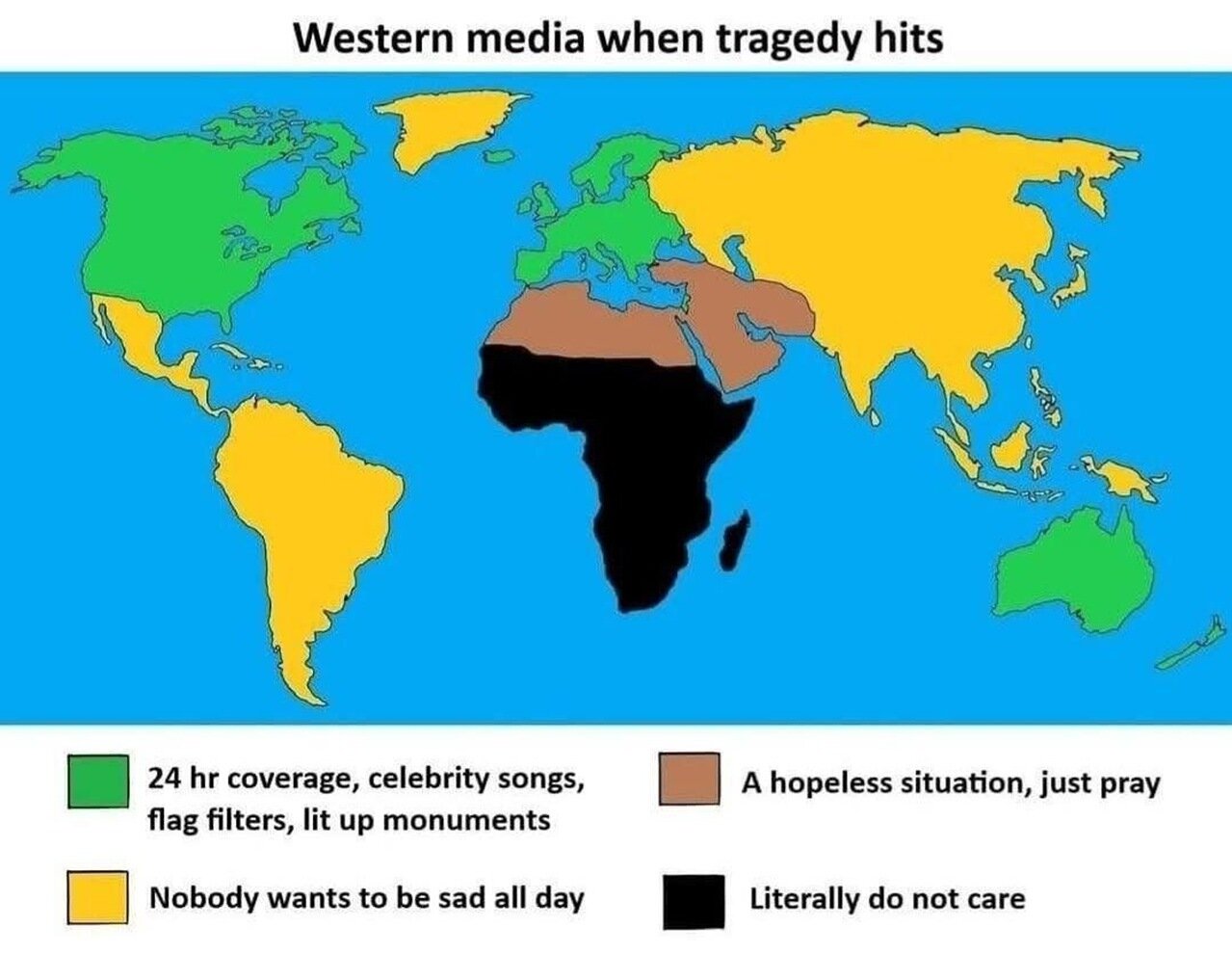
‘Western Media When Tragedy Hits’. Image source: Brilliant Maps, 11 November 2025; header of the source site cropped.
Related
DESCRIPTION: A world map categorises the sympathy expressed into four colours. A psychoanalytical cultural analysis of why the image is correct and yet is still ideology.
The Attention Map
A meme depicts the world in four colours, depending on how much news from each region affects us. It’s right. And precisely because it’s right, it’s worth asking what it actually offers its readers—a cultural analysis of four sentences that nobody needs to say out loud to understand them.
An image
A colour-coded world map has been circulating since late 2025 under the title ‘Western Media When Tragedy Hits’. Green: North America, Western Europe, Australia and Israel: ‘24-hour coverage, celebrity songs, flag filters, illuminated monuments.’ Yellow: most of Asia and Latin America. “Nobody wants to be sad all day.” Brown: the Middle East and parts of North Africa: “A hopeless situation, just pray.” Black: sub-Saharan Africa: “Literally do not care.”
The map makes no distinction between social factors or social milieus. It presents theoretical publics. It borrows the authority of a projection familiar from atlases and superimposes four model sentences upon it that could have come from an everyday conversation. This combination creates its impact: something one has said oneself suddenly appears as a global pattern.
The image circulates without a creator, without a date, without a source. It thus belongs to that category of objects that lend themselves particularly well to cultural analysis, because nobody vouches for them and yet everyone understands them.
The map is right
Before any interpretation can begin, the factual issue must be clarified. The Global Peace Index 2025 has cross-referenced media data with conflict data and sorted the number of articles per conflict fatality by country group. For 2023, the median is 1,663 articles per fatality in high-income countries and 17.4 in low-income countries. Ethiopia and Burkina Faso each recorded over 20,000 civilian deaths that year, yet were barely mentioned. Ladislaus Ludescher analysed over 5,000 episodes of the ARD Tagesschau, the oldest and most watched daily television news program in Germany, produced by the public broadcaster ARD. In the first half of 2022, around 6 per cent of airtime was devoted to the Global South, where around 85 per cent of humanity lives. During the same period, sports news received more airtime than all the countries of the Global South combined.
The map is therefore not an exaggeration. This fact is crucial to everything that follows, as it prevents a convenient dismissal of the issue. For Alfred Lorenzer, ideology consists neither of false knowledge nor of deliberate lies. An image can be accurate and yet serve a purpose unrelated to its truth content.
The legend consists of phrases.
All four sentences are self-contained. You don’t have to construct them; you recognise them. ‘Who wants to feel sad all day?’ is not a statement someone makes about themselves; it is a phrase that is in common use and which everyone has heard at some point. The same applies to ‘just pray’ and to the shrug implied in ‘literally do not care’.
Lorenzer refers to such constructs as ‘clichés’. Symbols disintegrate: their shells continue to have an effect without their biographical and emotional meaning being accessible. This gives rise to a ‘pseudo-language’ which outwardly resembles ordinary language but does not reveal its subjective meaning. The four captions are precisely that. They sound like descriptions of emotional states but do not name any individual emotion.
It is not about hidden content behind the image. It is about disconnects between what the caption says and what the image depicts. In the case of this card, the first disconnect is that its sentences appear to be self-revelations but, in truth, are not.
Green: the obituary as nation-building
In the green field, expressions of sympathy are visible to the point of hysterical sentimentality. Round-the-clock coverage, statements from celebrities, profile picture filters, flags, illuminated monuments.
Judith Butler offers an uncomfortable description of these signs. She asks how an obituary becomes an instrument that publicly regulates the capacity for suffering, and therefore calls it an ‘act of nation-building’. The illuminated monument is an obituary in precisely this sense. It makes a life publicly mournable whilst simultaneously establishing the community that mourns.
Solidarity and self-affirmation coincide here. Public rituals of mourning draw attention, break through political isolation and create pressure to act. However, they always do both at the same time, and the card thrives on its viewers accepting both.
Yellow: the right to one’s own mood
‘Who wants to be sad all day long?’ Here, the suffering of others is openly described as an imposition, and it is precisely for this reason that attention paid to it is limited.
Psychologically, this field operates by isolating the emotion. The event is acknowledged, but the burden it places on the West is meted out in measured doses. The statement claims a right to determine one’s own mood, beyond any statement about human resilience. As a legend on a world map, it shows the point at which a real boundary gives way to a permission: one is allowed to take note that something is happening, as long as this event neither takes up time nor dampens one’s mood or daily life.
Brown: Hopelessness as a ‘ ’ justification
‘A hopeless situation – the only thing that helps is prayer.’ This line of thinking masquerades as humility. The situation is declared unsolvable, and with it, one’s own responsibility. After all, those who pray are, in a sense, doing something.
Luc Boltanski has described what underlies this stage. In the case of the Good Samaritan, seeing and acting still coincide, and it is precisely this that makes a sense of obligation possible: it is this very connection between the possibility of recognition and the possibility of action that defines a situation … which allows one to get involved and commit oneself to. Before the news content is presented, the two fall apart. One looks on and is under no obligation to act.
Susan Sontag draws the conclusion that applies to this field. In *Regarding the Pain of Others*: the frustration at being unable to do anything about what the images show tends to lead to the accusation that viewing such images is inappropriate, rather than to an impulse to act. Powerlessness thus becomes the justification for not having to look.
The judgement ‘hopeless’ has a twofold effect here. It denies the people in these regions their capacity to act and reduces them to an anonymous mass that cannot be helped in any way.
Schwarz: When the excuse falls away
‘I literally don’t care.’ No claim to the right to one’s own mood, no personal burden, no sense of hopelessness, nothing: simply disinterest.
Thus, the series culminates in an unexplained refusal to show compassion. The further away the suffering is, the less the cold-heartedness is justified, to the point of sheer indifference. Justifications are an effort one only makes when faced with suffering close to home.
(There is a German-speaking variant whose final line reads differently: ‘For us, it’s all about sheer survival right now.’ The same end stage, a different self-image. The English-speaking public allows itself blatant indifference; the German-speaking public invents a hypocritical reason for it.)
Ideology
Now for the crucial question of the analysis: what does this image achieve for those who share it?
Ideology exerts a psychological effect because it taps into desymbolised, socially excluded situations of need and conflict. What cannot be symbolised and negotiated within the subject as their own desire, fear, or ambivalence finds an apparent solution in collectively available interpretative frameworks. The ideological formula provides a socially accepted language for something that must not be said subjectively. It organises affect without naming it.
What conflict situation does this card address? The viewer lives in the green field. They are aware of wars over whose course they have no influence, and they benefit from an order whose costs are borne elsewhere. It is difficult to admit to being affected by one’s own dependence on this order, one’s own powerlessness and the shame that comes with it. These do not fit with the image the viewer has of themselves.
The card offers a ready-made language for this. It recasts an undeniable personal involvement as an accusation against a third party: against the Western media, against an anonymous audience, against ‘us’ in a form in which one does not feature oneself. The emotion is channelled and given a direction. It is not named.
This is precisely where its ideological power lies. The figures prove the card right. Its power lies in the fact that the formula appeases an individual need that would be almost impossible to justify in words.
Sharing
There is an awkward moment when dealing with the meme: when it is shared.
Anyone who shares the image is doing something described in the green box. They are making a visible gesture of solidarity that, however, takes no time and entails no action, whilst at the same time placing the sender on the ‘right’ side. Sharing accomplishes precisely what it accuses the image’s intended audience of doing: a feeling that is dealt with simply by scrolling on or sharing.
This duality is the meme’s most revealing feature from a cultural-analytical perspective, because it demonstrates how a critique itself becomes a form of exoneration. The disconnect between what the image says and what it achieves when read is the point at which language both conveys and deflects an experience.
Added to this is another point at which the whole image shifts. The green category explicitly includes not only North America, Western Europe and Australia, but also Israel. In doing so, the map comments on the distribution of attention from a standpoint that lies at the heart of the disputes it addresses. Anyone who shares it conveys this premise without having articulated it. This, too, is one of the functions of the cliché: it conveys positions that are not apparent in its literal content.
What the map does not explain
An interpretation that explains everything explains nothing. Defence presupposes that there was something from which one could turn away. On 4 November 2020, Ethiopia imposed a communications blackout on Tigray; in Sudan, mobile networks collapsed from February 2024 onwards; and the Committee to Protect Journalists describes the siege of El Fasher as an information blockade. Where no editorial team is at work, and no deaths are recorded, the gap arises within the news content itself, even before any public reaction.
This limits interpretation and renders it useful. Access, budget and editorial routine explain why reporting takes place. The defence mechanism explains what happens when reporting occurs, yet the knowledge remains without consequence.
Genuine concern
The question remains as to what form of compassion would be worthy of the name. It would be neither a constant sense of personal distress nor, even less so, a self-righteous, perpetual moral outrage. No one can mourn eight billion people without ceasing, and the widespread talk of ‘compassion fatigue’ is, in any case, less well-substantiated than it sounds. In 2011, Daryl Cameron and Keith Payne demonstrated that compassion for large numbers of victims only wanes when test subjects expect to be asked for help immediately. The feeling remains present, but is suppressed as soon as a demand looms.
Appropriate compassion is thus manifested in a resilient balance of knowledge, attention and action: keeping oneself informed, not reducing those affected to the image of victims, supporting concrete support structures, identifying political responsibilities and, where possible, demanding institutional consequences. This is the yardstick by which to measure what would otherwise remain mere lip service.
Defence does not begin with distancing oneself. It begins when one’s own burden, or the alleged hopelessness of the situation, becomes a blanket formula that delegitimises every claim made by others. Indifference rarely presents itself as such. It masquerades as self-protection, as hopelessness, as prioritisation or as existential distress, and only at the very end, when no one is looking any more, does it shed all pretence.
The key points in brief
• The meme ‘Western Media When Tragedy Hits’ categorises the world into four colours based on media sympathy and superimposes four everyday phrases onto a world map.
• The order reflects a decreasing effort to justify coverage: the more distant the suffering, the less effort is spent on justification, until the final stage dispenses with any excuse altogether.
• The image’s claim is accurate: 1,663 articles compared with 17.4 per fatality in a conflict (2023); around 6 per cent of *Tagesschau*’s airtime devoted to 85 per cent of humanity (first half of 2022).
• For Lorenzer, ideology is neither false knowledge nor a lie. It is effective because it ties in with conflict situations that cannot be articulated as one’s own, and organises emotion without elucidating it.
• The captions are clichés in Lorenzer’s sense: they sound like self-revelation and do not name a single emotion.
• The most revealing moment lies in the act of sharing. The image criticises empty gestures of sympathy whilst itself functioning as one.
• There are limits to interpretation: communication blackouts and the absence of editorial teams explain the lack of reporting before any audience can push back.
Sources
· Brilliant Maps: Western Media When Tragedy Hits Map Meme — https://brilliantmaps.com/western-media-when-tragedy-hits/
· Vision of Humanity / Institute for Economics & Peace: Unequal Attention. Why Some Conflicts Make Headlines, and Others Don’t (2025) — https://www.visionofhumanity.org/unequal-attention-why-some-conflicts-make-headlines-and-others-dont/
· Ladislaus Ludescher: Forgotten Worlds and Blind Spots. The Media’s Neglect of the Global South — https://www.ivr-heidelberg.de/studie-analysen/
· Committee to Protect Journalists: Sudan’s 3 Years of War, Impunity, and the Silencing of the Press — https://cpj.org/2026/04/sudans-3-years-of-war-impunity-and-the-silencing-of-the-press/
· Committee to Protect Journalists: Journalists, Shutdowns in Myanmar, Ethiopia, Kashmir — https://cpj.org/2021/05/journalists-shutdowns-myanmar-ethiopia-kashmir/
· C. Daryl Cameron, B. Keith Payne: Escaping Affect. Journal of Personality and Social Psychology 100 (2011), pp. 1–15 — https://pubmed.ncbi.nlm.nih.gov/21219076/
· Alfred Lorenzer: The Destruction and Reconstruction of Language. Suhrkamp, Frankfurt am Main, 1970.
· Alfred Lorenzer: The Council of Accountants. Europäische Verlagsanstalt, Frankfurt am Main, 1981.
· Judith Butler: *Precarious Life: The Powers of Mourning and Violence*. Verso, London, 2004.
· Luc Boltanski: Distant Suffering. Morality, Media and Politics. Cambridge University Press, 1999.
· Susan Sontag: *Regarding the Pain of Others*. Penguin, London, 2004.
‘Western Media When Tragedy Hits’. Image source: Brilliant Maps, 11 November 2025; header of the source site cropped.
Related
Newsletter
Möchten Sie informiert werden, wenn ich einen neuen Blogbeitrag veröffentliche? Tragen Sie sich gern hier ein.
Klicken Sie auf „Kostenlos abonnieren“, wenn Sie meine Datenschutzerklärung gelesen und akzeptiert haben. Ihre Einwilligung können Sie jederzeit widerrufen.
Newsletter
Möchten Sie informiert werden, wenn ich einen neuen Blogbeitrag veröffentliche? Tragen Sie sich gern hier ein.
Klicken Sie auf „Kostenlos abonnieren“, wenn Sie meine Datenschutzerklärung gelesen und akzeptiert haben. Ihre Einwilligung können Sie jederzeit widerrufen.